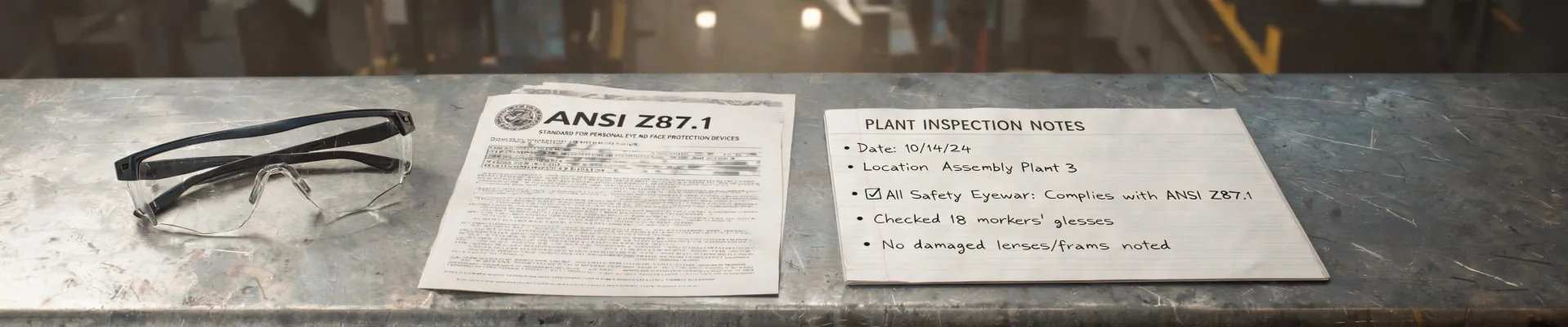
Short version: For most tactical, construction, and industrial jobs, Wiley X prescription safety glasses are the right first choice. They deliver ANSI/ISEA Z87.1-2020 impact protection and your corrective prescription in a frame that holds up to daily use. But for fine dust, chemical splash, or any task that requires a sealed eye socket, you need a goggle. The choice isn't brand vs. brand. It's seal vs. no seal.
I coordinate emergency PPE orders for a company that supplies law enforcement, military, and industrial clients. In eight years I've processed more than 200 rush orders, including same-day turnarounds when someone's safety rating expired just before an exercise. If you're in a hurry, this is the answer I'd give you.
If you need corrective lenses and impact resistance, start with Wiley X RX safety glasses. Switch to a goggle only when the hazard requires a seal.
Why I Started Recommending Wiley X RX Safety Glasses
When I first started ordering PPE, I assumed goggles were always safer. More coverage, sealed around the eye, what could go wrong? Then I watched a crew abandon fogged-up goggles in the first hour of a shift. The hazard didn't disappear. The eye protection just became uncomfortable.
Comparing a team wearing Wiley X RX glasses against a team wearing goggles with RX inserts changed how I think about compliance. The glasses team kept them on for a full seven-hour session. The goggle team carried them after the first hour. The best protection is the one people actually wear.
Safety Glasses vs. Safety Goggles: What the Standards Say
Both safety glasses and goggles can meet ANSI/ISEA Z87.1-2020 impact standards. The difference is seal. Safety glasses protect against impact and flying debris. Goggles also protect against fine dust, chemical splash, and airborne particles that can slip under a frame.
OSHA 29 CFR 1910.133 requires employers to make sure employees use the right eye protection for the hazard. That sounds obvious, but most last-minute calls I get start with someone reading that paragraph after the hazard was already present.
- Glasses: good for impact, flying chips, construction, shooting, inspection, and everyday industrial tasks.
- Goggles: good for dust, splash, sand, grinding, chemical exposure, and any task where a gap between frame and face is unacceptable.
What You Get With Wiley X Prescription Safety Glasses
A Wiley X RX safety glasses order is not just a frame with a lens. The frame and lens are designed as a system. Many models are ANSI/ISEA Z87.1-2020 rated, and some also meet MIL-PRF-31013, the military's ballistic fragmentation eyewear spec. That's why you see them on authorized equipment lists for law enforcement and military units.
People often type wiley-x when they search, but the brand's official form is Wiley X. You can order them as wiley x prescription safety glasses, or wiley x rx safety glasses for short. Options include polarized lenses, anti-fog coatings, low-profile frames, and RX carriers for stronger corrections. Based on public price lists I checked in January 2025, complete RX orders land roughly between $180 and $320 before shipping. Prices move, so verify current costs before you budget.
Ask What's Not Included
I've learned to ask what's not included before what's the price. The quote that looks transparent on page one can hide a ton of add-ons: side shields, lens polishing, hard case, RX carry fee, rush freight, anti-fog treatment, even the little bag.
Here's the checklist I use for any supplier:
- Is the prescription lens included? Single vision or progressive?
- Is the frame rated for ballistic impact, or just the lens?
- Are polarized, anti-fog, and anti-scratch coatings included?
- Are side shields included?
- Are rush handling and shipping quoted separately?
- What happens if the frame doesn't fit?
A transparent quote doesn't always show the lowest price. It usually shows the lowest total cost. That's the number that matters.
The Fuzzy Part of My Job
Last March, 36 hours before a training exercise, a client called needing 30 pairs of Wiley X RX safety glasses and, no joke, two sets of fuzzy handcuffs for a retirement gag. The same week, someone asked if he could wear On Cloud tactical boots with his new kit. I don't advise on costume props, and I don't sell footwear. But I do know this: nobody calls me at 9 p.m. because their boots are comfortable. They call because eye protection has a compliance date and a lens prescription attached.
When Goggles Still Win
For a sealed hazard, glasses can't win. Cement dust, chemical mist, blood spatter, or molten metal can hit the gap between frame and cheek. That gap is exactly what a full-seal goggle is designed to close.
If your hazard requires a full seal, choose a safety goggle with indirect ventilation, anti-fog coating, and an RX insert if needed. It's less comfortable than Wiley X RX glasses. It's also the only appropriate answer when the hazard can reach your eye around the lens.
The Boundaries I Don't Cross
- If you don't need corrective lenses, a standard pair of ANSI Z87.1 safety glasses may be enough. You don't need Wiley X for every job. But if ballistic rating matters, or you need RX, Wiley X is where I'd start.
- If you need MIL-SPEC compliance for deployment, check your unit's authorized equipment list before ordering anything.
- If you need a sealed goggle for chemical work, don't try to save money by using a glasses frame with snap-on side shields.
- If a quote looks cheap and doesn't list what's included, get it in writing. The extra fees tend to appear after you're already on a deadline.
The honest version: Wiley X RX glasses cover most real-world tactical and industrial jobs. Goggles own the sealed half of the market. Know which hazard you're facing, ask about the costs that aren't listed, and don't wait until 36 hours before an exercise to make the call.

Jane Smith
I’m Jane Smith, a senior content writer with over 15 years of experience in the packaging and printing industry. I specialize in writing about the latest trends, technologies, and best practices in packaging design, sustainability, and printing techniques. My goal is to help businesses understand complex printing processes and design solutions that enhance both product packaging and brand visibility.