After six years of ordering PPE for a 60-person crew, I've documented 14 mistakes totaling about $6,200 in wasted budget. The short version of what I learned: check the certification, check the fit, and check the delivery date before you place any order. Buying cheap glasses that people won't wear, boots that don't fit, or gear that arrives late costs way more than the money you saved. It took me six years and over 180 orders to understand that the most expensive PPE is the gear people won't wear.
I'm a safety coordinator at a mid-sized construction and site services company. I've placed over 180 PPE orders since 2019. Some went smoothly. The failures, though? Those stick. I now keep a pre-order checklist on our shared drive, partly so no one else repeats my mistakes.
Fit and certification beat price, every single time
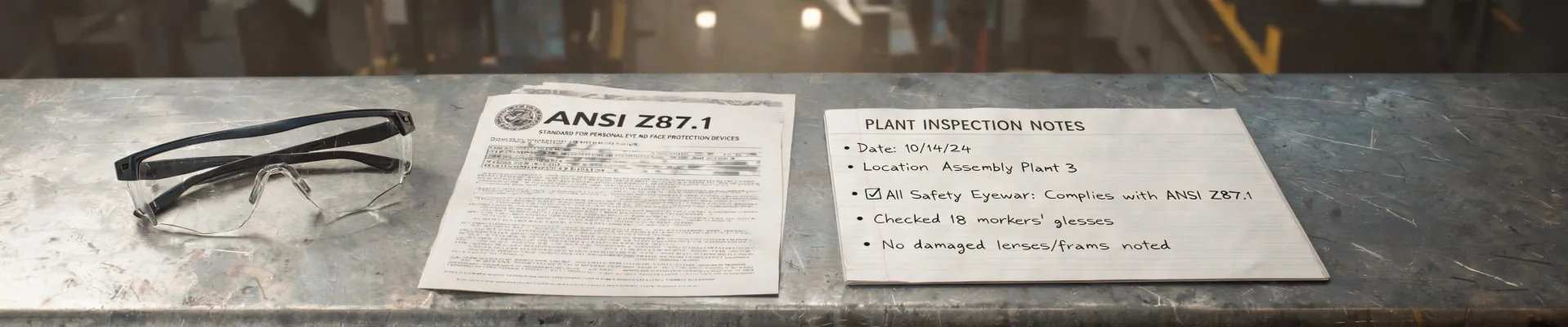
In my first year (2019), I ordered 60 pairs of low-cost "safety-style" glasses because the unit price looked great. The box said "ANSI approved." Nothing on the lens or frame had a Z87+ mark. I didn't know the difference back then. Within a month, half the crew said the lenses scratched during normal cleaning, and the other half just stopped wearing them. One worker got dust in his eye on a grinding job, and that's when I started paying real attention. Those $11 glasses—$660 total—were trash by month three.
From the outside, all safety glasses look the same. The reality is that frame geometry, lens thickness, and anti-fog/anti-scratch coatings differ a lot, and that difference shows up in whether people actually wear them. People assume a brand like Wiley X is expensive because of the name. Actually, it's the other way around: the testing and certification behind its products is part of the price you pay. Certification costs real money. A cheap "safety-style" product cut that cost out, and the protection goes with it.
Per FTC guidelines (ftc.gov), advertising claims about safety performance have to be substantiated. For impact eyewear, that usually means ANSI Z87.1. A legitimately certified product carries a visible "Z87+" marking on the lens. The plus sign means high-impact protection, not just the basic drop test. If a listing says "safety glasses" but nothing on the product shows a standard mark, that's a red flag. Don't assume.
The other thing I got wrong about fitting: prescriptions. If a worker wears prescription glasses all day, they won't switch to non-prescription safety glasses just because you ask. In 2022, one of our best field techs kept wearing his personal glasses on site. The "safety glasses give me a headache" complaint turned out to be a simple Rx issue. We spent about $160 on a prescription insert for his Wiley X frame, and he's worn the same pair ever since.
Prescription compatibility is one of the main reasons I buy Wiley X Profile safety glasses for the crew now. The same frame can take clear lenses, Wiley X safety sunglasses with polarized lenses, and prescription inserts. We had glare complaints from outdoor crews for two full summers before I ordered the polarized batch. The complaints stopped almost immediately. It's not just comfort—a worker who isn't squinting is a worker who actually sees hazards.
Delivery delays cost more than the invoice shows
In early 2023, I needed twelve pairs of glasses ready for a new shift starting Monday. I picked the cheapest shipping option because the price difference felt like pocket change. The order arrived the following Thursday. Four new hires spent the work week with whatever scratched pairs I could dig out of the spare bin. You want to build a safety culture? Handing a new guy a smudged pair of used glasses is the fastest way to show him safety is optional.
Why do rush fees exist? Because unpredictable demand is expensive to accommodate. And when you pay for expedited delivery, what you're really buying is certainty—the knowledge that the gear arrives when it needs to. The value of guaranteed turnaround isn't really the speed. It's knowing that Tuesday's safety training isn't canceled because the package is stuck in a sorting facility.
This is also why I started searching "work boots near me" before ordering online. Boot fit varies by brand, sometimes by a full half-size. In 2022, I ordered six pairs of boots online based on the size charts, and three went back—too narrow, tight in the toe box. Return shipping cost me about $60, but the bigger loss was the week of delay before those workers had boots that fit. A local store gets it right on the first try because people try the boots on.
If you do order online, understand the shipping timelines. According to USPS (usps.com), as of January 2025, a First-Class Mail letter costs $0.73, and that's for documents. A box of safety glasses is generally Priority Mail, which runs 2-5 business days depending on the zone. When your deadline is shorter than the delivery estimate, pay for expedited or guaranteed shipping. I'd rather pay $40 for overnight than lose a $450/day technician to a delay.
In December 2024, I paid $200 to overnight a $40 prescription insert because that field tech couldn't work without it. He billed $450 that day. You don't need a spreadsheet to see which choice made sense.
The small gear nobody budgets for
Bump cap inserts are an item I used to ignore completely. A bump cap insert is a slim plastic liner that fits inside a work cap. It's not a hard hat replacement—it's for those in-between areas where there's no serious fall hazard, but you can still bang your head on a low pipe or a cabinet door.
Two hard-earned lessons here. First, buy inserts that match the cap brand. In 2023, I ordered generic ones because they were cheaper. They didn't seat properly in the caps we use, so they shifted around all day. Roughly $180 wasted on something I could have verified by simply looking inside the cap. Second, replace the insert after a solid impact, even if nothing looks broken from the outside. The liner absorbs one good hit, and after that, it's done. We date-stamp inserts when they go in. It looks a little obsessive, but it works. (Note to self: re-check the date stamping system in 2025—the marker fades on that cap liner material.)
And then there's the leather glove disaster of April 2023. I machine-washed 30 pairs of leather work gloves in a commercial washer. They came out stiff, shrunken, and two pairs had cracked seams after drying. $340 gone in one load.
If you're wondering how to wash leather gloves without ruining them: hand wash in lukewarm water with mild soap (saddle soap works great), gently press the dirt out—don't twist or wring—rinse, and air dry away from heaters and direct sun. Once dry, condition them with leather balm. It takes about 20 minutes for a few pairs and adds months to their life. Machine agitation is the enemy. There's no shortcut.
Where this checklist stops being enough
I don't want to oversell this list. It's baseline advice.
For high-risk tactical, military, or ballistic-threat work, ANSI Z87.1+ is the floor, not the ceiling. You need ballistic-rated eyewear tested against a specification like MIL-PRF-31013—which Wiley X carries models for—at a different price point and with a more careful selection process.
For complex prescriptions—prism, progressives, severe astigmatism—don't order online. Take the person to an optician and get actual measurements. I can pick a frame, but I'm not qualified to measure pupillary distance.
And this whole article assumes general construction and site work. Chemical splash hazards, welding radiant energy, extreme cold—those require completely different standards. This checklist is where I start, not where any of us should stop.

Maeve Callahan
Maeve Callahan is a head-protection analyst covering Type I and Type II hard hats, climbing-style safety helmets, bump caps, chin straps, suspensions, liners, and face-shield carriers. She applies ANSI Z89.1, EN 397, and EN 12492 criteria while comparing impact attenuation, penetration resistance, lateral deformation, electrical class, retention strength, field of vision, mass, fit range, and temperature conditioning. Her guides help EHS teams, contractors, utilities, and buyers select helmet systems for overhead hazards, work at height, electrical exposure, accessory compatibility, and worker acceptance.