The order came through on a Tuesday afternoon in February 2024. It wasn't a huge order—maybe twenty line items—but the first few lines caught my eye. "Prescription safety glasses Wiley X." "Ugg earmuffs women." "Water fire extinguisher." And in the notes section, someone had asked: "Are latex gloves food safe?"
As the quality/compliance manager here, I review every order before it ships. Most days, that means box checks and paperwork—or rather, detailed line-by-line verification when the order is unusual. Roughly 200+ unique items a year. I rejected about 12% of first deliveries in 2024, mostly for spec mismatches that could have been caught with a five-minute phone call. This order was one of those times.
I'll be honest: my first instinct was to trust the lineup. The customer was a food-processing plant with a real safety manager. They'd filled out the spreadsheet. But I'd made the mistake before of assuming "PPE" means one clean category. It doesn't. Safety glasses, hearing protection, fire extinguishers, and gloves all have different rules. Mixing them up is how bad orders happen.
Prescription Safety Glasses Wiley X: The Assumption That Almost Made It Out the Door
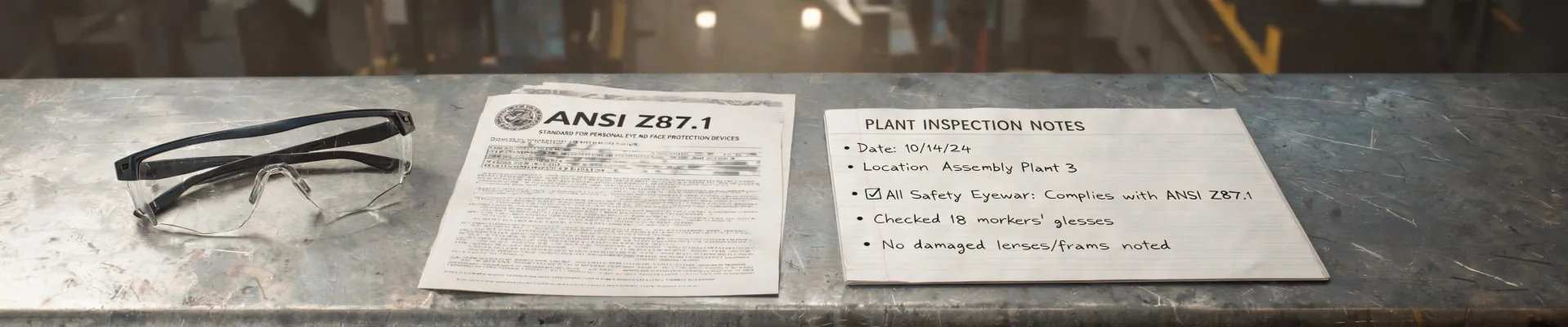
Let's start with the eyewear. The line item said "prescription safety glasses Wiley X" and that's a solid start. Wiley X has a strong military track record. I've seen Wiley X military contracts specify frames for the same reason they show up on construction sites: lens retention, anti-fog performance, and ANSI Z87.1-rated impact protection. But here's the nuance: a brand name alone doesn't make a pair of prescription glasses compliant.
Actually, let me rephrase that. The frame can be compliant, and the lens can be compliant, but the assembly—frame plus lens—has to meet the standard. If a vendor takes a regular prescription lens and puts it into a Wiley X frame, you don't automatically get an impact-rated product. You need the lens made from the right material, at the right thickness, with the right base curve, in a facility that follows the manufacturer's instructions.
When I called the customer, the safety manager said he'd assumed "Wiley X" meant everything was covered. That's a common belief, and I understand why. The brand is so strong in tactical and military settings that people forget to check the prescription lens spec. The fix was straightforward: order through a certified prescription program, specify ANSI Z87.1+ high-impact, and ask for the test certificates before approval. Ten minutes on the phone saved a shipment of expensive glasses that might have been nothing more than fashion frames with RX lenses.
Ugg Earmuffs: A Quick Check Saved a Compliance Gap
Then there were the Ugg earmuffs. I admit, I paused. There are two very different kinds of earmuffs in the world: the kind that keep your ears warm, and the kind that protect your hearing from noise. Ugg makes the first kind. They're not in the hearing protection business.
The requisition said "Ugg earmuffs women" and listed them under PPE. If the worker needed hearing protection in a compressor room, these would have been useless. But if the worker was in a cold freezer aisle, they were perfect. I didn't want to reject them without asking.
Honestly, I'm not sure why so many procurement systems mix "earmuffs" under one category. My best guess is search-term collision. People type "earmuffs" and get both comfort and safety products. We called and confirmed these were for warmth, not noise. Problem solved. But the mistake would have shown up in an audit because the PPE inventory would have included a non-rated item with no corresponding noise hazard assessment. That's the kind of thing that creates a false sense of compliance.
The Water Fire Extinguisher That Didn't Belong
The biggest red flag was the "water fire extinguisher." Let's be clear: water extinguishers have a place. They're rated for Class A fires—ordinary combustibles like wood, paper, and fabric. But they're not safe on electrical fires, flammable-liquid fires, or grease fires. In a food processing plant, those are exactly the hazards you're likely to face.
This one was headed to a break room. It sounded harmless. But break rooms have microwaves, toasters, and sometimes even a hot plate. If a toaster oven catches fire and someone uses a water extinguisher, they're risking electrocution. If a grease fire comes out of a skillet, water makes it worse. The conventional wisdom says "any fire extinguisher is better than none." My experience says otherwise: the right extinguisher for the wrong hazard can make a bad situation much worse.
For anyone reading this, here's the simple version:
- Class A: ordinary combustibles — wood, paper, cloth
- Class B: flammable liquids — gasoline, oils, grease
- Class C: energized electrical equipment
- Class K: cooking oils and fats
A water extinguisher is a one-trick pony. An ABC dry chemical extinguisher covers multiple classes and is a better fit for common areas. In a commercial kitchen, a Class K extinguisher is the standard. The NFPA 10 standard spells this out in more detail. For this order, we swapped the water unit for an ABC dry chemical extinguisher and added the fire class to every future purchase order.
The safety manager didn't fight the change. He said, "I've been doing this six years and nobody ever explained the classes." That's not a dumb person. That's a systems problem.
Are Latex Gloves Food Safe? Usually, Nitrile Is the Better Answer.
Last on the list: four cases of latex gloves. In the margin, someone had written "are latex gloves food safe?"
It's a question I get often. The short answer is: it depends, and in most food-service situations, nitrile is the safer choice. Latex gloves aren't specifically banned by the FDA Food Code for food service, but they carry allergen risks. Latex proteins can trigger reactions in both the wearer and the people eating the food. Latex also breaks down faster when it contacts fats and oils—which are kind of the point in a kitchen. Once gloves degrade, you get pinholes and contamination.
I knew I should have flagged this immediately, but I almost didn't. I thought, "what are the odds?" The odds were high enough. The FDA Food Code emphasizes minimizing allergen risks, and many health departments now expect nitrile or vinyl for ready-to-eat food. If you see a box labeled "food safe," don't take the label at face value. That's a claim, and per FTC guidance (ftc.gov), claims need to be truthful and substantiated. Ask the supplier for documentation.
We swapped the latex for powder-free nitrile. The cost difference was small. The peace of mind wasn't.
What I'd Tell a Buyer
That order didn't ship as originally written. We swapped the extinguisher, changed the glove material, verified the prescription eyewear program, and left the Ugg earmuffs alone because they were never really PPE. The customer thanked us. The safety manager said something I still think about:
I'd rather have someone ask questions than ship me four cases of the wrong thing.
In my job, I'd rather spend ten minutes explaining options than deal with mismatched expectations later. An informed customer asks better questions and makes faster decisions. That's not just a nice-to-have—it's how you avoid the $22,000 redo that nobody budgets for.
I can only speak to the system we use in the U.S. If you're dealing with international regulations, the calculus might be different. This worked for us because the customer was willing to slow down. If you're a one-person company buying a single pair of safety glasses, don't panic. Just check the standard. Look for the ANSI mark on the lens, ask for the test certificate, and remember that "PPE" is a category, not a pass/fail grade.
The Tuesday afternoon order changed how I think about assumptions. A brand name is a starting point, not the whole story. A comfort earmuff isn't hearing protection. A water fire extinguisher is only right for the right fire. And "food safe" claims are worth verifying. It's not about making customers feel uninformed. It's about making the next order better.

Maeve Callahan
Maeve Callahan is a head-protection analyst covering Type I and Type II hard hats, climbing-style safety helmets, bump caps, chin straps, suspensions, liners, and face-shield carriers. She applies ANSI Z89.1, EN 397, and EN 12492 criteria while comparing impact attenuation, penetration resistance, lateral deformation, electrical class, retention strength, field of vision, mass, fit range, and temperature conditioning. Her guides help EHS teams, contractors, utilities, and buyers select helmet systems for overhead hazards, work at height, electrical exposure, accessory compatibility, and worker acceptance.