I'm the office administrator for a 130-person construction services company. I manage all of our PPE and safety supply purchasing — roughly $85,000 a year across eight vendors — and I report to both operations and finance. That puts me in an odd position: I sit far from the actual work site, but I'm the person responsible for the gear that keeps people safe on it.
When I took over purchasing in 2020, I didn't have strong opinions about safety eyewear. I do now. After five years of ordering, walking job sites, and reconciling what happens when things go wrong, I've landed on a position I don't mind defending.
The cheapest "safety glasses" in the supply catalog are the most expensive eye protection your company will ever buy. I now order Wiley X prescription ballistic glasses for our higher-risk crew members and Wiley X Brick safety glasses for general site use — and I'd make that same call tomorrow.
This isn't brand loyalty. It's basically arithmetic. Five minutes of verification before I place an order beats five days of correction after someone gets hurt. The prevention-over-cure idea sounds like a slogan until you're the person explaining a near miss to your boss.
A near miss behind a chain link fence changed how I order eyewear
Last fall, a site manager asked me to come see why our crews kept leaving their eye protection in their trucks. I arrived at a fenced yard and waited while someone signed me in. Through the chain link fence, I watched a guy using a grinder on concrete.
He stopped every minute or two to wipe his glasses. Then he took them off entirely, squinted at the slab, and kept working. A fragment of concrete or metal could have caught him in the eye at any second. It didn't that day. But I stood there thinking about the hospital visit, the paperwork, and the phone call to his family that I would have had to make.
When I got inside, he showed me why he'd taken the glasses off. The lenses were scratched badly enough that he genuinely couldn't see through them. He told me he kept them in his vest pocket and put them on when the safety manager was nearby. He wasn't careless. He'd been handed gear that made his job harder, and he made the logical call.
Every month or two, a new hire asks me where to buy work boots near me. They'll drive across town, try on six pairs, and spend good money on boots that fit. But eye protection was something to grab out of a bucket. The whole system was kind of backwards. The body part you rely on for every single task deserves the same consideration as the body part you walk on.
Reason one: certified impact protection that I can actually verify
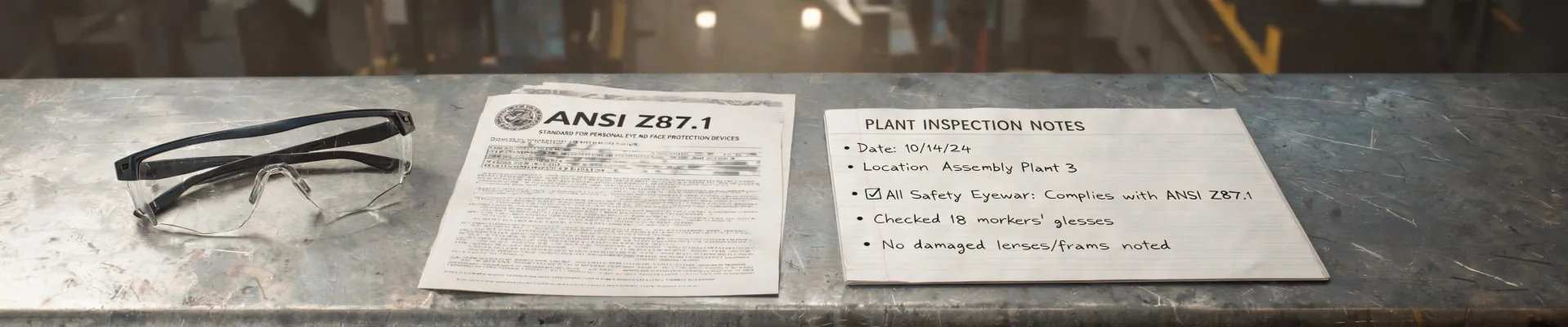
Before I approve any eyewear now, I ask for ANSI/ISEA Z87.1 documentation. Under OSHA's eye protection rules (29 CFR 1910.133), protective eyewear must comply with the ANSI Z87.1 standard when workers face hazards like flying particles. The regulation doesn't name a brand — and that's exactly why the paperwork matters.
That's not a knock against basic protective spectacles. They're perfectly adequate for a lot of low-risk work. What changed for me is that I stopped buying "safety glasses" as a category and started asking what standard each model actually met.
During our 2024 vendor consolidation project, one supplier told me their glasses "met ANSI." When I asked for the test report and the lens marking details, the emails went silent. I'm not a safety engineer, so I can't certify a product myself. But I can verify that someone else did. A missing spec sheet is a red flag right out of the gate.
That's a big part of why Wiley X is in our program now. For the models we issue, the lenses arrive marked to Z87.1, and many of the same frames also meet MIL-PRF-31013, a military-grade ballistic fragmentation standard. To be clear, "ballistic" doesn't mean indestructible, and I never describe it that way to crews. It means the lens and frame were tested against high-velocity impact instead of a marketing claim.
Reason two: prescription models actually get worn
The second reason is less about the lens and more about the person behind it. We have operators, inspectors, and crew leads who need corrective lenses every day. Before the switch, their options were essentially regular prescription glasses under a pair of over-glasses, or no over-glasses at all. Most days, they chose no over-glasses. It wasn't rebellion; it was practicality. Over-glasses add weight, bounce when you move, and make it harder to see what you're doing.
That's where Wiley X prescription ballistic glasses changed our compliance numbers. Higher-risk crew members with prescriptions get one pair that handles both vision correction and impact protection. I'm not an optician, so I can't speak to how the lenses are ground or fitted. From a purchasing perspective, the prescription is managed through an authorized lab, the paperwork comes back clean, and the worker walks away with eyewear they'll actually leave on.
If you've ever tried to convince someone to wear gear that fogs up or causes a headache by lunch, you know this isn't a training problem. It's a gear problem. Give someone a clear, comfortable pair of protective glasses that fits their prescription, and they'll keep them on. The guy who keeps his glasses on is the guy who doesn't end up in the emergency room.
Reason three: the real cost math favors the better pair
Here's what you need to know about our budget process: the per-pair price matters less than the total cost of the program. I don't have hard data on injury rates across every company in our industry. I do have our own claims history, and it's enough. A single workers' compensation claim — even a relatively minor one — exceeds what we spend on eye protection for entire crews in a year. According to the National Institute for Occupational Safety and Health, roughly 2,000 U.S. workers each day sustain job-related eye injuries requiring medical treatment (Source: CDC/NIOSH).
When our safety coordinator first asked me to order a batch of Wiley X Brick safety glasses for crews that don't need prescription lenses, I hesitated. The spreadsheet said we'd spend more per pair. My gut said that was the whole point — the cheap pairs were ending up in glove boxes. I went with my gut. Over the 2024 season, the Brick glasses came back scratched less, fogged less and, most importantly, stayed on people's faces. That's anecdotal, not a scientific study, but it's our experience on our jobsites.
Fair objections — and my answers
I hear the obvious pushback, so let me answer it directly.
"We don't do high-risk work, so ballistic eyewear is overkill." Maybe it is. I'm not a safety consultant, and your hazard assessment should drive your purchasing decision. But I've watched crews do ordinary tasks: grinding, chipping, drilling, working next to someone else who's doing the same thing. A perimeter fence can keep uninvited people out of a yard, but it doesn't stop a fragment thrown from three yards away.
"The better glasses cost more per pair." They do. But the total cost of an eye injury includes medical bills, lost time, the OSHA recordable, the investigation, and the part that doesn't fit in a spreadsheet. Roughly speaking, one serious preventable injury will erase the savings from choosing the cheapest option for a long time.
"Train workers better and they'll wear whatever you issue." Training matters, and we do it. But I've watched a reasonable adult take off his issued glasses because he couldn't see through them. No amount of training fixes scratched lenses or fogged optics.
"What about the accidents prevention can't stop?" Fair. That's why every company vehicle first-aid kit includes a CPR face shield. I check them the same way I check our eyewear inventory. A CPR face shield doesn't prevent an accident — it helps you respond to the one that still happens. Prevention doesn't replace response. But response shouldn't be the only thing in the budget either.
Bottom line: I didn't switch to Wiley X because a brochure told me to. I switched because the products solve problems I was seeing in our program: certification I can verify, prescription options that improve compliance, and models like the Wiley X Brick that our crews don't secretly hate.
Take it from someone who signs the purchase orders. Prevention is cheaper than cure, and a few extra dollars per pair of protective eyewear is the cheapest insurance you'll ever buy. If the glasses stay on, the emergency room visit is a lot less likely. That's the outcome I'm paying for.

Maeve Callahan
Maeve Callahan is a head-protection analyst covering Type I and Type II hard hats, climbing-style safety helmets, bump caps, chin straps, suspensions, liners, and face-shield carriers. She applies ANSI Z89.1, EN 397, and EN 12492 criteria while comparing impact attenuation, penetration resistance, lateral deformation, electrical class, retention strength, field of vision, mass, fit range, and temperature conditioning. Her guides help EHS teams, contractors, utilities, and buyers select helmet systems for overhead hazards, work at height, electrical exposure, accessory compatibility, and worker acceptance.