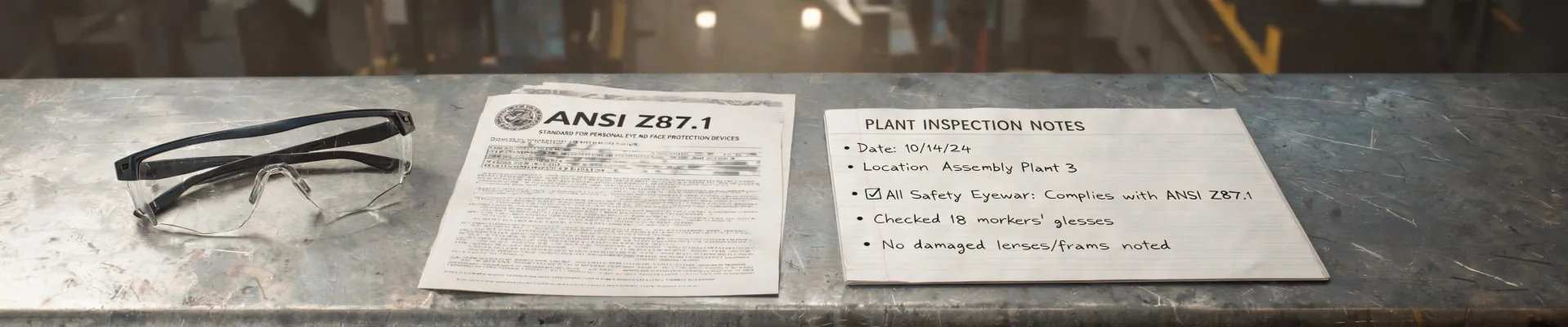
In 2017, I was the guy who approved a $3,200 order for safety glasses that ended up being completely wrong for the job. Not the wrong tint. Not the wrong frame. I mean wrong category of eye protection for the hazard. The boxes sat in our warehouse for six months before anyone even opened them.
That mistake—and about seven others totaling roughly $8,000 in wasted budget—taught me more about PPE procurement than any training course ever did. So let me walk you through what I've learned, starting with the part that still stings.
The Problem Everyone Thinks They Have
Most people think their PPE problem is finding products that meet safety standards. They search for "ANSI Z87.1 certified glasses," compare prices, and call it a day.
That's what I thought too. In my first year, I checked for the ANSI stamp, checked the price, and placed the order. Everything looked fine on paper.
Then the crew started complaining. The glasses fogged up. They scratched within a week. Some guys just stopped wearing them.
The Real Problem: Standards Are Only the Floor
Here's what took me three years and several expensive mistakes to understand: a certification stamp doesn't mean the product is right for your specific hazard or your specific workers.
People think ANSI Z87.1 means "safe for everything." Actually, ANSI Z87.1 is a baseline—it's the minimum performance requirement. It doesn't tell you whether a lens will handle a 150 mph projectile, whether it meets military ballistic standards, or whether it will stay comfortable for a 10-hour shift in a humid environment.
The assumption is that if it passes the standard, it's good enough. The reality is the standard is just the starting line. I've seen $20 glasses pass the same basic impact test as $200 ballistic goggles—but the $20 pair shatters on the second week when a grinder wheel throws a burr at exactly the wrong angle.
That's when I learned about the real hierarchy in eye protection:
- Basic impact (ANSI Z87.1) — drops a steel ball from a set height. Fine for grinding dust, not for high-velocity impacts.
- High-velocity impact (ANSI Z87.1+) — shoots a 1/4-inch steel ball at 102 mph. Better, but still not military grade.
- Ballistic (MIL-PRF-31013 or similar) — the standard Wiley X ballistic goggles and glasses are tested to. This is where fragmentation actually stops.
I didn't know any of this in 2017. I just saw "ANSI Z87.1" and assumed we were covered.
What It Actually Costs to Get PPE Wrong
Let me break down my $8,000 of mistakes, because the costs weren't just the purchase price.
Mistake #1: The Right Standard, Wrong Product — I ordered 200 pairs of basic safety glasses for a crew that was cutting steel. The glasses met ANSI Z87.1, but they didn't have side shields. The spec called for side protection. I didn't catch it. The safety auditor did—during a surprise visit. We got a citation, had to reorder at rush pricing, and ate the cost of the original 200 pairs.
That was a $1,700 mistake. Plus a $340 citation. Plus the credibility hit with the crew: "the guy who buys cheap glasses and gets us in trouble."
Mistake #2: The Communication Failure — I said "we need ballistic eye protection for the range." The vendor heard "we need glasses that look tactical." Nobody wrote down the threat level. We ended up with a box of Wiley X glasses that were great—but they weren't the specific model with the highest ballistic rating. The actual spec required MIL-PRF-31013 protection. What we got was Z87.1+.
We were using the same words but meaning different things. Discovered this when I finally read the military specification page nine of the contract. $2,900 wasted, and we had to reorder the right ones.
Mistake #3: The Tyvek Suit Fiasco — This one still makes me cringe. We needed chemical splash protection for a cleanup job. I ordered Tyvek suits because that's what everyone calls them—"Tyvek suits" as a generic term. But there's a huge difference between Tyvek coveralls (particulate protection) and Tyvek with polyethylene coating (liquid splash protection).
I ordered the wrong ones. The crew showed up to a site with liquid chemicals, and the suits would have soaked through in minutes. We caught it before anyone got hurt—thanks to a site supervisor who knew his PPE—but the order was non-returnable.
That was $1,150 in suits that went to a local training facility for mock drills. The real cost? Three days of schedule delay while we waited for the correct suits.
The surprise wasn't the price difference between Tyvek and coated Tyvek. It was how much knowledge matters in what seems like a simple purchase.
Fall Protection Measures: The "Common Sense" That Isn't
If eye protection trips people up, fall protection is where the stakes are highest. And I've noticed a pattern: people assume fall protection means harnesses.
That's like assuming PPE means gloves. It's incomplete.
What are fall protection measures, actually? In the simplest terms, they're a hierarchy:
- Elimination — Can the work be done without going up there? This is always the cheapest option, but people skip it because it requires rethinking the job.
- Passive systems — Guardrails, safety nets, covers. These protect workers without requiring them to do anything.
- Fall restraint — A harness and lanyard adjusted so the worker can't reach the fall edge.
- Fall arrest — The last line of defense: a harness, anchorage, and energy absorber that stops a fall after it starts.
I've seen teams go straight to buying harnesses without asking the obvious question: do we even need to be up there? Or they buy harnesses without checking the anchorage points, which is like buying Wiley X ballistic goggles but never checking if they fit under the welding helmet.
The saddest part: in my experience, about 30% of fall protection equipment in small construction sites is either misused or never inspected after purchase. Harnesses with frayed webbing. Lanyards that were used as tow straps. Anchorages that aren't rated for the load. I've caught all of it.
One lesson that stuck with me: a harness that's never been inspected is a cheap way to feel safe without actually being safe. The inspection isn't paperwork—it's the product.
The Deeper Issue: Nobody Owns the PPE Program
Here's what all my mistakes had in common: nobody was responsible for the full PPE picture. Procurement bought to spec. Supervisors assumed the gear was right. Workers assumed someone smarter had checked.
That gap is where the money went. And the embarrassment. And the near misses.
I don't say this to scare you—but I've been in this industry long enough to see that the companies who get PPE wrong aren't the ones buying cheap. They're the ones buying without a process. I've made that mistake at least five times.
The Process That Finally Fixed It
After the third rejection in Q1 2024, I created a pre-purchase checklist. It's nothing fancy. Four questions that must be answered before any PPE order:
- What is the specific hazard? Not "impact"—make them describe it. A 1-inch falling object? A high-velocity projectile? A chemical splash? Each changes the answer.
- What does the standard actually require? Look it up yourself. Don't trust the sales rep. If it's ANSI Z87.1, which of the three impact levels? If it's Tyvek, is it for particulates or liquids?
- What are the workers' real conditions? Fogging, sweat, compatibility with other gear (hard hats, respirators, ear muffs). If the gear isn't comfortable, workers will not wear it, and the standard won't save you.
- Who will inspect it—and when? This isn't just for harnesses. I've been surprised at how often workers end up with scratched, cracked lenses that were "fine" six months ago because nobody checked.
We've caught 47 potential errors using this checklist in the past 18 months. Not all of them were about the products themselves. Some were about compatibility, some were about storage (UV damage is real), some were about sizing. But all 47 would have been mistakes that cost money or confidence.
What I'd Tell Someone Starting Today
If you're reading this because you're about to order PPE, here's the blunt version:
Don't start with products. Start with the hazard. And I do not mean "the hazard" as an abstract idea. I mean the specific, measurable, OSHA/NIOSH-defined hazard your people actually face.
For eye protection: if there's any chance of high-velocity impact, do not settle for basic ANSI Z87.1. Look for the Z87+ mark or better, and ask whether the product meets any ballistic standard. Wiley X makes a lot of models—Valor, Contender, Boss, etc.—but the right one depends on the threat level, prescription needs, and what else the person is wearing.
For Tyvek covers: read the technical datasheet, not the product title. If liquids are involved, verify the coating rating. If it's asbestos or dust, regular Tyvek might be fine. Know the difference.
For fall protection: if you haven't already, do a hazard assessment first. Not to be confused with "trust the harness vendor to tell you what to buy." They're not the people who will be wearing it at height on a hot July day.
And one more thing: the checklists are not a substitute for actually talking to the people who wear this stuff. The most expensive mistake I ever made was assuming I knew better than the crew. I didn't. I'd never worn a harness in a 100-degree attic or tried to see clearly through fogged-up safety glasses while swinging a hammer.
There's something satisfying about a system that finally works. After all the stress, seeing the right gear on the right worker, on time, under budget—that's the payoff. But you have to be willing to look at your own mistakes first.
I still make small errors. Last month I almost ordered the wrong size gloves because I didn't check the sizing chart twice. But the big, expensive, credibility-damaging mistakes? Those stopped when I started asking better questions.
That's the whole secret. Not perfect products—better questions.
Pricing note: All cost figures are from my own invoices (2017–2025) and will vary by vendor, quantity, and timing. ANSI Z87.1 and OSHA requirements are updated periodically—verify current regulations at osha.gov and ansi.org before making decisions.

Jane Smith
I’m Jane Smith, a senior content writer with over 15 years of experience in the packaging and printing industry. I specialize in writing about the latest trends, technologies, and best practices in packaging design, sustainability, and printing techniques. My goal is to help businesses understand complex printing processes and design solutions that enhance both product packaging and brand visibility.