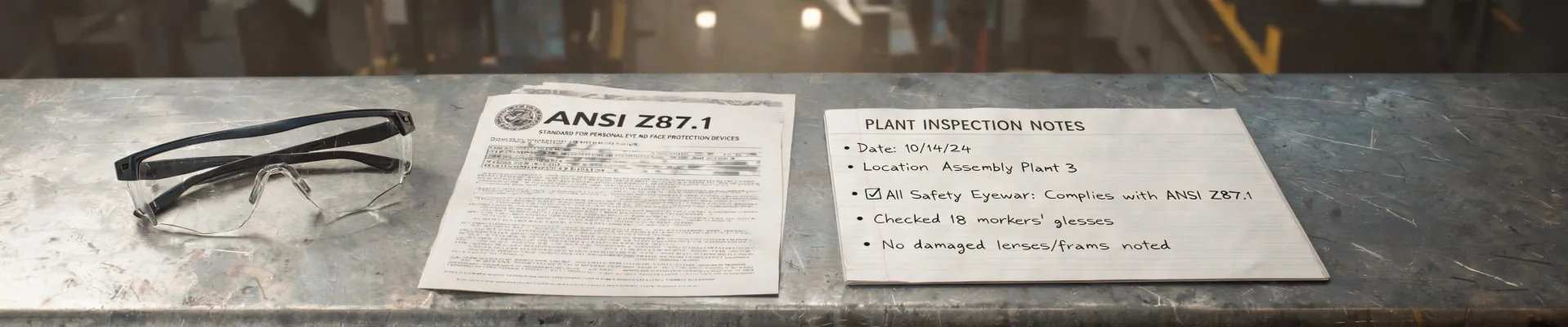
In March 2024, a client called 36 hours before a scheduled range training event. They needed 140 pairs of Wiley X tactical goggles with clear lenses for indoor shooting. Normal turnaround was five to seven days. We found a supplier, paid about $380 in overnight freight, and delivered with 14 hours to spare. Missing that deadline would have meant losing a $15,000 contract.
That call went smoothly. The harder problem wasn't speed. It was what happened next. The client asked: should the second shift get Wiley X clear safety glasses or the same tactical goggles? I asked what the second shift was doing. No answer. That's the pattern I keep seeing in safety eyewear decisions: teams choose a product before they define the hazard.
What you think the problem is
Most people start with brand or product category. Are Wiley X tactical goggles worth it? Do I need clear safety glasses with side shields or a goggle with a foam seal? Those are real questions, but they're downstream from a bigger one: what is the eye protection supposed to do?
The problem is not the model number. The problem is that protection only makes sense in relation to a specific threat. A ballistic lens that is perfect for a range is overkill for a conveyor line. A lightweight spectacle that works in an office is not enough for a nail gun. If you start with the product, you're guessing. If you start with the hazard, the product gets easier.
The deeper problem: protection is tied to threat, not brand
Eye protection has one job: keep a hazard from reaching the eye. To do that, you need to know the hazard first.
Impact from a swinging chain or a thrown object? Basic impact-rated glasses might be enough. High-velocity debris or ballistic fragmentation? You need a lens tested to a high-impact standard, often with a Z87+ marking, and sometimes a military ballistics spec. Chemical splashes? You need a goggle with indirect vents, not just a spectacle. Welding? You need a welding helmet or hand shield with the correct shade, and usually impact-rated eyewear underneath. Hearing? You need an NRR or a hearing protection rating, not warm earmuffs.
This is where the bump helmet vs ballistic helmet comparison helps. A bump helmet protects against bumping your head on a low rack. A ballistic helmet protects against fragments and, in some cases, rifle threats. There's no 'better' helmet until you define the threat. Same with eye protection. Choosing a premium tactical goggle without a threat definition is like buying a ballistic helmet for warehouse work: safe, maybe, but heavy and expensive. Or buying a bump helmet for a combat environment, which is the opposite mistake.
Why 'military-grade' is not enough
The phrase 'military-grade' is a red flag when there is no standard behind it. A pair of sunglasses can be called military style. That doesn't make it military tested.
ANSI/ISEA Z87.1 marking: Z87 means basic impact. Z87+ means high impact. If the lens has no marking, the lens has no proven impact rating.
OSHA's eye and face protection rules reference this standard for most U.S. workplaces. Many Wiley X tactical goggles and clear safety glasses are built to meet or beat Z87+, and some model families add MIL-PRF-31013 ballistic fragmentation protection. But the individual product still needs to be marked. Ask for the spec sheet. If the lens doesn't have the marking, it hasn't been through the test. No marking, no proof. That's it.
The cost of skipping this analysis
Every time a team chooses eyewear because 'it looks tactical' or 'everyone uses this brand,' I get worried. The real cost isn't the upfront price. It's the difference between rated protection and guessed protection.
A plant coordinator called me in March 2024 after a batch of glasses from a discount vendor arrived with no markings at all. The frames looked tough. The lenses had a nice anti-scratch coating. But no Z87. No high-impact claim. The upside of using them was saving about $800. The risk was running a crew without certified eye protection. I kept asking myself: is $800 worth an injury or a citation? It wasn't. We placed an overnight order for ANSI-rated replacement glasses.
Even after approving the rush order, I second-guessed. What if the frames were too small? What if the lenses arrived scratched? I didn't relax until every box was opened and every lens showed the Z87+ mark. The extra freight cost about $400. The client's alternative was a week of workers with 'probably okay' glasses. Probably is not a safety standard.
The hidden cost of 'almost right' equipment
Welding safety equipment is a good example. If you wear a welding hood with the correct shade lens, the hood handles the arc flash. But what about grinding sparks or a dropped part? That's why many welders wear clear safety glasses under the hood. If the underside protection is a cheap lens with no impact rating, you've done the hard part right and the simple part wrong.
A welding helmet should follow the shade requirements in AWS/ANSI Z49.1, not whatever looks cool. The filter shade number is based on the process and amperage, not style. If someone asks whether a dark sunglass lens is 'good enough for welding,' the answer is no. Not because the brand is wrong, but because it doesn't have a verified shade number or an impact rating. Different problem, different solution.
Same thing happens with cold-weather gear. I've heard someone ask whether insulated earmuffs could double as hearing protection—including the Ugg earmuffs women get for winter. No. Those earmuffs have no NRR, no tested noise reduction claim, and no place in a hearing conservation program. If the package doesn't show an NRR under the EPA's hearing protector labeling rule, it's not hearing protection. They're fine for the parking lot, not for a generator room.
What actually works
If you're in the middle of a rush, the fastest route to a good decision is short: write down the operation, identify the hazard, match the standard, then choose the product.
For most industrial or tactical work, Wiley-X tactical goggles or Wiley-X clear safety glasses with a Z87+ mark and a good frame fit are legitimate choices. They offer prescription inserts, replacement lenses, and tested impact protection. But they are not magic. A high-impact goggle still won't protect you from chemicals if you need a chemical splash goggle. A clear safety glass won't shield your eyes from welding arc if you look directly at the arc. The standard has to match the threat.
If you're in welding, the welding safety equipment decision has three parts: the shade filter, the impact protection under the hood, and the surrounding ventilation. If you're in a cold plant, hearing protection needs an NRR, and cold-weather earmuffs are for warmth. If you're deciding between a bump helmet and ballistic helmet, decide the threat first. These are not interchangeable categories.
My experience is based on about 300 rush PPE orders with mid-size industrial and law-enforcement clients. If you're working in heavy chemical processing or ultra-budget retail, your requirements probably differ. Don't copy the checklist blindly. Use it to ask better questions.
The bottom line
Nobody really buys safety glasses. They buy a risk reduction assumption. If the product has a marking and a standard behind it, the assumption is grounded. If it doesn't, it's a guess. In a procurement meeting, the first question should be: what standard does this product meet? If no one on the supply side can answer, that's a deal-breaker.
In an emergency, I'll pay for certainty. The $400 rush fee is easier to explain than an eye injury, a plant shutdown, or a wasted PPE budget. The premium isn't about brand ego. It's about the difference between 'probably okay' and 'tested to a known standard.' That difference is the whole point.

Jane Smith
I’m Jane Smith, a senior content writer with over 15 years of experience in the packaging and printing industry. I specialize in writing about the latest trends, technologies, and best practices in packaging design, sustainability, and printing techniques. My goal is to help businesses understand complex printing processes and design solutions that enhance both product packaging and brand visibility.