PPE Compliance Isn't a Product Feature
I'm a quality and compliance manager at a safety equipment distributor. I review every inbound batch before it reaches customers—roughly 400 SKUs a week, maybe 360 if we're not in peak season. In Q1 2024, I rejected about six percent of first deliveries for documentation or spec mismatches. The vendor called it "within industry tolerance." It wasn't.
The same buyer who searches "can you use latex gloves for food?" is often the same buyer who compares photos of Wiley X Brick safety glasses on a laptop. Both questions sound easy. Neither is.
The surface problem: quick answer, false confidence
Can you use latex gloves for food?
Technically, yes. Per the FDA Food Code (the 2022 edition is the current reference as I write this in January 2025), an intact, clean single-use glove can be used for food handling. The Code doesn't single out latex. Some state and local health departments have stricter rules, but there's no blanket federal ban on latex gloves in food service.
If you stop there, you're missing the point. The question "can you use latex gloves for food?" is a shortcut. It treats a glove as a product, not as part of a food-safety system. Latex also carries a protein-based allergen risk for employees and customers. A facility can save four cents a glove on latex, then pay for it in cross-training and incident reports. I'd rather see a written glove policy that says "we use X material, we change gloves at Y intervals, and we handle allergy risk with Z procedure." That's more durable than a yes/no answer.
The same shortcut shows up in eye and head protection
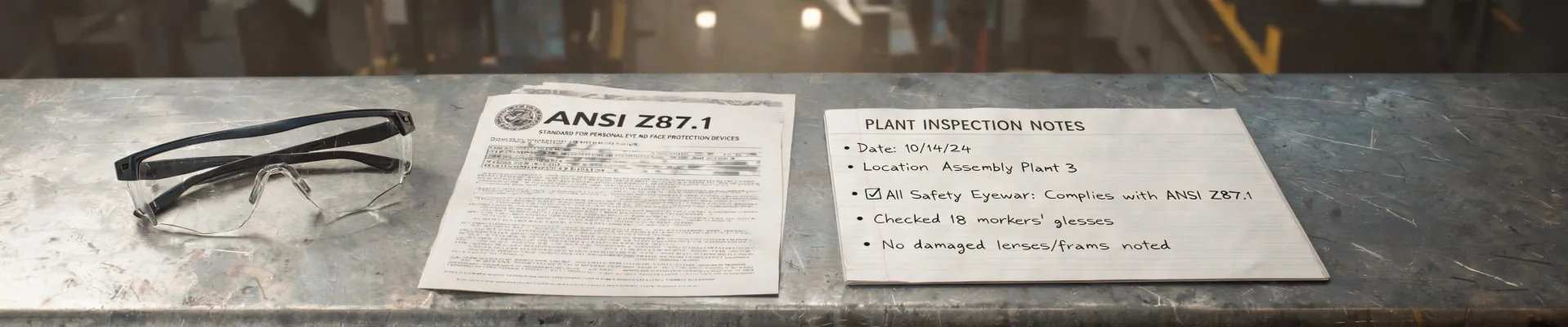
Take the Wiley X Brick safety glasses. The common question is "which lens tint is best?" That's a preference. The question that needs to be asked first is "does this model carry the ANSI Z87.1 high-impact marking?" The Brick frame is popular on job sites because it's a wraparound frame with a secure fit. But a frame alone doesn't make it safe. The lens marking tells you it was tested against a specific impact threat.
Military buyers can fall into the same trap. When someone asks about Wiley X military models, I explain that "military" isn't one feature. It means the product was tested against a military performance spec—MIL-PRF-31013—which covers things like fragmentation impact and optical quality. The name on the frame matters less than the documented standard behind it.
Head protection works the same way. A Type 2 hard hat is not just a "more expensive" version of a Type I. Type I protects against vertical impacts from above. Type II adds lateral impact protection. If a worker is near a mechanical arm, inside a confined space, or any place a blow can come from the side, Type II matters. And a hard hat liner is not a warm extra. It is a component in the impact-absorption system. If you attach a liner that has not been tested or installed per the manufacturer's instructions, you can change the clearance between the shell and the suspension. You don't have a certified Type 2 hard hat anymore. You have a shell with a liner.
The deep problem: we treat certification as a sticker
Here's the oversimplification: "It says safety glasses, so it's safe." The reality is that safety standards define specific tests for specific hazards. A pair of Wiley X Brick safety glasses can meet multiple impact levels, but the marked high-impact version is different from the basic version. A hard hat can be Type I or Type II. A glove can be food-safe but not chemically resistant. The word "safety" doesn't mean the same thing in every context.
Another misconception is that expensive products create quality. In PPE, the causation runs the other way. Companies that invest in certification, testing, and batch consistency can charge more because they've already paid for those systems. The price is not the cause of quality; it's the consequence. That's why I'd rather buy a Wiley X Brick from a distributor who can show a certificate of conformance than accept a cheaper "equivalent" from a source that can't show one.
In 2022, I implemented a simple verification protocol: every inbound case had to include a lot number and a certificate of conformance. In the first month, roughly eleven percent of orders failed. By Q1 2024, that was down to just under three percent. The vendors didn't like it at first. Then they realized that catching a spec mismatch before shipping costs them less than a return after installation.
This is also why I ask for accessory compatibility documentation before approving a hard hat liner. The two weeks of waiting were stressful—"Did I order the right thing? Did I over-specify?"—but the letter eventually came back and confirmed the liner had already been tested with that shell.
Protective equipment shall be provided, used, and maintained in a sanitary and reliable condition wherever it is necessary by reason of hazards of processes or environment, chemical hazards, radiological hazards, or mechanical irritants encountered in a manner capable of causing injury or impairment in the function of any part of the body.
OSHA 29 CFR 1910.132(a) sets the floor. If the gear doesn't match the hazard, it's not "protective equipment." It's just equipment.
The real cost of mismatched PPE
Mismatched PPE doesn't always fail dramatically. It fails quietly, then it shows up in callbacks, medical reports, and customer complaints.
- Eye protection: a lens that meets basic impact but not splash protection leads to corneal irritation, lost workdays, and a reputation for uncomfortable glasses.
- Head protection: a Type I hard hat in a lateral-impact zone creates false security.
- Hand protection: latex gloves used for food can create allergen liabilities that don't surface until someone has a reaction.
There's also the perception issue. When you put a worker in gear that feels flimsy, the customer sees it. The forty-dollar difference on a pair of Wiley X Brick safety glasses translates into a customer thinking, "These people know what they're doing." The five-dollar difference on a hard hat liner can translate into the opposite. That's not about looks; it's about confidence.
What I actually specify now
Instead of asking "which product?" I ask "what standard is this product certified to, and what is the system around it?"
Eye protection: Require an ANSI Z87.1 high-impact marking on both lens and frame when there is any impact risk. If the customer is military, law enforcement, or tactical, ask for MIL-PRF-31013 compliance and verify the model on an approved list. That is often a Wiley X military or Wiley X Brick model, but the point is the marking, not the brand.
Hard hats and liners: Specify Type 2 for lateral hazards. When you add a hard hat liner, get written confirmation from the hard hat manufacturer that the liner is compatible with that shell and suspension. Put it in the contract. It's not a detail; it's part of the system.
Food-handling gloves: Check your local health code first, then set a written policy. If you choose latex, document the allergen assessment. If you choose a synthetic alternative, you're paying a little more for a lower exposure burden. On a 50,000-unit annual order, that's a decision worth making consciously. Even after we standardized on nitrile gloves in our food service catalog, I kept second-guessing. What if the thicker synthetic glove hurt dexterity? Two months of customer feedback—zero dexterity complaints—settled it.
The plain version
No procurement decision is just a product decision. A pair of safety glasses is a set of tested materials and markings. A hard hat is a shell, a suspension, and anything attached to it. A glove is only as safe as the task, the allergen profile, and the hygiene procedure around it. When someone asks "can you use latex gloves for food?" the honest answer is: yes, under certain conditions—but the way the question is phrased tells me they're looking for the easy version.
I don't mind questions. I mind when a purchase is made before the standard is confirmed. That's when I send the batch back, reject the quote, and let the real cost show up—not at the register, but after the product reaches the field. At least, that's been my experience in the PPE distribution chain.

Jane Smith
I’m Jane Smith, a senior content writer with over 15 years of experience in the packaging and printing industry. I specialize in writing about the latest trends, technologies, and best practices in packaging design, sustainability, and printing techniques. My goal is to help businesses understand complex printing processes and design solutions that enhance both product packaging and brand visibility.