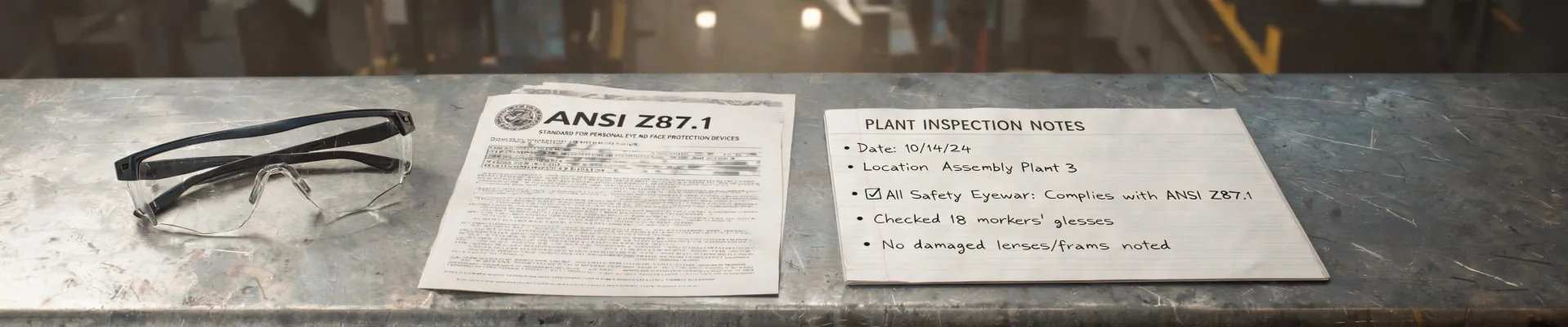
If you're responsible for buying safety glasses for your company, here's the short answer: Wiley X is the brand I've standardized on after roughly 200 orders and six years of PPE purchasing for a 400-person company. The premium price over bargain-bin safety glasses is worth it for three concrete reasons—the MIL-PRF-31013 military impact rating, prescription lens support that actually works, and the fact that employees don't hate wearing them. That last one matters more than any spec sheet.
I'm the office administrator for a manufacturing company with around 400 employees across three locations. I manage all the PPE ordering—roughly 60 to 80 orders per year across eight different vendors. I report to both operations and finance, so I'm always balancing two priorities: keep people safe and don't blow the budget. It's a job that's taught me more about ballistic ratings and lens coatings than I ever expected to know.
When I took over purchasing in 2020, safety glasses were the first category I tackled. The company had been buying $2 generic glasses from a local supplier because they technically met the ANSI Z87.1 requirement. They were a disaster. Employees complained about fogging, about scratches appearing after a week, about glasses sliding down their noses constantly. Then they stopped wearing them altogether. That's when I learned the most important lesson of my procurement career: a safety glass nobody wears protects nobody. The cheapest option was actually the most expensive one—an eye injury claim would cost far more than upgrading everyone to proper eyewear.
What actually makes Wiley X different
I tested samples from several brands before committing. What I could verify with my own hands: lens clarity was noticeably better, frames held their shape under pressure, and lenses stayed seated in the frames when I dropped them. That last part comes from the military-spec thing. Many Wiley X models meet MIL-PRF-31013, which is a significantly tougher ballistic impact test than ANSI Z87.1. For us, that mattered because we have workers doing grinding and metal-cutting where debris can hit hard enough to crack a standard lens.
Here's something vendors won't tell you: at the $2–5 price point, most safety glasses are just standard frames with lenses that barely clear the minimum impact test. You're basically paying for a logo sticker. Wiley X builds most of their lenses from polycarbonate or Trivex, and many frames use a replaceable lens system. When a lens gets scratched, we order a lens, not a whole new pair. That alone cut our replacement costs by maybe 40%—I'd have to check the exact numbers, but the savings were real. I'm honestly not sure why more brands don't do this. My best guess: it's easier to sell a $2 disposable product than to build one that lasts.
Prescription lenses: the feature that tipped the scale
In 2021, we ran a survey and found that about 30% of our workforce already wore prescription glasses. Those employees were either doubling up—prescription glasses underneath safety glasses, which is uncomfortable and genuinely unsafe—or just skipping eye protection. Neither option was acceptable.
Wiley X's prescription support became the deciding factor. You can get actual prescription lenses installed in their safety frames, through your optometrist or their authorized dealer network. The turnaround was about two and a half weeks from the time we sent in the prescription and pupillary distance measurements. If I remember correctly, we paid roughly $120 to $160 per pair depending on the frame and lens options. It's not cheap. But it's the difference between an employee who can see and an employee who's waiting to have an accident.
To be fair, I can't credit all of our compliance improvement to the glasses. We also stepped up training around the same time. But eye protection usage at our sites went from maybe 60% to over 90% after the switch. The timing was too clear to be a coincidence.
Polarized lenses and the military connection
I used to dismiss polarized lenses as a sales gimmick. I was wrong. Our outdoor crews deal with glare from concrete, water, and vehicle windshields all day. Polarized lenses cut that glare, which means less eye fatigue at the end of a shift. Fewer complaints, better focus. Simple as that.
Wiley X also sells sunglasses in the same safety-rated frames. This is a bigger deal than it sounds: workers who need sun protection don't have to carry a second pair of glasses. And the military credibility is real. I've lost count of how many service members I've seen wearing Wiley X sunglasses on duty. The brand is genuinely built for tactical environments, and it shows. They also offer a military discount—I want to say around 15%, but don't quote me on that—which helped when we supplied our overseas contractor teams.
Beyond glasses: what else I've bought as a PPE buyer
Since I handle most of our safety equipment purchasing, the same conversations have come up in other categories. A few things worth sharing:
Body armor. Our security team needed body armor for executive protection work. I had to learn a whole new acronym soup: NIJ Level IIIA, soft armor vs. hard plates, ceramic vs. polyethylene. My regular PPE supplier told me something I appreciated: "This isn't our lane. We do eyewear and gloves well. For armor, go talk to a specialist." That honesty earned my trust more than any cross-sell attempt. I'd rather work with a specialist who knows their limits than a generalist who overpromises. We ended up buying from a dedicated armor distributor who walked us through the threat levels properly.
Metatarsal boots. If you've never bought these, metatarsal boots are safety boots with extra armor over the instep—the top of the foot. Steel toe caps alone don't protect the metatarsal bones, which is exactly what makes these different. They're needed when heavy objects could fall or roll onto the top of the foot. We bought 60 pairs for our foundry crew. I first looked them up in 2022 after one of our safety inspectors flagged the gap in our boot policy.
The "fence in Spanish" story. This one's off-topic but I'll include it because it frustrated me enough to remember. We hired a contractor to install a security fence around one of our lots. The crew spoke mostly Spanish, and my Spanish is, to put it kindly, bad. I had to look up the word for fence—it's "cerca" if you mean a permanent boundary fence, or "valla" if it's more of a temporary barrier. We needed the permanent type. I spent an afternoon with Google Translate and a very patient foreman, and somehow we got it right. If you're in procurement and don't speak the language of your suppliers, find someone who does. It's not worth the miscommunication risk.
What I don't like about Wiley X
No product gets everything right, and Wiley X has real downsides that you should consider before committing.
Cost. Wiley X glasses run three to five times what basic safety glasses cost. If your workforce loses or destroys glasses constantly, the budget hit adds up. We keep a stock of cheap backup glasses for visitors and temp workers so we're not wasting expensive pairs on one-day employees.
Style. Some models look tactical. I mean "about to clear a room" tactical. That's great for a military or security context, but awkward in a customer-facing environment. The more understated models like the Wiley X Gravity or the Slim series work for general industrial use. Do your research before rolling them out.
Counterfeits. Fake Wiley X glasses are everywhere online. A counterfeit doesn't have the ballistic rating, proper lens material, or warranty. It's a liability, not a bargain. Buy from authorized distributors and verify what you're getting.
When Wiley X isn't the right choice
I'll be straightforward about this: Wiley X isn't for everyone. If you run a small operation with low-impact hazards and a tight budget, basic ANSI Z87.1 glasses will do the job fine. If you need disposable eye protection in food processing or healthcare, Wiley X is overkill. And if you're buying visitor glasses, just buy the cheap ones.
My experience is based on about 400 workers in light manufacturing, warehouse, and outdoor operations. If you're in a very different environment—chemical plants, cleanrooms, high-heat foundries, or anywhere with very specific hazard profiles—you should talk to someone in that sector. I can't speak to those requirements.
Where I land after six years
I still kick myself for not switching to Wiley X sooner. The cheap glasses we bought in 2020 didn't save money—they cost us in constant replacements, compliance gaps, and a risk I don't want to think about. Per FTC guidelines (ftc.gov), the claims a manufacturer makes need to be substantiated, and after testing these glasses myself, I believe Wiley X's claims check out.
Wiley X safety glasses are not the cheapest option. I've never seen them positioned as such. But for someone whose job depends on 400 people going home with their eyesight intact, they're worth the premium. Probably worth more, honestly.

Maeve Callahan
Maeve Callahan is a head-protection analyst covering Type I and Type II hard hats, climbing-style safety helmets, bump caps, chin straps, suspensions, liners, and face-shield carriers. She applies ANSI Z89.1, EN 397, and EN 12492 criteria while comparing impact attenuation, penetration resistance, lateral deformation, electrical class, retention strength, field of vision, mass, fit range, and temperature conditioning. Her guides help EHS teams, contractors, utilities, and buyers select helmet systems for overhead hazards, work at height, electrical exposure, accessory compatibility, and worker acceptance.