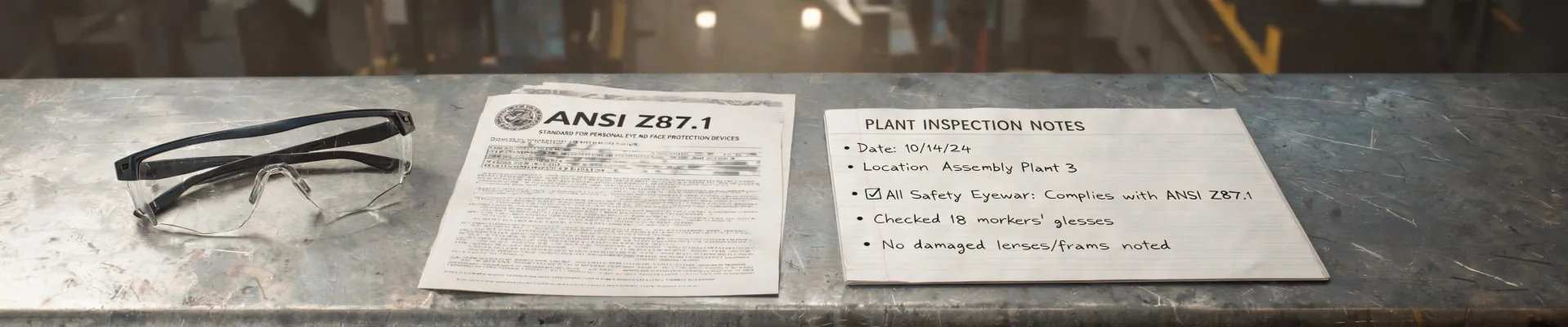
In my role coordinating rush PPE orders for industrial facilities, “we need it tomorrow” is not an unusual request. But a call in March 2024 reminded me that the equipment people wear under pressure is also a reflection of the brand they work for. That lesson involved Wiley X tactical sunglasses, welding gloves, a 1620 Workwear jacket, and a simple food safety question about black nitrile gloves.
The call came in at 3:40 p.m. on a Wednesday. It was a facilities manager at a food-and-beverage plant that also operated its own maintenance shop. He didn't waste time: “I'm walking the site in half an hour and I just counted eleven people on the outside crew with cracked or missing eye protection. Our biggest customer is auditing us Friday morning. I need thirty pairs of outdoor tinted safety eyewear and twelve clear pairs on-site by Thursday night. Can you do it?” We had roughly 36 hours and a clear deadline. Yes, we could do it—but I wasn't going to do it by ordering the first generic safety glasses in stock.
That is not the way I always operated. When I first started buying PPE in bulk, I assumed that if a product carried an ANSI Z87.1 mark, one pair was more or less the same as another. Then, in 2023, I helped a contractor send back a cheap bulk shipment of tactical-looking sunglasses sold with a “safety” label. The lenses scratched the first time they were wiped. The logo on the frame started peeling. The frames were not a listed model with any manufacturer. The client had a week before a big inspection and was out the entire cost of that order. It cost us time and money, but worse, it made everybody question the rest of the PPE we had supplied.
Wiley X tactical sunglasses are not a fashion choice
The manager did not ask for a specific look because he wanted his crew to look cool. He asked for Wiley X tactical sunglasses because he knew the difference between glasses that get worn and glasses that get left in a truck. For an outdoor yard crew, a secure rubberized fit, verified impact resistance, and a model that can be traced back to its standards are worth more than a small price difference. I appreciate that because, on a jobsite, protective eyewear only works when it is on someone's face.
But with a big brand, there is also a bigger counterfeit problem. I have seen products listed as “Wiley X tactical sunglasses” that were nothing more than unbranded fashion shades with a copied logo added to the listing photo. When the order arrives, the Wiley X logo is slightly off, or missing entirely, and there is no manufacturer marking to trace. In genuine safety items, the Wiley X logo is backed by a model number on the frame. That lets a safety manager look up certifications and order replacement parts. A logo alone does not create safety. But if the logo and model cannot be verified, there is no way to know what standard was actually tested.
1620 Workwear was part of the same lesson
After we sorted out the eyewear quantities, the manager asked me to look at two members of the maintenance crew who would lead the tour. One of them wore a 1620 Workwear coat that had clearly been through real work. It wasn't flashy; it just looked sturdy, and it made the guy look like someone who cared about his equipment. “That's the image I want my audit team to see,” the manager said. I get it. Quality perception is not about vanity. A client sees that detail before a single conversation happens.
We couldn't put the whole crew in brand-new 1620 Workwear gear in 36 hours, and I would never claim that a clothing brand replaces a proper hazard assessment. But we were able to add a couple of clean layers to the people who would be in the walkthrough. In a tight situation, that is often all it takes to turn “makeshift safety gear” into “a team with standards.”
Don't send “welding gloves” when someone asks for mig welding gloves
The maintenance shop also had a small welding bay, and the audit route passed within a few feet of it. The manager had noticed that one welder's current gloves were frayed, so he asked us to include two pairs of mig welding gloves in the shipment. Not just any leather work gloves. MIG welding gloves.
I have seen emergency orders fail because someone grabbed the first heavy leather glove in the storeroom. A welder might tolerate an unsuitable glove for a while because they are too busy to complain. Then it goes missing, or a hand gets burned. We sent gloves designed for MIG work: enough heat resistance for wire welding, with a cuff and finger profile that allowed real dexterity. It is a detail you can feel in the first few seconds—and a missing detail you can feel much faster.
Are black nitrile gloves food safe?
Just as we were wrapping up, the manager stopped me in the office. His team was going to serve lunch to the auditors, and someone had found a case of black nitrile gloves in the maintenance supplies. He asked, point-blank: “Are black nitrile gloves food safe?”
That may sound like a strange question in a story about safety eyewear, but it is a perfect example of why labels and specifications matter. Color alone does not make a glove food-safe. Some black nitrile gloves are made from materials that comply with FDA food-contact requirements. Many others are made for automotive, janitorial, or industrial work and are not meant to touch prepared food. The only way to know is to read the case or the manufacturer's spec sheet for a food-contact statement. If it does not say it is food-safe, treat it as a no.
According to FDA guidance (fda.gov), any food-contact material must meet specific regulatory conditions for its intended use. Always verify against the current requirements in force for the product you are using; don't assume a glove is food-grade simply because it is a black nitrile glove.
The 36-hour bottom line
By Thursday evening, the delivery was staged. Every pair of Wiley X eyewear had its markings checked. The two pairs of mig welding gloves were labeled and boxed. The 1620 Workwear pieces were clean and ready for the tour. And the nitrile glove question was resolved with a simple, clear label: food service only.
The audit went fine. The rest of the week went fine too. Nothing dramatic happened, and that is exactly the point. Good emergency logistics should feel boring. But if I had sent a stack of generic glasses, random leather gloves, or let a food handler use the wrong gloves, the failure would have shown up exactly when the client was looking.
Here is what I want every purchasing manager to remember: productivity and protection are both part of quality. If someone on your team has to put on gear made of assumptions and guesswork, they will feel it, and so will your customers. You don't need to buy the most expensive item in every category. You do need to make sure that what you buy is traceable, task-appropriate, and good enough that people will actually use it.
That, to me, is quality perception. It is not about expensive labels. It is about the small decisions that tell a worker—and everyone watching—that safety is not an afterthought. Take it from someone who spends most of his career in the emergency lane: you can hurry and still do it right.

Maeve Callahan
Maeve Callahan is a head-protection analyst covering Type I and Type II hard hats, climbing-style safety helmets, bump caps, chin straps, suspensions, liners, and face-shield carriers. She applies ANSI Z89.1, EN 397, and EN 12492 criteria while comparing impact attenuation, penetration resistance, lateral deformation, electrical class, retention strength, field of vision, mass, fit range, and temperature conditioning. Her guides help EHS teams, contractors, utilities, and buyers select helmet systems for overhead hazards, work at height, electrical exposure, accessory compatibility, and worker acceptance.