I coordinate emergency PPE orders for a living. At a specialty safety distributor, that means I'm the person called when a ship date slips, a SKU goes out of stock, or a warehouse sends the wrong case. I've worked on maybe 200 rush jobs over the last six years, give or take a few I'd have to check my CRM to count.
Most advice about protective gear is written for people with time. It says compare specs, verify standards, read reviews. That works when your order isn't already late. It doesn't help when a safety manager is looking at an emptied shelf and a deadline that hasn't moved.
So before we talk about Wiley X profile safety glasses, earplugs, coveralls, or the nitrile glove question, we need to sort out your situation. There's no universal best pick. The right pick for an emergency order is often wrong for a program purchase. Here are the three versions I see every week:
- Scenario A: The clock is the boss. You need gear on-site within 24-48 hours or a contract, audit, or job start slips.
- Scenario B: You're building a program. This is a long-term PPE buy for workers who'll use the gear day after day.
- Scenario C: One-off or trial. You need a visitor pair, a replacement lens, or a test of one new product before committing.
More than a few buying mistakes happen when people use Scenario A's decision rule in Scenario B, or Scenario B's budget logic in Scenario A. Let's walk through each.
Scenario A: You need it tomorrow, and 'tomorrow' is not flexible
When a client calls asking for wiley x military glasses to be at a site in 18 hours, I stop thinking about price and start thinking about inventory. The cheapest option isn't the one with the lowest invoice. It's the one that will actually arrive in time to prevent a shutdown.
I remember a January call from a plant safety manager. A box of prescription safety glasses had been misrouted to another state. Corporate auditor was due at 7 a.m., and the affected technician couldn't work without compliant prescription eyewear. Normal delivery was four days. We found two Wiley X Profile safety glasses in stock at a local distributor, paid a $45 courier fee on top of the $280 base cost, and had them on-site by 6:10 a.m. The alternative was rescheduling the audit, which would have triggered a penalty clause worth far more.
In that mode, total cost means the cost of being wrong. It includes the $45 rush fee, but it also includes the unspoken cost of a failed audit and a crew that can't start. If a supplier says they can get you something cheap but will 'try' to deliver by Friday, they're not offering you a better deal. They're offering you a risk.
The same logic applies to the rest of the PPE list. A box of earplugs doesn't seem like an emergency until a hearing protection program has nothing to distribute on Monday. Coveralls aren't usually urgent, but a cleanroom crew with no disposable coveralls can't enter the line. I've paid overnight shipping on a carton of foam earplugs because the original order was two days late. The unit cost looked great in the vendor's quote. The delayed cost didn't.
Scenario B: You're buying for the long term — think per-use, not per-pair
If the same worker will wear these items week after week, the comparison changes. Unit price still isn't the total cost, but now you're calculating total cost of ownership: base price + accessories + replacement parts + fit issues + training time + the cost of an injury if the gear is bypassed.
Take safety eyewear. If someone asks for a budget pair just to check a box, the quickest quote can win. But if an operator wears glasses all day and they fog, pinch, or scratch in two weeks, they'll end up in a locker. Now you've paid for protection that isn't worn. In my experience, that's why full-time workers often end up in Wiley X profile safety glasses or another frame that can handle prescription lenses, replacement parts, and real impact testing. Not because the logo matters. Because a frame that fits is more likely to stay on a face, and a frame that stays on a face is doing its job.
It took me a few years and a bunch of why-didn't-they-wear-the-glasses incident reports to see that. I used to think comfort was a soft feature. It's not. It's a cost driver.
For clients with higher hazard or outdoor roles, the Wiley X military glasses category is a frequent match. The tinted, wraparound styles are available with impact-rated lenses, and many have grippy temple materials that help them stay put during active work. If someone specifically asks for military glasses, they usually know they want an ANSI Z87.1-rated platform that's also been tested for high-velocity impact. I always confirm the standard for the actual task rather than assuming one style covers everything.
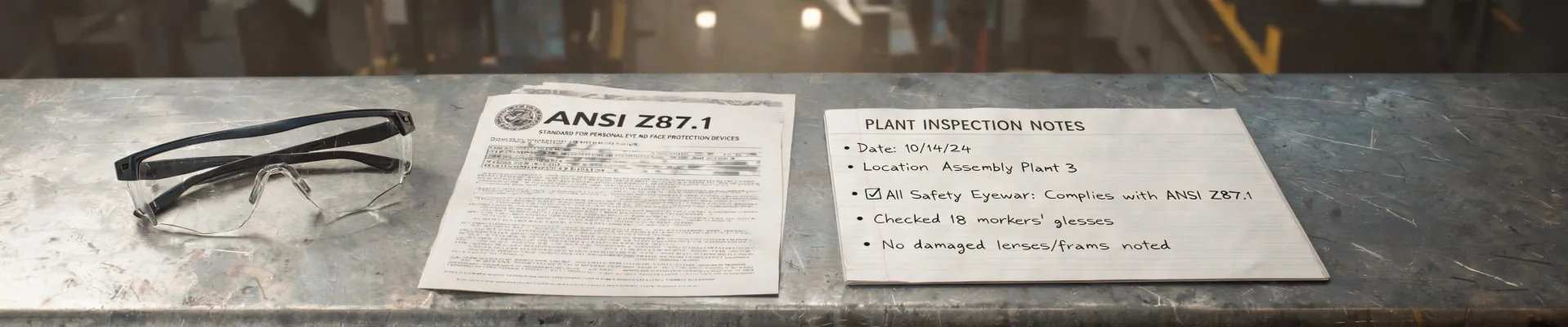
In the U.S., industrial safety eyewear should meet ANSI/ISEA Z87.1-2020. For high-impact tasks, look for impact-rated markings on both frame and lens. Ballistic-rated products may carry additional specifications depending on the contract.
The same per-use thinking applies beyond eyewear:
- Earplugs: The best earplug is the one that stays in. Disposable foam is fine for occasional use. For daily eight-hour wear, a moldable or banded plug can reduce irritation and replacement cost. Compare cost per wearing, not cost per box.
- Coveralls: A $12 pair of coveralls that tears after one job can cost more than a $28 pair that survives 10 washes. But not every job needs the heavy-duty option. Match material and seam strength to the actual exposure. Also confirm whether disposal is required; that changes the equation completely.
Can you use nitrile gloves for cooking?
Every few months, a PPE order includes the same side question: Can you use nitrile gloves for cooking? It usually comes from someone who grabbed a box that didn't say food-safe. Here's the straight answer: Only use nitrile gloves for cooking if the box is labeled food-safe. If a glove is label-free, made for automotive or chemical work, or has touched solvents, it doesn't belong around food. Even food-grade nitrile gloves are single-use. The cost of cross-contamination is not worth getting clever.
Scenario C: It's a replacement, a visitor pair, or a test — don't overthink it
Not every decision needs a TCO spreadsheet. If you just need one pair for an insurance auditor visiting the plant, the right move is a basic ANSI Z87.1-rated pair that fits a wide range of faces. Overbuying there is as much a cost mistake as underbuying in Scenario B.
The key is not to let a one-off purchase set your whole PPE policy. That's how companies end up with a drawer full of one-size-fits-none glasses and no budget left for the prescription pair the operator actually needed.
If you're testing one frame before ordering more, treat it like a pilot. Have two or three people wear it for a week. Ask about fit with hearing protection, hard hats, and coveralls. If you're replacing a lens or temple in an existing frame, the fastest fix may beat a new product purchase. At least, that's been my experience with frames that have replaceable parts.
Which scenario are you in? A 90-second check
When I get a call, I ask three questions. They'll tell you almost everything.
- What happens if this order doesn't arrive by the date on your calendar? If the answer involves a penalty clause, a rescheduled audit, or a stopped job, you are Scenario A. Stop comparing prices and start verifying physical stock and delivery time.
- Will the same people use this gear repeatedly for a year or longer? If yes, you're in Scenario B. Compare per-wear cost, availability of replacement parts, and warranty support before you look at the invoice.
- Is this a one-time need or a small trial? If yes, keep it simple and keep a note. A visitor pair should not trigger a warehouse-scale order.
If you're stuck between two scenarios, handle the urgent one first, then go back and optimize the long-term one. Nothing in this business is more expensive than mixing those priorities.
I still remember the day a customer picked the lowest quote on an order of coveralls and earplugs. The gear arrived four days late, after the project had paid for temporary replacements at retail prices. The initial savings was about $60. The overtime, courier fees, and management time ran past $700. That's not an argument against being cost-conscious. It's an argument for counting the full cost.
So whether you're considering wiley x profile safety glasses, wiley x military glasses, hearing protection, coveralls, or even a box of food-safe nitrile gloves, start with the situation. Then calculate the real cost. The right choice will usually make itself clear.

Maeve Callahan
Maeve Callahan is a head-protection analyst covering Type I and Type II hard hats, climbing-style safety helmets, bump caps, chin straps, suspensions, liners, and face-shield carriers. She applies ANSI Z89.1, EN 397, and EN 12492 criteria while comparing impact attenuation, penetration resistance, lateral deformation, electrical class, retention strength, field of vision, mass, fit range, and temperature conditioning. Her guides help EHS teams, contractors, utilities, and buyers select helmet systems for overhead hazards, work at height, electrical exposure, accessory compatibility, and worker acceptance.