When I took over purchasing for our company in 2020, I figured the main skill I needed was price comparison. Take the request, find the cheapest supplier that matched, order enough, move on. I was wrong. What actually matters is whether a product's certification matches the hazard. It took one chaotic week and a lot of wasted money to teach me that.
To give you context: I'm the office administrator for a 120-person security training and facilities company. I manage PPE purchasing across range operations, maintenance, and field teams—roughly $180,000 per year across 14 different vendors. I report to both operations and finance, so when protective gear underperforms, I hear about it twice.
The request that revealed the real problem
Last year, a simple restock request exposed how broken my old system was. The range coordinator needed Wiley X ballistic sunglasses for four new instructors before their Monday training block. The maintenance lead wanted to order the Studson hard hat model we had used before. A renovation crew needed N95 masks in a hurry, and somebody had already googled n95 mask near me. Meanwhile, a new trainee asked a question that should have been easy: what is a ballistic helmet?
At the time, I treated those as four separate purchasing errands. File one order, check the price, file the next. It felt manageable. But the real problem wasn't the list. It was that our company had no shared understanding of what the PPE was supposed to do or what standards it had to meet. We were ordering products by name, not by requirement.
What I missed about PPE purchasing
When I first started buying PPE, I assumed a product that looked tough was tough. Dark frames, heavy lenses, tactical styling—surely that equals protection? Actually, no. Protective is only meaningful when a product is tested against a specific hazard and passes. Otherwise it's a piece of clothing claiming to be safety gear.
The key is the standard. Here is how I think about it now.
Eye protection: military sunglasses and ballistic eyewear
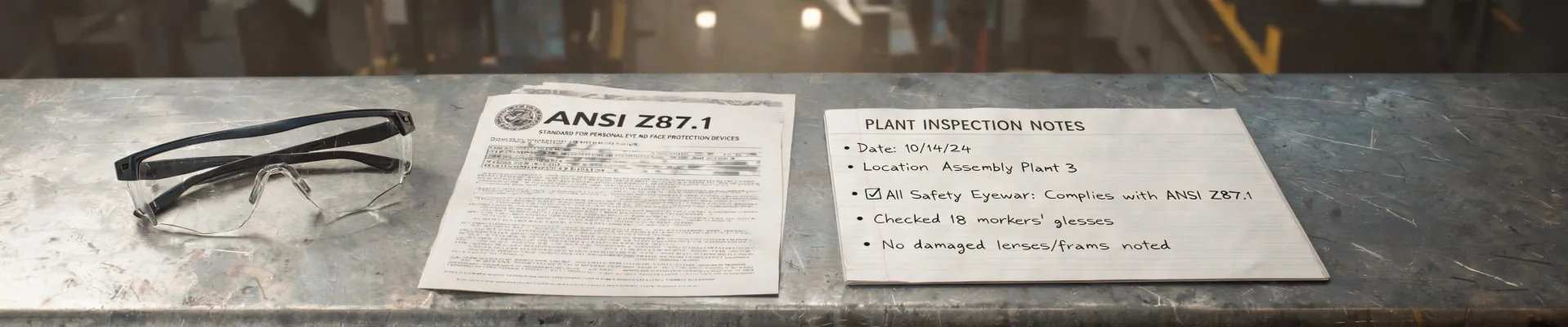
Our range instructors often ask for Wiley X military sunglasses, because many of them wore Wiley X products in service. I get it: the style and heritage matter. But when I place a B2B order, I care about the certification, not the image. What makes an eyewear product suitable for range work is whether it meets an impact standard like ANSI Z87.1 and whether the manufacturer documents that performance openly.
When I order Wiley X ballistic sunglasses for our range staff, I check the model's protection rating the same way I would check a hard hat's rating. These are not fashion accessories. They are impact-rated eye protection whose labels describe what they can withstand. I also make sure the team knows the difference between a safety spectacle and a ballistic lens—and I don't use the word bulletproof anywhere near an order, because no eyewear product should be sold on that kind of promise.
Head protection: hard hat or ballistic helmet?
A few weeks ago, a new trainee asked me, totally seriously, what is a ballistic helmet? It's not a stupid question. A ballistic helmet is head protection designed and tested against projectile and fragmentation threats under military or law enforcement standards. A hard hat, by contrast, is designed and tested for workplace hazards like falling objects, bumps, and limited electrical exposure. They are not interchangeable. Telling a site crew they can wear a ballistic helmet instead of a hard hat is as wrong as telling a security team to wear a hard hat on a range.
That distinction matters when you order a Studson hard hat for construction tasks. We use them because the crew finds them comfortable and reliable. But I still confirm that the model meets the relevant impact standard and has visible production dating. The label, not the brand name, is what makes it safe.
Respiratory protection: n95 mask near me is a red flag
The phrase n95 mask near me makes me wince now. Usually it means an urgent need was not planned, and urgency is exactly when people grab whatever is closest. The problem is not the product category. The problem is that searching is not the same as verifying. If you buy an N95 mask without confirming the NIOSH approval marking, you might be buying a mask-shaped item with no performance guarantee.
A real N95 respirator carries specific markings, and the packaging should have a lot number. I need to know what it filters, how well, and whether the compliance side of our company will accept it. When one supplier could not produce that documentation, our finance department would not pay the invoice, and the order had to be scrapped. That is a direct chain: missing paperwork becomes a missing shipment.
What it actually costs to get this wrong
In March 2023, I learned that hidden costs show up long before anyone gets hurt. A facility emergency sent a renovation crew into a dusty crawlspace, and I was asked to get N95 masks quickly. The onsite lead had already typed n95 mask near me into a search bar and sent me a screenshot. The nearest listing had boxes in stock and a low price, so I authorized the purchase to save time.
When the shipment arrived, the label had no NIOSH approval number and no lot traceability. We quarantined every box and wrote off about $2,100. Worse, the crew lost a day while I ordered replacements from our regular, documentable supplier. The cheap local option ended up costing money, time, and trust.
The same lesson applies to eye protection. An instructor once brought his own tactical sunglasses from an outdoor retailer. They looked right: dark frame, tight fit, aggressive styling. But they had no impact rating marking on the lens, so we told him not to use them on our range. That was a hard conversation because he thought he had bought protection. The hidden cost isn't the invoice. It's the moment a person believes they are protected when they are not. That false sense of safety is more expensive than any eyewear purchase, because it sits behind an incident that should have been prevented.
Transparency is the procurement strategy
Because of these mistakes, I have become a pain in the neck about certifications and total cost. I now ask every new vendor two questions. The first is obvious: what is the price? The second is more valuable: what is NOT included? Rush fees, split shipments, missing paperwork, replacement lenses—the listed product price is only the beginning.
I've learned to ask what's NOT included before I ask what's the price. The vendor who lists all fees upfront, even when the total looks higher, usually costs less in the end.
A vendor that lists everything up front probably costs less over the full lifecycle of the order. I have seen this pattern enough times to trust it. The cheaper quote that arrives without specs, without a certificate, and without an invoice system costs more in reorders, delays, and employee confidence.
This is why I came around to paying for transparent, documented, verified products. Wiley X ballistic sunglasses are not the cheapest eye protection on the market. But the certification is clear, the product documentation is available, and the total cost is predictable. For a company that needs the same gear week after week, that kind of transparency is worth real money.
What our purchase process looks like now
I cannot eliminate urgent requests. But I have built a process that handles them without starting from zero.
- Define the hazard before naming a product. Falling objects, projectiles, dust, impact—the threat decides the standard.
- Select against the standard. For eyewear, check ANSI Z87.1. For hard hats, confirm the relevant industrial impact rating. For respirators, verify NIOSH approval. For ballistic protection, match the gear to the actual threat level.
- Buy from a pre-approved vendor who shows the total cost and provides documentation. If they cannot supply that, they do not get the order.
- Keep a small stock of authorized substitutes so nobody has to search n95 mask near me during an emergency.
Now when the range coordinator asks for Wiley X ballistic sunglasses, I already know the SKU, the rating, and the vendor in the system. When the maintenance lead needs a Studson hard hat restock, I do not start from a blank spreadsheet. I check inventory, confirm the model, and place the order against an established agreement.
Looking back, I should have built this system before the emergency, not after. But once you start looking at the full cost of a PPE order—certification, documentation, delivery, liability—you rarely go back to shopping by price alone. It is not about trusting a brand. It is about trusting the evidence behind it. And if anyone asks you what is a ballistic helmet, the honest answer is that it is rated for a completely different threat than the hard hat hanging next to it. Knowing the difference is where good PPE buying starts.

Maeve Callahan
Maeve Callahan is a head-protection analyst covering Type I and Type II hard hats, climbing-style safety helmets, bump caps, chin straps, suspensions, liners, and face-shield carriers. She applies ANSI Z89.1, EN 397, and EN 12492 criteria while comparing impact attenuation, penetration resistance, lateral deformation, electrical class, retention strength, field of vision, mass, fit range, and temperature conditioning. Her guides help EHS teams, contractors, utilities, and buyers select helmet systems for overhead hazards, work at height, electrical exposure, accessory compatibility, and worker acceptance.