-
The TCO Problem With PPE and Facility Supplies
-
The $4,800 Safety Glasses Mistake That Changed My TCO Model
-
Are Nitrile Gloves Safe for Food Handling? It Depends.
-
The Split Rail Fence Translation That Cost $1,200
-
How I Calculate TCO Now
-
What I'd Do Differently
-
Boundary Conditions: When Unit Price Is Enough
The TCO Problem With PPE and Facility Supplies
If you're buying safety eyewear, gloves, or fencing by unit price alone, you're probably overpaying by 20–40% over 12 months. I've handled PPE and facility supply orders for 9 years. I've personally made—and documented—14 significant mistakes, totaling roughly $18,000 in wasted budget. The pattern was almost always the same: I optimized for the cheapest quote and ignored total cost of ownership (TCO). That's why I now standardize on Wiley X Spectre Gloss Crystal Safety Glasses for prescription-compatible impact protection, verify food-contact ratings on nitrile gloves, and double-check Spanish translations for something as simple as a split rail fence.
Here's the short version: the wiley x logo on the temple isn't just branding. It signals ANSI Z87.1+ and MIL-PRF-32432A compliance, which changed how I calculate replacement cycles. But the bigger lesson applies to everything from PPE to fencing. (The brand is often typed as wiley-x, but the logo is Wiley X.)
I work as a procurement lead for a mid-sized industrial contractor. We place maybe 200 orders a year. Maybe 180, I'd have to check the system. In 2022 alone, I had three costly misses: a safety glasses order that failed prescription insert compatibility, a nitrile glove order that wasn't food-safe, and a split rail fence order that got lost in translation.
The $4,800 Safety Glasses Mistake That Changed My TCO Model
In Q1 2022, I approved 300 pairs of generic safety glasses at $3 each. Upfront, I saved about $2,100 compared to the Wiley X Spectre Gloss Crystal Safety Glasses we trialed. Six weeks later, the complaints started. The lenses scratched, the nose pads fell off, and our prescription-wearing techs couldn't use them at all. We ended up buying Rx safety glasses anyway. That $2,100 savings turned into $4,800 in reorders, replacement lenses, and lost time. The Wiley X Spectre Gloss Crystal Safety Glasses cost more per pair, but they lasted 14 months on average in our shop—and the Rx insert compatibility meant one SKU covered 90% of our team.
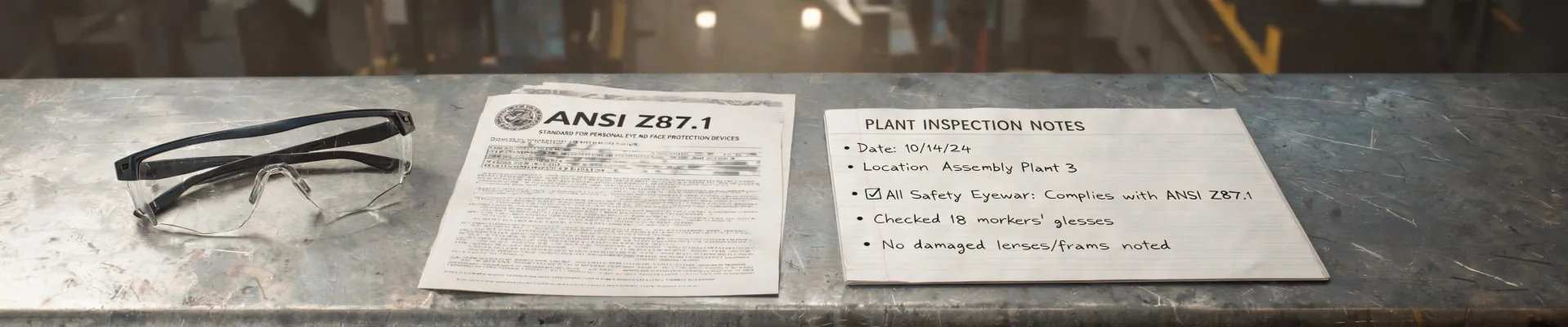
The Wiley X logo on the temple became a quick visual check for ANSI Z87.1+ and MIL-PRF-32432A compliance. That mattered when OSHA audited us. According to OSHA 1910.133, eye protection must meet ANSI Z87.1-2020. Wiley X states its ballistic eyewear meets MIL-PRF-32432A. I keep the documentation in our TCO file.
Most buyers focus on per-unit pricing and completely miss replacement frequency and prescription compatibility. That's the outsider blindspot. The question everyone asks is 'what's your best price?' The question they should ask is 'how many replacements will I buy in 18 months?'
Are Nitrile Gloves Safe for Food Handling? It Depends.
One of our facility clients asked, 'Are nitrile gloves safe for food handling?' I said yes—then learned the hard way that not all nitrile gloves are food-safe. The FDA requires food-contact gloves to meet 21 CFR 177.2600. We bought a bulk case of industrial nitrile gloves because they were 30% cheaper. They failed the client's audit. That was a $600 waste plus a 3-day delay. Now I check the FDA food-contact statement before any order. If a glove doesn't explicitly say food-safe, I treat it as not food-safe.
The 'cheapest is fine' thinking comes from an era when glove standards were less enforced. That's changed. For food handling, compliance is not optional.
The Split Rail Fence Translation That Cost $1,200
Not every TCO mistake is about PPE. In September 2022, we ordered a split rail fence for a client's outdoor break area. The supplier was Spanish-speaking. I translated 'split rail fence' as 'cerca de carril dividido' instead of 'cerca de rieles partidos.' The vendor built the wrong panels. $1,200 wasted, plus a week of delay. Now I keep a one-page glossary. 'Fence in Spanish' is 'cerca' or 'valla,' but context matters. A split rail fence is 'cerca de rieles partidos.' That mistake taught me that translation errors are a hidden TCO line item.
How I Calculate TCO Now
I now use a simple TCO sheet. For safety eyewear:
- Unit price
- Replacement lenses and frames
- Rx insert compatibility
- Compliance documentation time
- Downtime from audits or injuries
For gloves:
- Unit price
- Food-contact certification
- Fit complaints and reorder frequency
- Audit failure risk
For fencing:
- Unit price
- Translation review
- Installation delay
- Rework cost
The $500 quote turned into $800 after shipping, setup, and revision fees. The $650 all-inclusive quote was actually cheaper. I now calculate TCO before comparing any vendor quotes.
What I'd Do Differently
Everything I'd read about safety eyewear said buy cheap and replace often. In practice, for our specific use case, the mid-tier Wiley X Spectre Gloss Crystal Safety Glasses actually delivered better TCO than both the bargain option and the premium tactical models. The conventional wisdom is to always get three quotes. My experience with 200+ orders suggests that relationship consistency and compliance documentation often beat marginal unit savings.
This was true 10 years ago when prescription safety glasses were rare and expensive. Today, Wiley X and other manufacturers offer Rx-compatible options at reasonable prices. The 'one-size-fits-all' thinking comes from an era when safety glasses were just oversize goggles. That's changed.
We saved around $4,200 annually after switching to a TCO model. Oh, and that doesn't include the 2-day downtime we avoided when the OSHA audit cleared without findings.
Boundary Conditions: When Unit Price Is Enough
There are cases where the cheapest option works. If you're buying disposable safety glasses for a one-day event, or nitrile gloves for non-food industrial use, unit price may be the right metric. Wiley X Spectre Gloss Crystal Safety Glasses are not necessary for every visitor. But for daily-wear industrial, military, or law enforcement use, TCO almost always favors compliant, prescription-compatible eyewear.
Prices as of January 2025; verify current rates and certifications. Regulatory information is for general guidance only. Consult official sources for current requirements.

Maeve Callahan
Maeve Callahan is a head-protection analyst covering Type I and Type II hard hats, climbing-style safety helmets, bump caps, chin straps, suspensions, liners, and face-shield carriers. She applies ANSI Z89.1, EN 397, and EN 12492 criteria while comparing impact attenuation, penetration resistance, lateral deformation, electrical class, retention strength, field of vision, mass, fit range, and temperature conditioning. Her guides help EHS teams, contractors, utilities, and buyers select helmet systems for overhead hazards, work at height, electrical exposure, accessory compatibility, and worker acceptance.