-
Start With Risk: Sort Your Site Into One of Three Scenarios
-
Scenario A: Indoor Shop Work → Wiley X Guard Advanced Safety Glasses
-
Scenario B: Outdoor or Dual-Hazard Work → Wiley X SG-1 Tactical Goggle + Klein Hard Hat
-
Scenario C: High-Risk Impact or Splash → Bionic Face Shield Over Your Eyewear
-
The Hands Question: Is Nitrile Gloves Latex Free?
-
How to Determine Which Scenario You're In
-
The Bottom Line
I manage procurement for a 180-person industrial services company. Our annual PPE spend sits around $42,000, and I've tracked every dollar of it for the past six years, negotiating with more suppliers than I care to count. That's a lot of safety glasses, hard hats, face shields, and gloves. It's also a lot of mistakes. Let me save you the ones I made.
Here's the thing: there is no universal "best" safety eyewear. Anyone who says otherwise is selling you something. The right product depends on what your workers actually face during a shift. Get it wrong, and you're either under-protecting people or burning budget on gear they don't need.
Start With Risk: Sort Your Site Into One of Three Scenarios
Before you open any catalog, put your environment into one of these buckets:
- Scenario A — Indoor debris work. Assembly, machining, carpentry, warehouse. The threats are chips, dust, and dropped objects.
- Scenario B — Outdoor or dual-hazard work. Construction, utilities, landscaping, tactical. Sun, wind, dust, plus impact risk.
- Scenario C — High-risk impact or splash. Grinding, cutting, chemical handling. Flying fragments and liquids that can reach the face.
Each bucket has a different cost-effective answer. The worst thing you can do is treat them all the same.
Scenario A: Indoor Shop Work → Wiley X Guard Advanced Safety Glasses
Let me tell you about a mistake from 2022. We needed safety glasses for our workshop crews, so I ordered 300 pairs of the cheapest bulk option I could find. Unit price looked great. Total cost looked great. Then reality hit: the lenses scratched within days, they fogged up constantly, and workers stopped wearing them. Unworn safety glasses protect nobody.
That order should have lasted a year. I was rebuying within four months, close to $3,400 spent, plus the hours of handing out replacements. I still kick myself for not doing that math upfront.
Standard stuff? Maybe. But here's the shift worth making: we moved to the Wiley X Guard Advanced safety glasses. They cost around $18 a pair in volume, but the frame holds up, the wrap-around lens keeps debris out of the corners, and most of the crew has been on the same pair for over a year. Do the TCO math once and this switch becomes a no-brainer.
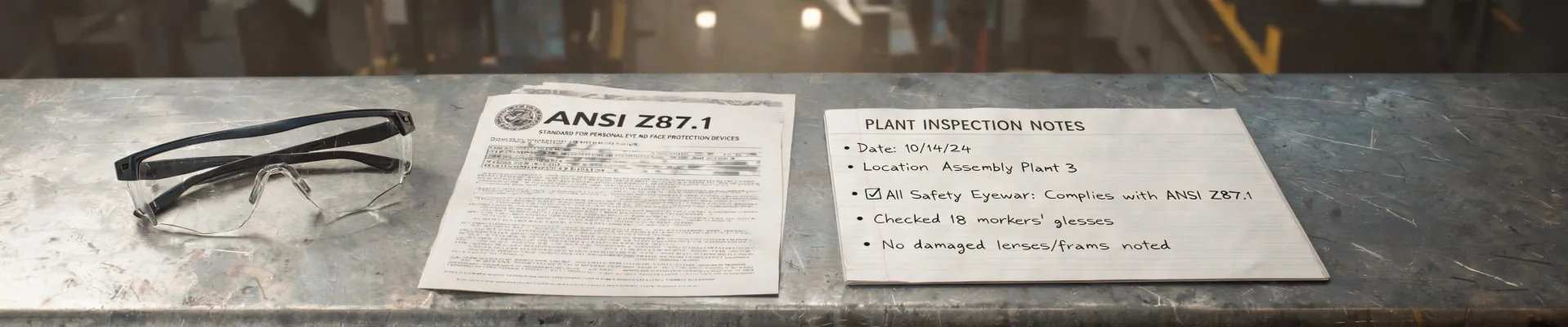
The Guard Advanced is rated to ANSI Z87.1, which is the impact standard that actually matters in a workshop. A lens that won't shatter, a frame that survives being dropped, and workers who keep them on. That's the combo.
Scenario B: Outdoor or Dual-Hazard Work → Wiley X SG-1 Tactical Goggle + Klein Hard Hat
When crews move between sun, wind, dust, and rough terrain, standard glasses leak at the edges. Dust sneaks in, eyes dry out, and the natural reaction is to take the glasses off mid-task. That's exactly when a foreign object finds your eye.
The Wiley X SG-1 tactical goggle fixes the seal problem. It locks tight around the eyes with an elastic strap, holds an impact-rated lens, and offers polarized options if glare is your crew's daily enemy. Watching someone squint through ten hours of bright sun tells you everything about why polarization matters — they keep the gear on instead of stashing it in a pocket.
Over the head goes a Klein hard hat. Klein's head protection line is solid, with polycarbonate shells and dielectric models for electrical work. But there's a date stamp inside every shell for a reason. Most manufacturers recommend replacing hard hats five years after the date of manufacture; UV exposure and temperature swings can degrade the shell faster.
Here's my hard-learned lesson: in Q3 2024, we almost failed an audit because I never checked date stamps on a shelf of hard hats. We'd used the same reliable supplier for years. What are the odds? The odds caught up with me. Three expired shells, sitting there waiting for an inspector.
Five minutes to check. That's it. Now every new shipment gets a log entry with the manufacturing date. Red flag avoided.
Scenario C: High-Risk Impact or Splash → Bionic Face Shield Over Your Eyewear
For grinding, cut-off work, chipping, or chemical splash, you need face protection on top of eye protection. That's where the Bionic Face Shield fits.
It covers the whole face, mates with a hard hat, and the visor is replaceable. But listen: a face shield is secondary protection. ANSI Z87.1 treats it that way, and so should you. It deflects the big chunks; the impact-rated glasses underneath catch the small stuff that slips around the edges.
A face shield is not a substitute for safety glasses. Ever.
We deployed the Bionic Face Shield after a near-miss on a grinding job, when a cut-off wheel failed and sent fragments across the shop. Nobody was hit. Luck, not planning. Each station now has a shield, roughly $45 per unit with spare visors. That's a price I'll pay every time.
The Hands Question: Is Nitrile Gloves Latex Free?
Every PPE conversation eventually lands on hands, and the question I hear most: is nitrile gloves latex free?
Yes. Nitrile is a synthetic rubber. It doesn't contain the natural latex proteins that trigger allergic reactions. For anyone with contact dermatitis or a developing sensitivity, OSHA and NIOSH point toward eliminating latex products and switching to nitrile. That's the standard.
Nitrile runs 1.5 to 2 times the cost of latex, but one case of occupational dermatitis can erase years of glove savings in claims and lost time. The "latex is the default" thinking comes from an era when synthetic alternatives were limited and pricey. That's changed. We use nitrile across chemical handling and maintenance crews, and I don't lose any sleep over the line item.
How to Determine Which Scenario You're In
Here's a test I use before buying for a new site. Ask: what would actually hit a face on the worst believable day?
- Sawdust, small chips, or a bounced hand tool → Scenario A. The Wiley X Guard Advanced is your answer.
- Sun glare, wind-blown dust, overhead risk → Scenario B. Wiley X SG-1 tactical goggle plus a Klein hard hat.
- Grinding sparks, shattered wheel fragments, chemical splash → Scenario C. Bionic Face Shield layered over impact-rated eyewear.
If you're not sure, walk the floor for half an hour. Watch how close faces get to the work, and whether the gear you already bought is actually on anyone. That observation beats any spec sheet.
The Bottom Line
Buying PPE comes down to matching protection to real risk, and replacing "cheap enough to rebuy" with "good enough to keep." The Wiley X family covers the eye and face spectrum well: the Guard Advanced for shop-floor impact, the SG-1 for outdoor and tactical work, and the Bionic Face Shield layered on top when things get dangerous. Klein covers the head. Nitrile covers the hands.
Build the kit around the work you actually do. Your people stay safe, your budget survives contact with the auditor, and you won't be explaining an expired shell to anyone. Done.

Maeve Callahan
Maeve Callahan is a head-protection analyst covering Type I and Type II hard hats, climbing-style safety helmets, bump caps, chin straps, suspensions, liners, and face-shield carriers. She applies ANSI Z89.1, EN 397, and EN 12492 criteria while comparing impact attenuation, penetration resistance, lateral deformation, electrical class, retention strength, field of vision, mass, fit range, and temperature conditioning. Her guides help EHS teams, contractors, utilities, and buyers select helmet systems for overhead hazards, work at height, electrical exposure, accessory compatibility, and worker acceptance.