Let me start with the scene that made me stop buying cheap safety glasses.
We were on a two-week shutdown at an automotive plant. One of our techs was cutting a seized bolt with an angle grinder when the cutoff wheel shattered. A piece of debris hit his lens dead center. The lens didn't break, but the scratch looked like a spiderweb. He tossed the glasses in the trash and said, 'Good thing I closed my eyes.'
I laughed at the time. Later, I realized he shouldn't have had to close his eyes.
I'm the Procurement Guy
I'm a procurement manager at a 140-person industrial maintenance company. I've managed our safety equipment budget, about $180,000 a year, for eight years now. I've compared quotes from dozens of vendors and built spreadsheets that would bore a CPA.
And for the first few years, I bought the cheapest safety glasses our supply catalog had.
My logic was simple. Safety glasses are a disposable PPE line item. They get lost. They get scratched. They get left on dashboards. So why spend $80 on something designed to be replaced?
That logic held up until the cutoff wheel incident. And then it fell apart completely.
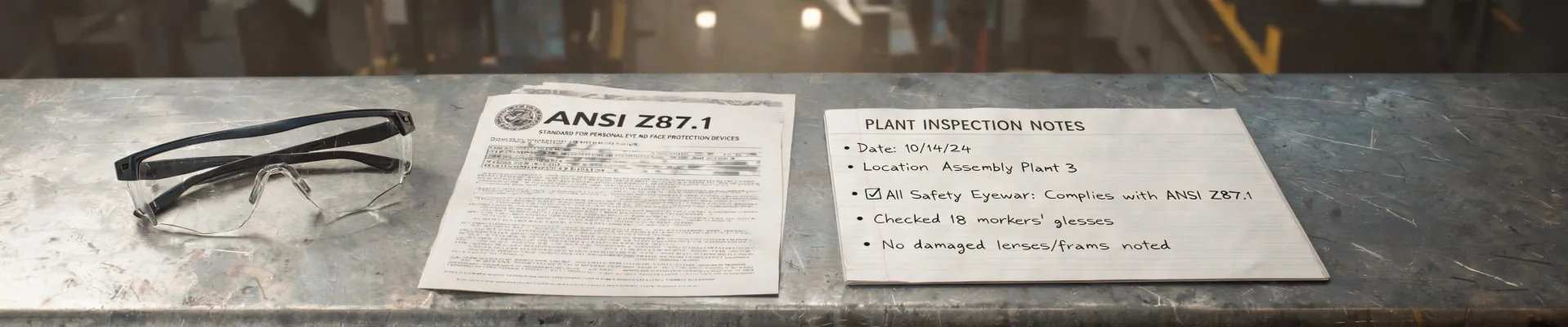
When I first took over this role, I assumed every ANSI-rated pair gave the same protection. I thought Z87.1 was Z87.1, full stop. I'm not a safety engineer, I'm the guy who signs POs. If a pair of glasses had the right marking, I checked the price column and moved on.
It turns out the markings can mean very different things.
According to OSHA's eye and face protection standard (29 CFR 1910.133), employers must provide eye protection when there's a reason to expect flying objects, hazardous liquids, or harmful light. ANSI/ISEA Z87.1 is the most common consensus standard used to show compliance. And within that standard, a Z87+ mark means the product passed high-impact testing, not just the basic impact test.
Basic impact. High impact. That distinction didn't matter to me until a piece of cutoff wheel was moving at enough speed to pit a lens.
The Bid That Made Me Reconsider Everything
In Q2 2024, we had to re-kit 60 field technicians after we picked up a new industrial contract. The client's safety department required high-impact eye protection on their floors. I did what I always do. Sent an RFQ to six suppliers, compared unit prices, and ranked them.
The lowest quote was $4.10 per pair. They came in a bulk box. No packaging, no replacement parts, no documentation about impact rating beyond 'ANSI Z87.1.'
I was about to get approval when our safety manager looked over my shoulder and said, 'You're going to buy those?'
'They meet the spec,' I said.
He didn't try to change my mind. He just handed me a pair of his own glasses. They were Wiley X. I'd heard the name before because our military-trained site leads used them, but I'd written them off as a brand premium.
Then I noticed the lens on his pair was photochromic.
I had no idea Wiley X made photochromic safety glasses. We spend a lot of time moving between outdoor lots and dark machine bays. Half of our guys would wear clear glasses indoors and swap out to sunglasses when they went outside, or more often, just keep them on and squint. The idea of one pair that changes tint automatically was something I associated with $200 ski goggles, not industrial PPE.
That night, I went to the Wiley X official website. I expected a marketing wall. What I found was a catalog of certified eye protection, replacement lenses, prescription options, and a dealer locator. I also found that many of their models are certified to military impact standards, which I didn't know existed for commercial eyewear.
I searched 'wiley x safety glasses near me' and found a distributor about twenty minutes away. Our safety manager and I took a trip. We tested half a dozen pairs. We had a tech with a strong prescription try an RX insert. We asked about replacement parts and warranty support. That visit cost me an afternoon and probably saved us from a very expensive mistake.
While we were at the distributor, I also got a quote on insulated coveralls for men for the winter shutdown crew. The sales rep didn't just pitch gear. She asked what our crew does when they're outside in 10-degree weather. That conversation stuck with me because it reminded me that PPE is a system. A guy with freezing hands doesn't adjust his eyewear. A guy rushing through outdoor work in bad gear isn't focused on the hazard in front of him. All the high-impact lenses in the world don't matter if the person wearing them is just trying to get through the shift.
The Cost Calculation I Should Have Done Years Ago
I've learned to ask 'what's NOT included' before I ask 'what's the price.' That's where hidden cost lives.
Yes, the Wiley X quote was higher than the $4.10 import. But once I put the numbers into a three-year total cost model, the true gap narrowed a lot.
- Cheap glasses in our environment lasted about 3 months before the lenses scratched enough to cause complaints.
- We lost or had technicians abandon at least 15 percent of them during the first 6 months.
- No replacement program. If a lens got pitted, the whole pair got thrown out.
- The Wiley X option included replaceable lenses, anti-fog choices, and a warranty.
- The photochromic version cut down on the outdoor/indoor swapping and the complaints that came with it.
When I ran the real math, the cheap option was about $16.40 per worker per year in replacement costs. The Wiley X worked out to roughly $34.50 per worker per year over the first two years, if you ignored the fact that the cheap ones were more likely to be left at home after one bad experience.
I ignored that fact for years.
The bigger cost wasn't the lost pairs. It was the near-miss I watched happen. A pair of decent glasses costs less than one trip to urgent care. In our workers' comp experience modifier, that trip would show up for three years and raise our premium. One incident would have covered the entire cost difference for the whole crew.
The Same Lesson About Nitrile Gloves
About a week after the distributor visit, a junior buyer asked me, 'Can I use nitrile gloves for cooking?' It seemed like a tangent. But it's actually the same lesson.
Nitrile gloves are great for certain tasks, like chemical exposure, cleaning cables, or handling oils. They are not designed for heat. Nitrile degrades at high temperatures, and unless the gloves are explicitly certified food-grade for kitchen use, you shouldn't assume they're safe for cooking. Just because a product is a glove doesn't mean it's right for every job.
That's how I now think about safety glasses. Just because a lens has 'ANSI' stamped on it doesn't mean it's right for every hazard. You have to match the tool to the task, the environment, and the human wearing it.
The Outcome
We made the switch in July 2024. I won't pretend every tech was thrilled at first. Some grumbled about the higher price and the snug fit. But after the first outdoor day, the photochromic pairs earned their keep. At the six-month mark, our eye protection replacement rate dropped by more than half. Nobody reported a scratched lens from a grinding spark hitting it.
I also didn't cut the insulated coveralls line item. That winter, our guys had warm jobsite outerwear and eye protection that actually stayed on. For the first time in years, I didn't get an end-of-year pile of complaints about PPE being a nuisance.
What I'd Tell Another Cost Controller
- Don't buy on unit price alone. Ask about replacement lenses, warranty, and whether the product fits the real hazards.
- Check the fine print. A Z87.1 mark is not the same as a Z87+ high-impact mark.
- If a brand has a military reputation, find out why. In Wiley X's case, that reputation comes from meeting ballistic impact standards for tactical use, not from a marketing budget.
- Test the gear before you scale. I spent years comparing paper specs and zero time watching a real technician use the glasses.
I still kick myself for not doing this sooner. The cutoff wheel incident could have been the one that ended in a lost eye. It wasn't. But I've been doing this job long enough to know that 'I got lucky' is not a procurement strategy.
If you're comparing safety eyewear, start with the specs, not the price column. Or better yet, go to the Wiley X official website, find a local dealer, and put a pair on a technician. The total cost becomes much clearer once you see what they're actually up against.

Jane Smith
I’m Jane Smith, a senior content writer with over 15 years of experience in the packaging and printing industry. I specialize in writing about the latest trends, technologies, and best practices in packaging design, sustainability, and printing techniques. My goal is to help businesses understand complex printing processes and design solutions that enhance both product packaging and brand visibility.