-
What This FAQ Covers
-
The Questions and My Answers
-
1. Are Wiley X ballistic glasses worth the price premium?
-
2. What does "Wiley X safety" actually mean in the specs?
-
3. Should I buy polarized Wiley X safety glasses or stick with clear?
-
4. Can you use nitrile gloves for cooking?
-
5. What men's leather gloves are worth putting in the PPE budget?
-
6. Do I need safety glasses when applying fence stain?
-
7. Can I get Wiley X safety glasses with a prescription?
-
1. Are Wiley X ballistic glasses worth the price premium?
What This FAQ Covers
I'm a procurement manager at a 40-person construction and maintenance company. I've managed our PPE budget ($120,000 annually) for six years, negotiated with 20+ vendors, and tracked every order in our cost system. I don't want to sell you anything. I want to answer the questions that actually come up when you're buying Wiley X safety glasses for a team.
In this FAQ, I cover:
- Are Wiley X ballistic glasses worth the premium?
- What "Wiley X safety" means in spec sheets
- Polarized vs. clear lenses
- Can you use nitrile gloves for cooking?
- Men's leather gloves for fence work
- Do you need safety glasses for fence stain?
- Prescription options for Wiley X
One theme runs through every answer: price is not cost. The cheapest SKU often gets expensive after injuries, downtime, foggy lenses, or replacement orders.
The Questions and My Answers
1. Are Wiley X ballistic glasses worth the price premium?
Honestly, sometimes yes and sometimes no. That's why you compare the hazard to the rating before you compare price tags.
Wiley X ballistic glasses are built for projectile threats. Some models list a military ballistic spec, such as MIL-PRF-31013. That means the lens and frame were tested against high-speed fragments, not just a dropped bolt or a tool swinging into your face. If your crew works around heavy equipment, concrete, or any environment with flying particles, the extra cost is easy to justify. In October 2024, I compared five vendors for a demolition team using our total cost of ownership spreadsheet. The ballistic-rated pair was roughly $38 more per person per year than a basic pair once I counted replacement and downtime. That's a small number compared to one eye injury.
But if someone only needs to protect against paint drips or dust, a fully ballistic-rated model is overkill. Buy the rating to the hazard, not the most expensive spec. And when management asks why ballistic frames are in the budget, I show them the replacement history from Q2 2024: basic glasses broke at about twice the rate of the ballistic frames on the demolition crew. The price per month of usable eyewear was almost identical.
2. What does "Wiley X safety" actually mean in the specs?
It means a documented standard, not just the word "safety" printed on the box. It's tempting to think all safety glasses are the same because they look similar; the test standard is the difference. Our purchasing request forms used to say "Wiley X safety" as if every model were identical.
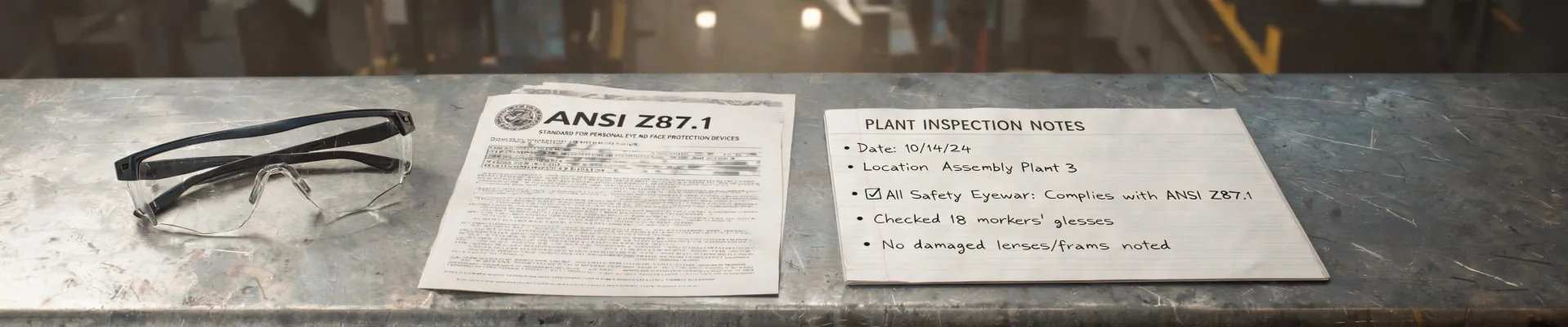
For most industrial and construction jobs, look for ANSI Z87.1-2020 on the frame or lens. If you need high-impact protection, check the marking and the model's data sheet. Wiley X also makes ballistic models with military test backing. The point is to make your vendor show you the compliance sheet before you approve the SKU. I keep a copy in our shared drive so the field supervisor can match the model number to the worker. As of 2025, this matters even more because some online marketplaces list "safety glasses" without a test standard.
Put another way: "Wiley X safety" is shorthand for eyewear that has passed a published impact test. The exact rating depends on the model. Don't assume one pair is identical to another just because the logo is the same.
3. Should I buy polarized Wiley X safety glasses or stick with clear?
I keep clear lenses for indoor tasks and polarized lenses on the vehicles that go outside. Polarized lenses cut glare from water, roads, snow, and sun, which honestly makes the last hour of an outdoor shift easier. They also help with quality work. For example, when a crew is applying fence stain, polarized lenses reduce the glare that hides skipped spots on wood.
In the summer of 2023, I put polarized Wiley X safety glasses on our fence-maintenance crew as a trial. The next week they finished an average of one more section per day, mostly because they stopped re-checking dry areas. The labor saving was maybe $600 that week, let me see, maybe a bit less, I'd have to pull the invoice. Either way, the polarized upcharge paid for itself. If someone is mostly indoors, clear lenses are fine. Don't buy polarized just because it sounds premium if your crew never sees glare. One other tip: for humid jobs, add anti-fog coating. A clear lens that fogs may be more dangerous than no lens, because the person will take it off.
4. Can you use nitrile gloves for cooking?
Yes, but only if the box is marked food-grade or food-safe. The nitrile gloves in a maintenance closet are not automatically the same as kitchen gloves. Industrial 6-mil nitrile may contain powders, dyes, or processing agents that don't belong around food.
So, can you use nitrile gloves for cooking? If the label says food-safe, yes. For the breakroom and prep kitchen, I keep a separate box of powder-free, food-grade nitrile gloves below the sink (not that it stops everyone from grabbing the wrong box, but it helps). We don't share, even when someone is "just mixing up a marinade." If the label doesn't say food-safe, don't use it for cooking. Also, don't use any nitrile near high heat; it melts. That sounds obvious, but a hot pan is how we ended up with a burned hand in our breakroom. And black nitrile is not automatically safer than blue; color is a supplier choice, not a standard. Two SKUs cost a little more. One safety incident costs a lot more.
5. What men's leather gloves are worth putting in the PPE budget?
For fence work, wood framing, and handling pressure-treated lumber, I recommend cowhide or pigskin leather gloves with a reinforced palm. They don't need to be expensive, but they need to be real leather.
I used to buy cheap woven gloves because the unit price was low. Then I replaced them every two weeks. From January to June 2022, our crew used fourteen pairs of those gloves. A reasonable pair of men's leather gloves cost about 3x more per pair but lasted close to two months. The price per hour of hand protection was lower with the leather, and there were fewer splinters.
Pair those gloves with eye protection. Leather handles the hand side; safety glasses handle the face side. A wire can't cut your hand through good leather, and a splinter can't reach your eye through a Wiley X lens. Neither is the place to cut corners. And don't buy heavily padded gloves for detail work; if the crew can't feel the framing square, the gloves will end up on the ground.
6. Do I need safety glasses when applying fence stain?
Yes. Fence stain looks like a low-risk job until a brush drips, a sprayer kicks back, or wind blows solvent into your face. In May 2023, one of our employees leaned too close to a power sprayer and took a face full of water-based wood stain. He wasn't hurt because he had clear Wiley X safety glasses on. And honestly, he said he almost took them off before lunch. That's the moment I made the rule: no staining, no spraying, no mixing, no exceptions.
For fence stain, you don't need dark tints. A clear lens with anti-fog or a light tint is usually enough. If you're spraying overhead, consider a model with side shields, and make sure the lens meets ANSI Z87.1. Regular sunglasses, even expensive ones, are not a substitute for a rated safety lens. If you're stripping old stain first, a tight-fitting goggle is a better choice for the chemical stripper; glasses handle dust, but a goggle keeps liquid splash out.
7. Can I get Wiley X safety glasses with a prescription?
Yes. Wiley X makes RX-ready frames, and you can choose between a prescription insert and custom safety prescription lenses. For employees who wear glasses all day, this is a requirement, not a perk.
My own prescription is about -3.75 in both eyes, checked in 2024. When I tried an insert in a Wiley X frame, the whole assembly felt heavy and the image wobbled at the edge. A custom lens fixed that. It cost more, but it also meant I didn't keep pulling the glasses off to look at my paperwork. From a procurement perspective, the budget cost of custom RX lenses is still lower than the cost of a person who avoids wearing eye protection because it's uncomfortable.
I put this in our purchasing policy: anyone who wears a prescription on the job gets prescription Wiley X safety glasses in their first week. The cheaper over-glasses option saves money in the short run and then ends up in a toolbox by Tuesday. Order a spare lens at the same time; scratched lenses get replaced on the first request instead of after a safety audit.

Maeve Callahan
Maeve Callahan is a head-protection analyst covering Type I and Type II hard hats, climbing-style safety helmets, bump caps, chin straps, suspensions, liners, and face-shield carriers. She applies ANSI Z89.1, EN 397, and EN 12492 criteria while comparing impact attenuation, penetration resistance, lateral deformation, electrical class, retention strength, field of vision, mass, fit range, and temperature conditioning. Her guides help EHS teams, contractors, utilities, and buyers select helmet systems for overhead hazards, work at height, electrical exposure, accessory compatibility, and worker acceptance.