-
What This Checklist Is For
-
Safety Glasses vs Safety Goggles: A 30-Second Refresher
-
The Checklist
-
1. Start with the hazard, not the product category
-
2. Check the standard mark, not the logo
-
3. Price the total cost, not the unit price
-
4. Test fit and comfort before you order 200 pairs
-
5. Check replacement parts and consumables
-
6. Write a justification line on the purchase order
-
7. Verify the vendor channel
-
1. Start with the hazard, not the product category
-
Common Mistakes I Still See (And Sometimes Make)
-
Final Thought
What This Checklist Is For
I'm the person who handles PPE orders for a mid-sized industrial contractor. I've been doing this for about eight years, and I've made—and documented—six significant mistakes that added up to roughly $32,000 in wasted budget. This checklist is the one I wish I had before my first order.
It's for anyone who buys eye protection for a crew: safety managers, facilities buyers, military supply folks, construction superintendents. It's especially useful when you're stuck on the 'safety glasses vs safety goggles' question, or when a quote looks too cheap to be true.
The short version: protection works only if the person actually wears it. And the cheapest option often isn't the least expensive one. Here's how I avoid the traps I hit.
Safety Glasses vs Safety Goggles: A 30-Second Refresher
Safety glasses have a glasses-style frame and usually side shields. They can be impact-rated, but they leave a small gap around the eye. Safety goggles sit against the skin and create a seal. That seal is what matters for splash, dust, and particles that can bounce behind a lens.
If you're grinding metal, high-impact safety glasses with side shields are often enough. If you're mixing chemicals or doing dusty demolition, goggles are usually the safer call. Some products, like Wiley X military issue sunglasses, sit in a hybrid category: they look like sunglasses and accept a removable foam gasket that makes the frame behave like a goggle. That is a real advantage for tactical or outdoor crews, but it also means you need to confirm the exact model and gasket. The brand name alone doesn't tell you what you're getting.
The Checklist
1. Start with the hazard, not the product category
I still see purchase requests that just say 'safety glasses.' That tells me almost nothing. Instead, I write the hazard next to the item:
Impact and flying debris → high-impact safety glasses with side shields. Chemical splash → sealed goggles with indirect vents. Dust storm or low visibility → goggle with an anti-fog lens. Bright outdoor work → sunglasses with UV and impact protection.
If you're not sure, walk the site before you order. A missing stair railing is a fall hazard, not an eye hazard, but it's a reminder to look at the actual task. If the crew is cutting that railing, you're dealing with metal chips. If they're spraying a fence, you're dealing with chemical drift. And here's a language detail I learned the hard way: 'fence' in Spanish isn't always the same word. A permanent property fence is cerca; a temporary construction fence is usually valla. Using the wrong term creates the same kind of gap as using the wrong PPE category: the intent and the order don't match.
2. Check the standard mark, not the logo
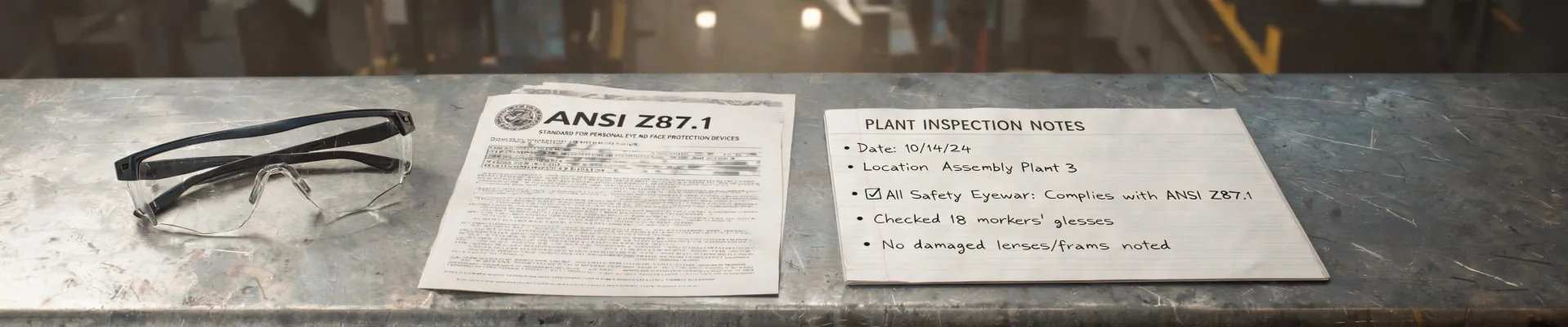
The logo does not protect the eye. The lens and frame do. For U.S. workplaces, I reference ANSI/ISEA Z87.1-2020 as of January 2025, and I specifically look for a Z87+ high-impact mark. For military or tactical purchases, I look for MIL-PRF-31013 or the applicable NSN, not just the word 'military.' If a purchase order calls for Wiley X military issue sunglasses, the box should identify the exact spec and the exact model.
Everything I'd read said a recognizable brand is the safe choice. In practice, I've found that a brand is only safe if you verify the model number and the marking. A logo is not a certification. I once put a 'military style' item on a PO because the photo looked like the real thing. It wasn't. When I checked our company Wiley X login portal, the model wasn't in the approved list. That order was stopped before shipping, but it cost me two weeks with the crew unprotected.
3. Price the total cost, not the unit price
My default answer to 'what's the cheapest?' is 'what does this cost per month of real use?' A $8 goggle that falls apart in three weeks is more expensive than a $28 goggle that lasts a year. That's not a premium-brand sales pitch; it's arithmetic.
I still kick myself for the time I picked a budget goggle over a Wiley X model because it was $12 cheaper per unit on a 150-pair order. The upfront savings looked great: $1,800. Then the foam started peeling, the lenses scratched, and the crew stopped wearing them. We replaced over a hundred pairs within six months, and we had a near miss because someone took off his damaged glasses during a grinding job. The $1,800 turned into a $3,100 loss and a safety report I had to explain.
I'm not saying every order needs the premium brand. I'm saying the lowest quote has to be evaluated with the cost of replacement, downtime, and non-compliance. In my experience, the lowest quote has cost us more in about 60% of cases. That number comes from my own order history, not an industry survey.
4. Test fit and comfort before you order 200 pairs
On paper, a lens can be perfect. In the field, a frame that digs into a guy's temple will end up on the truck seat. Then it's not protective equipment; it's a failed experiment.
Order samples. Have your actual crew wear them for a full shift. Ask about pressure points, compatibility with hard hats, and whether the strap is easy to adjust. For prescription safety glasses, make sure the insert doesn't push the lens too close to the eye. For outdoor crews, consider polarized lenses. For humid areas, anti-fog coating is not a luxury; it's what keeps the glasses on. I should have learned this after the fourth fogging complaint. I did not. I had to learn it after the fifth.
5. Check replacement parts and consumables
Eye protection is a durable product, but the consumables don't last forever. If you order a goggle, ask: Are replacement lenses available? What about the foam insert? The head strap? Can you buy a dark lens and a clear lens for the same frame?
For Wiley X, interchangeable lenses are one of the reasons I use them in certain programs. You can switch from clear to smoke to polarized without replacing the frame. That's useful. It also means you have to keep the right replacement parts in stock. A 'military issue sunglasses' program might have the frames but not the clear lens. That detail is what turns a good product into a shelf warmer.
6. Write a justification line on the purchase order
I started doing this after an audit where my line item said 'safety glasses' and the auditor asked 'for what task?' I didn't have an answer. Now every line has a one-liner. Example: 'Z87+ high-impact, anti-fog, low-profile frame to fit under a hard hat' or 'splash goggle, indirect vent, chemical mixing station.'
It takes a minute, and it forces you to think. If you can't write the reason, you probably haven't verified the spec. That one sentence has caught 47 potential errors in the past 18 months. It's not a paperwork exercise; it's a check on your own reasoning.
7. Verify the vendor channel
Marketplace photos are not spec sheets. If you need a genuine Wiley X product, or especially Wiley X military issue sunglasses, buy through an authorized channel. For contract buyers, that can mean using the supplier's login portal. In my case, the Wiley X login is the source I use to check approved models and current pricing. If a vendor can't produce a current, linkable product page and a spec sheet, I walk away. I've been burned twice by 'same product' listings that were not the same product.
Common Mistakes I Still See (And Sometimes Make)
I've been on both sides of these, so I keep them in the checklist during review:
- Calling every pair of eye protection 'safety glasses.' A goggle is not glasses. The safety glasses vs safety goggles decision comes down to whether the eye is sealed or not. Use the exact term and the exact spec.
- Choosing by brand alone. A Wiley X frame with a scratched lens is still a hazard. The checklist includes a lens replacement schedule, not just a brand preference.
- Ignoring language gaps on bilingual sites. If you're asking 'what is fence in Spanish' after an audit starts, you're already behind. Cerca is a permanent fence; valla is usually a temporary barrier. A stair railing is barandilla, not pasamanos, which is a handrail. The wrong word can send a worker to the wrong task or the wrong piece of PPE.
- Forgetting anti-fog until after the crew stops wearing the glasses. Add it to the spec, not to the complaint list.
Final Thought
No checklist catches everything. I still make mistakes, and I still learn from the expensive ones. But a written process makes the next order better. Take this list, adapt it for your team, and add your own failure notes. That's what makes a checklist useful: it's a map of what not to do, paid for by someone else's budget. Ideally mine, so you don't have to.

Maeve Callahan
Maeve Callahan is a head-protection analyst covering Type I and Type II hard hats, climbing-style safety helmets, bump caps, chin straps, suspensions, liners, and face-shield carriers. She applies ANSI Z89.1, EN 397, and EN 12492 criteria while comparing impact attenuation, penetration resistance, lateral deformation, electrical class, retention strength, field of vision, mass, fit range, and temperature conditioning. Her guides help EHS teams, contractors, utilities, and buyers select helmet systems for overhead hazards, work at height, electrical exposure, accessory compatibility, and worker acceptance.