It was 4:17 on a Thursday afternoon in March 2024, 36 hours before a chemical plant training exercise. The client on the phone had everything ready except the PPE. No eye protection. No coveralls for men that actually fit. One technician said he'd wear running shoes on an uneven loading dock. And someone in the break room had asked whether the latex gloves from the supply cabinet could be used for cooking.
In my role coordinating emergency PPE orders for industrial clients, that call was pretty normal. But this one stuck because it was the first time I saw a procurement manager almost make a $12,000 mistake to save $8 per person.
The 4:17 Phone Call
The client was hosting a hazmat spill response drill at their facility on Saturday morning. The training provider had confirmed the date, the instructors, and the rescheduling penalty: $12,000 if they canceled or failed the site audit. Everything was ready — except the team's personal protective equipment.
They had hard hats and reflective vests. They had gloves, if you count a random dust box of disposables. But the site safety manager had explicitly required Wiley X safety glasses with side shields. The client's first instinct was to ask if they could just pick up cheap $6 safety glasses from the hardware store instead.
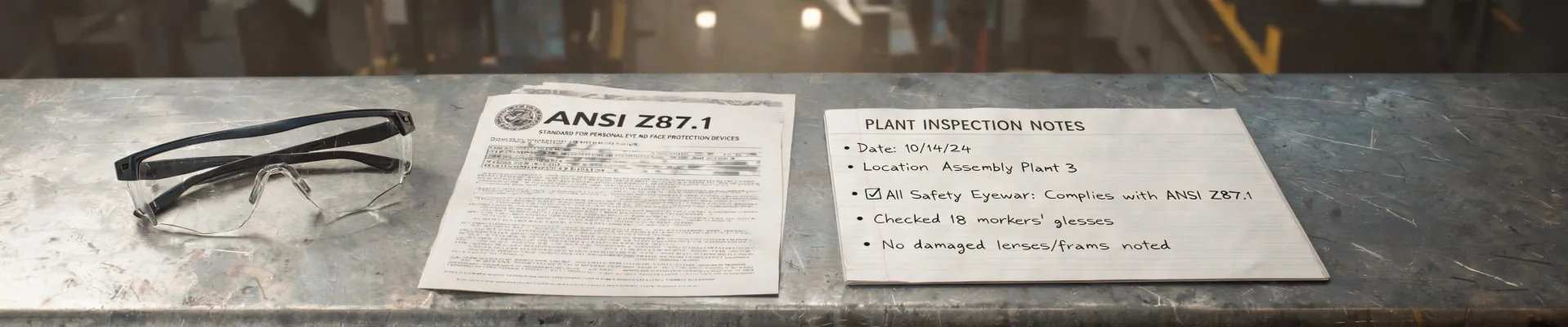
Technically, several of those cheap options might meet the basic impact test. But there's a difference between "might pass" and "will pass on the morning of a $12,000 audit." The trainer needed eyewear rated to ANSI Z87.1, and they needed it to stay on people's faces during actual movement — not slide down a sweaty nose while someone tries to wrangle a spill kit.
What We Actually Ordered
We went with the Wiley X Valor safety glasses. Not because they were the most expensive option in the catalog, but because the wraparound lens acts like a built-in side shield. That matters more than people think. A separate clip-on side shield can be lost, snapped off, or forgotten in a car. The Valor's lens wraps back toward the temples, which means the coverage is part of the frame itself. For a training exercise with active movement, that's the difference between a prop that looks good on a spreadsheet and equipment people will actually keep on.
We ordered six pairs with clear lenses and a few with mirrored lenses for outdoor sessions. According to the ANSI/ISEA Z87.1-2020 impact standard, safety eyewear has to pass specific high-impact and coverage tests, and the Valor line is commonly used in military and law enforcement settings. I won't claim it's indestructible — no eyewear is. But I've seen these frames take hits in actual work environments and walk away fine.
The client's procurement manager looked at the price and hesitated. That's when I told him a story he didn't want to hear.
The $6 Safety Glasses Trap
Back in March 2022, a different client of ours ordered a full set of budget safety glasses for a federal contractor audit. Each pair cost $6.50. The total order was around $300, so they felt good about the savings. The auditor checked the markings on the temple arms and found they didn't match the required high-impact rating. The whole batch was rejected.
That cost them $450 in overnight shipping for replacements, four hours of site coordinator time, and a tense conversation with the prime contractor. Total extra cost: easily $1,200. Their cheap glasses ended up costing four times more than the ones they eventually bought.
That's when I started thinking in total cost instead of unit price. The price tag is the opening bid, not the final bill.
The TCO Flip
Everything I read about procurement used to tell me to compare apples to apples: same spec, lowest quote. In practice, I found that the cheapest item usually carries the highest hidden costs — specifically time and risk.
Here's what I now include in every PPE comparison:
- Unit price — the obvious part.
- Shipping and rapid freight — especially when an order has to be broken up because one item isn't in stock.
- Fit and comfort — uncomfortable safety glasses get removed. A removed pair of safety glasses costs $0 until someone gets an eye injury.
- Compliance risk — if an auditor rejects the eye protection, the whole event stops.
- Replacement frequency — a $6 pair that scratches in a week is more expensive than a $20 pair that lasts a year.
The Wiley X Valor pairs were roughly $80 to $120 depending on lens color, based on distributor quotes I checked in January 2025. Yes, that's a big jump from $6. But across a six-person team, the extra cost was maybe $500. That's still less than half the $1,200 mistake from 2022. And unlike the cheap pair, the Valors were more likely to still be in service next year.
The value isn't the price. The value is certainty.
I have mixed feelings about premium-priced safety gear. On one hand, some brands overcharge for logos. On the other, I've watched a $12,000 project hinge on a pair of $60 glasses. The math starts to look very simple.
Boots, Coveralls, and the Latex Glove Question
Of course, eye protection wasn't the only gap in that emergency order.
One technician planned to use running shoes on the loading dock. The site manager required leather or synthetic boots with ankle support and slip-resistant soles. We ordered Danner tactical boots for that guy. They weren't cheap, and they weren't in the original budget. Neither was a twisted ankle on gravel. Danner's sole pattern and ankle design are built for uneven terrain, not just looks. That's the kind of specification you don't appreciate until you're carrying a spill kit over wet gravel.
We also had to source coveralls for men in the right sizes. This sounds simple, but men's coveralls are notoriously inconsistent. A large from one brand fits like a medium from another. We found a mid-tier brand with an elastic waist, double knees, and enough room to move without feeling like a tent. The budget option would have been replaced after one use — if it survived the first squat test. The slightly more expensive pair wasn't even that much more once you divided it by years of use.
And then there was the glove question. Someone in the client's office genuinely asked: "Can I use latex gloves for cooking?" The short answer is: not from a PPE supply cabinet. Most industrial latex gloves aren't certified food-safe and may have powder or manufacturing residues. If you need gloves for food prep, use food-grade nitrile that's clearly labeled for food handling. This wasn't even a training issue — I just didn't want anyone getting sick or starting a weird kitchen policy.
What I Do Differently Now
After more than six years of rush PPE orders, I keep a short checklist before I send any recommendation:
First, I ask what happens if the cheap option fails. If the answer is "someone gets hurt" or "a contract gets canceled," the cheap option is not actually cheap.
Second, I check whether the item meets the actual standard, not just the category. Not all safety glasses with side shields are equal. Some have plastic that fogs up. Some have arms that snap on a truck floor mat. Some don't meet the high-impact rating cited on the spec sheet. Wiley X safety glasses with side shields are one of the more reliable choices I've found, but I always verify the model number and applicable standard before ordering.
Third, I calculate TCO. If a $6 pair of glasses must be replaced three times a year and a $60 pair lasts three years, the premium pair wins. Add one audit failure or one eye injury and the comparison isn't even close.
In the end, that March 2024 training exercise ran on time. The auditors walked the site, checked the eyewear markings, watched the team move through the drill, and signed off. The client paid more upfront than they wanted to. But the alternative was a $12,000 penalty, a lost training slot, and a team standing around in boots that didn't fit.
I'd rather explain why the better gear costs more than explain why we tried to save $8 and lost $12,000. That's not a marketing line. That's a lesson I've learned the hard way.

Maeve Callahan
Maeve Callahan is a head-protection analyst covering Type I and Type II hard hats, climbing-style safety helmets, bump caps, chin straps, suspensions, liners, and face-shield carriers. She applies ANSI Z89.1, EN 397, and EN 12492 criteria while comparing impact attenuation, penetration resistance, lateral deformation, electrical class, retention strength, field of vision, mass, fit range, and temperature conditioning. Her guides help EHS teams, contractors, utilities, and buyers select helmet systems for overhead hazards, work at height, electrical exposure, accessory compatibility, and worker acceptance.