Let me start with a confession: when I'm triaging an emergency PPE order, I don't think about brand names. I think about what keeps someone safe for the next 12 hours. But the question I get more than any other is: Wiley X Spear tactical goggles or Wiley X prescription safety sunglasses? So here's a field-tested comparison, based on hundreds of rush orders, not lab theory.
How I compare them
I use four dimensions: impact protection, seal vs. breathability, vision correction, and compliance. Not because those are the only metrics—they're the ones that get people hurt when ignored.
Dimension 1: Impact protection
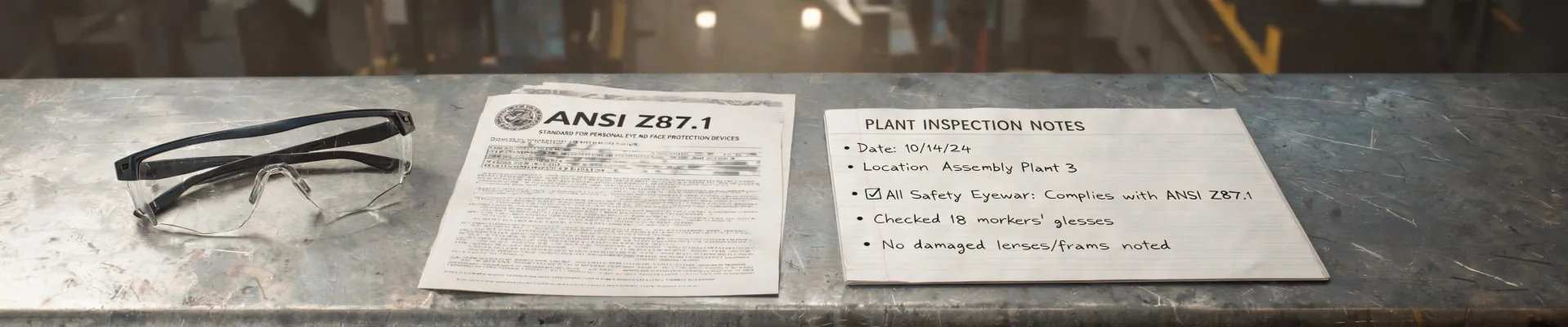
The Wiley X Spear tactical goggles are the heavyweights. They're ANSI Z87.1 compliant and Wiley X lists them as military-grade. For flying debris, shrapnel, or any projectile near the eye socket, goggles are the safer bet. I'd spec them for grinding, chipping, or tactical work without thinking twice.
The Wiley X prescription safety sunglasses also pass ANSI Z87.1 impact tests, but a sunglass frame leaves a gap at the temples. Is that a problem? Usually no. But if you take a ricochet to the side of the face, the gap matters. I'm not a ballistics engineer. My experience is based on about 300 orders for industrial clients, not lab data. If ballistic impact is a daily risk on your site, skip the debate and buy goggles.
Dimension 2: Seal vs. breathability
Here's where conventional wisdom gets shaky. The belief that goggles are always safer comes from an era when sealed goggles were the only serious option. Today, lens coatings and wrap-around frames have closed much of the gap.
Sealed goggles are excellent for dust, chemical splash, and wind-blown particles. For a hazmat response, I'd choose a sealed goggle every time. But in a hot, humid plant, goggles fog up—not in theory, but within 20 minutes of wear. When they fog, people take them off. When people take them off, protection drops to zero. That's a risk I've watched more than once.
A few years ago, a client called at 9 PM because their night crew was fogging up within minutes. We paid $60 in rush shipping to send anti-fog spray and replacement lenses. The spray helped. The root cause was the frame seal against a high-heat process, so the real fix was switching to a vented goggle or a well-sealed sunglass. The upside of the sealed goggle was higher protection. The risk was fogging. I kept asking myself: is a fogged goggle really safer than a clear pair of sunglasses? No.
Prescription safety sunglasses with a wrap frame stay clearer because they don't trap heat. Less coverage? Sure. Better compliance? More often than not, yes. The tradeoff isn't obvious until you're sweating through a 12-hour shift.
Dimension 3: Vision correction and daily wear
This is the piece that surprises clients. For many emergency responders, the prescription safety sunglasses are the right daily driver.
Why? Because the best eye protection is the pair you'll actually wear. If you need corrective lenses or polarized lenses for glare, the prescription safety sunglasses offer both. The Spear goggles can accept an RX insert or fit over some eyeglasses, but it's kind of clunky. Polarized lenses reduce glare, which matters for vehicle work and outdoor operations.
So the ranking flips here. For general duty, the sunglasses win. For specific high-risk tasks, the goggles win. Sort of, anyway.
Dimension 4: Fit, cost, and lead time
For fit, neither is automatically better. Goggles have a strap, which is great if you're wearing a hard hat. Sunglasses are more comfortable over a long day and easier to take on and off.
Cost-wise, the Spear goggles are typically a little more expensive than basic prescription sunglasses. But once you add custom prescription lenses, the sunglasses catch up fast. Lead time is the bigger variable. If you need zero-power safety glasses tomorrow, online retailers can get them to you fairly quickly. Custom prescription lenses? Not so fast. That's why I always tell clients to order prescriptions weeks before a project, not the night before.
Looking back, I should have emphasized this more with a client who needed a custom tint before a two-week field deployment. At the time, standard clear lenses seemed fine. They weren't. The glare was brutal.
The rest of the kit: boots, gas detectors, and pepper spray
Once eyewear is sorted, the next three items I get asked about are steel toe boots, a combustible gas detector, and pepper spray. They're not Wiley X products, but they belong in the same emergency PPE conversation.
Steel toe boots: local fits matter
For steel toe boots near me, the practical answer is buy in person. Fit and comfort are hard to judge online. A boot that doesn't fit is a boot that doesn't get worn. Online usually offers better prices, but for a first pair, go to a local safety supply store. My rule: try on locally first, then reorder online if needed.
Combustible gas detector: calibration is not optional
A combustible gas detector is a life-safety device, not an accessory. I've seen cheap detectors miss methane leaks that a properly calibrated catalytic bead sensor caught. For confined space entry, buy from a specialist safety vendor and verify calibration before every use. If you're uncertain about the calibration history, treat the detector as unverified until you check it.
Pepper spray: buy locally, not just online
For pepper spray, online ordering can be a trap. Shipping restrictions on aerosol OC spray are real, and some carriers refuse them. So where to buy pepper spray near me has a clear answer: a local sporting goods store, gun shop, or safety supply store. You can inspect the expiration date and confirm it's legal to carry in that jurisdiction. I've had clients receive returned or seized packages because they bought pepper spray without checking local rules. Not ideal, but workable.
What should you choose?
Here's the decision tree I use:
- If you face splash, dust, or ballistic debris: Wiley X Spear tactical goggles.
- If you need vision correction, glare protection, or all-day wear: Wiley X prescription safety sunglasses.
- If you can budget for both: get the prescription sunglasses first for everyday use, then add the goggles for high-risk tasks.
I recommend the prescription safety sunglasses for about 80% of the emergency responders I work with. But that also means 20% genuinely belong in goggles. Don't be the person who buys a cool-looking pair without checking hazard profile. And don't be the manager who insists on maximum protection on paper while the crew takes the goggles off at every break. The right choice is the one that protects people and that they'll actually wear.
Where my advice ends
This worked for us, but our clients are mostly mid-size industrial and tactical teams with predictable hazard categories. If you're a solo contractor moving between different site types, your context is different. I can only speak to U.S. operations. If you're dealing with international regulations or extreme climates, there are factors I'm not aware of.
Take the comparison as a starting point. Ask a safety professional who has used both in the field. And if a deadline is looming, buy the eyewear early enough to swap out if it doesn't fit.

Maeve Callahan
Maeve Callahan is a head-protection analyst covering Type I and Type II hard hats, climbing-style safety helmets, bump caps, chin straps, suspensions, liners, and face-shield carriers. She applies ANSI Z89.1, EN 397, and EN 12492 criteria while comparing impact attenuation, penetration resistance, lateral deformation, electrical class, retention strength, field of vision, mass, fit range, and temperature conditioning. Her guides help EHS teams, contractors, utilities, and buyers select helmet systems for overhead hazards, work at height, electrical exposure, accessory compatibility, and worker acceptance.