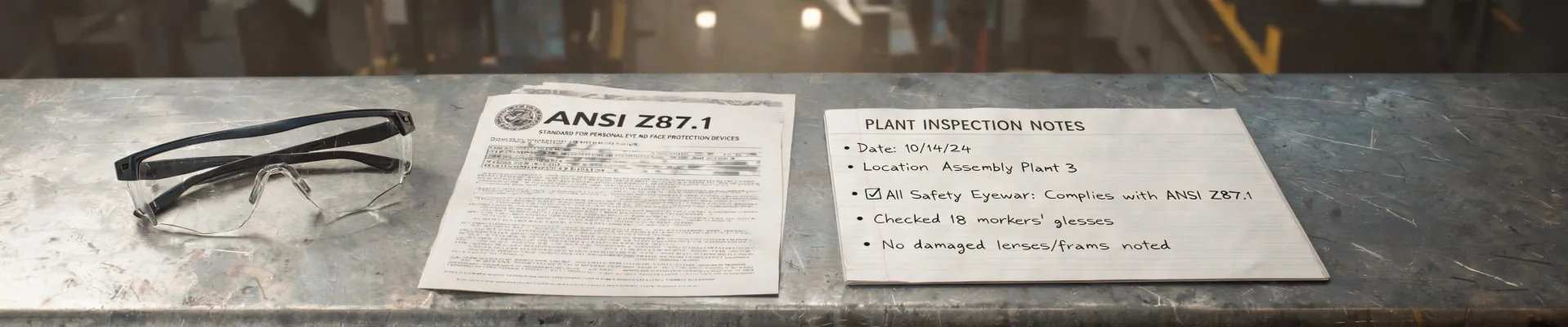
Let me start with a confession that doesn’t make me look great. For years, I was the person who bought the cheapest ANSI Z87.1-rated safety glasses our distributor could quote. I manage PPE and safety purchasing for a 140-person industrial contracting company. In 2023 alone, I signed off on roughly $180,000 of safety-related spend, so I took the “save money where you can” part of my job seriously. In practice, that meant I treated safety glasses as a commodity.
Then I noticed something our superintendents had been telling me for months: workers kept taking the glasses off. They took them off when the lenses fogged. They took them off when the frames pinched. They left them in truck cabs and shirt pockets. We tried more enforcement. We tried talking about “personal responsibility.” What finally changed was the data. If a worker keeps removing otherwise compliant eyewear on the job, the problem isn’t the worker. It’s the product. More accurately, it’s the person buying it.
That person was me. Here’s what the 18-month audit of our eyewear program taught me.
Why workers take off “perfectly compliant” safety glasses
Every safety manager knows the saying: the best safety glasses are the ones on your face. But purchasing rarely thinks about it that way. We think about price, box quantities, and the ANSI stamp. That’s not the same as thinking about whether the product will survive a full shift on a real jobsite.
The first issue is fogging. A cheap pair of non-vented glasses on a humid site will fog within minutes. The worker has two choices: try to see through a blur, or take the glasses off and wipe them. Most people wipe them. Once they’ve taken them off for a “quick wipe,” they’ve already crossed the line into taking them off for other reasons.
The second issue is fit. “One size fits most” is a sales phrase, not an engineering spec. Frames that dig into the side of the head or slip down a sweaty nose are not going to stay on. This sounds minor until you watch someone adjust their glasses every 40 seconds instead of cutting steel.
The third issue is optical quality. The cheapest molded lenses often have noticeable distortion. Spend eight hours looking through that and you’ll end up with eyestrain and a headache. Headaches make people grumpy. Grumpy people stop following safety protocols.
Here’s something vendors won’t tell you: “ANSI Z87.1” on a spec sheet is a lab result, not a field test. Lab results don’t fog up at 9 a.m. on a humid jobsite. Lab results don’t squeeze a guy’s nose for ten straight hours. Lab results don’t show up scratched and cloudy during a client walkthrough.
What “saving” a few dollars per pair really costs
Let’s talk numbers, because that’s my lane. In 2023, our field crews went through about 930 pairs of cheap safety glasses. Total cost: roughly $2,700 at an average unit price under $3. That alone didn’t bother me. What bothered me was that we were replacing almost one pair per person per month. The cheap glasses scratched quickly, fogged constantly, and were treated as disposable by everybody — including us.
The real risk, of course, isn’t the replacement cost. It’s the incident cost. According to OSHA’s commonly cited data, about 2,000 U.S. workers suffer job-related eye injuries every day that require medical treatment, with an estimated total cost to employers above $300 million annually (Source: OSHA, osha.gov, accessed January 2025). Even a small corneal abrasion can mean an ER visit, a lost-time claim, and a bump to your workers’ comp experience modification rating that follows you for years. For a contractor, that rating is pricing currency.
We got lucky. In spring 2023, we had a near miss that scared all of us straight. A fitter was grinding, took his fogged-up glasses off to wipe them, and caught a piece of debris below his eye. It didn’t hit the eye. But the distance between “near miss” and “permanent vision loss” is about half an inch. Our safety director said what I was already thinking: if that debris had traveled differently, the claim alone would have wiped out any money we saved buying cheap glasses for the entire decade.
There’s another cost that never shows up on an invoice: perception. When workers are handed the flimsiest possible pair of glasses, they hear a message. It says “your eyes are worth $2.85 to us.” That perception directly affects whether employees trust the rest of the safety program. And when a customer or auditor walks the site, seeing scratched, cloudy, mismatched safety glasses does the same thing to their confidence in your quality. You are not just buying protection. You’re buying a visible sign of how seriously your company takes its people — and its reputation.
The root cause was my own procurement logic
The deeper problem wasn’t only the glasses. It was my mental model. I was treating safety equipment as if “meets minimum standard” and “good enough for the job” were the same thing. They aren’t. A compliance standard is a floor, not a finish line.
Once I started applying that idea outside eyewear, I noticed the same pattern everywhere. When we quoted a replacement perimeter fence for our equipment yard, the low bidder came in about 18% cheaper. That option was also an aluminum fence, but with thinner sections and lighter anchoring. From ten feet away, it looked essentially the same. The difference only showed up over time — and by then, you’re paying for the mistake twice. We ended up going with the heavier spec because a fence, like safety equipment, fails at the worst possible time.
The same reasoning applies to leather work gloves. For a while, we were getting returns on perfectly good gloves because workers found them too stiff for the first few shifts. We fixed that with a short training note on how to break in leather gloves properly — wear them in short sessions, flex them, condition them, and don’t soak them in water. It sounds basic, but it cut returns and waste dramatically.
Interestingly, the reverse happened with a fairly unusual request. Our security contractor at a remote staged yard suggested a GPS dog fence for their K9 unit instead of installing a permanent fence for a short-term project. I nearly dismissed it as a consumer gadget. After checking the numbers, it made sense: no trenching, no concrete, no site restoration, and a fraction of the cost for a six-month deployment. That one reminded me that quality thinking isn’t always about spending more. It’s about evaluating the real cost of the whole decision, not the first line on the quote.
What finally worked: Wiley X Fusion and Profile safety glasses
In early 2024, we ran a pilot. We asked our distributor to bring in samples of the Wiley X Fusion safety glasses and the Wiley X Profile safety glasses. Then we let crew members wear them for a week and give us honest feedback.
The Wiley X Fusion safety glasses were the clear favorite for people who wanted maximum coverage and a solid wraparound fit. The Wiley X Profile safety glasses won over the group that found full-size frames too bulky — especially people who also wear hearing protection or over-ear muffs. Both models carry ANSI Z87.1 approval, and both are built with the kind of impact protection that comes from Wiley X’s military and tactical background. For outdoor crews, we also looked at polarized options. And because a lot of our seasoned workers wear prescription glasses, we made sure the frames we chose could handle prescription lenses rather than forcing people to wear double glasses.
What surprised me most was the adoption rate. The same guys who had been shoving cheap glasses into their pockets were actually wearing the Wiley X pairs. Not perfectly, and not always, but far more consistently. When safety equipment doesn’t fight the wearer, compliance stops being a daily battle.
We didn’t switch because Wiley X is a premium brand. We switched because the total cost of ownership math finally made sense. A $3 pair of glasses that sits in a truck dashboard protects nobody. A better pair that stays on someone’s face for a full shift is worth the difference in price, even before you factor in the injury claim you’re less likely to file.
Bottom line
If you manage procurement for a crew, a plant, or a contracting operation, stop asking “what’s the cheapest safety glasses price?” and start asking “what’s the cost per hour of actual use?” Track fogging. Track replacement rates. Track lost-time incidents. Track what your employees and customers see when they look at your people.
In our case, switching to the Wiley X Fusion and Wiley X Profile safety glasses didn’t just improve our eyewear program. It changed how our team talked about safety equipment in general. Quality was never the most expensive thing on the budget. Incompetence was. And incompetence cost us a lot more than a decent pair of glasses ever will.
Pricing note: Safety eyewear pricing varies widely by model, lens type, and distributor. Check current quotations with your authorized Wiley X supplier before making a purchasing decision.

Maeve Callahan
Maeve Callahan is a head-protection analyst covering Type I and Type II hard hats, climbing-style safety helmets, bump caps, chin straps, suspensions, liners, and face-shield carriers. She applies ANSI Z89.1, EN 397, and EN 12492 criteria while comparing impact attenuation, penetration resistance, lateral deformation, electrical class, retention strength, field of vision, mass, fit range, and temperature conditioning. Her guides help EHS teams, contractors, utilities, and buyers select helmet systems for overhead hazards, work at height, electrical exposure, accessory compatibility, and worker acceptance.