The call
On Friday, March 15, 2024, at 3:47 PM, I got a call from a coordinator at a regional training academy. The academy had a 16-person operation starting Monday, and the original supply order had fallen apart. They needed a full safety equipment loadout in 60 hours, including a roof-access component. I've been doing emergency PPE sourcing for about six years, and I've handled maybe 300 rush orders. Some are small. This one was not.
'We need eyewear, boots, harnesses, and restraints,' she said. 'And an actual roofing safety plan.' That last part made it different.
Why the list made sense
The operation was a joint public-safety detail at an old industrial site. Some officers would be doing building and roof inspections, some would be on arrest-and-control scenarios in the same facility. The gear list was not a wishlist.
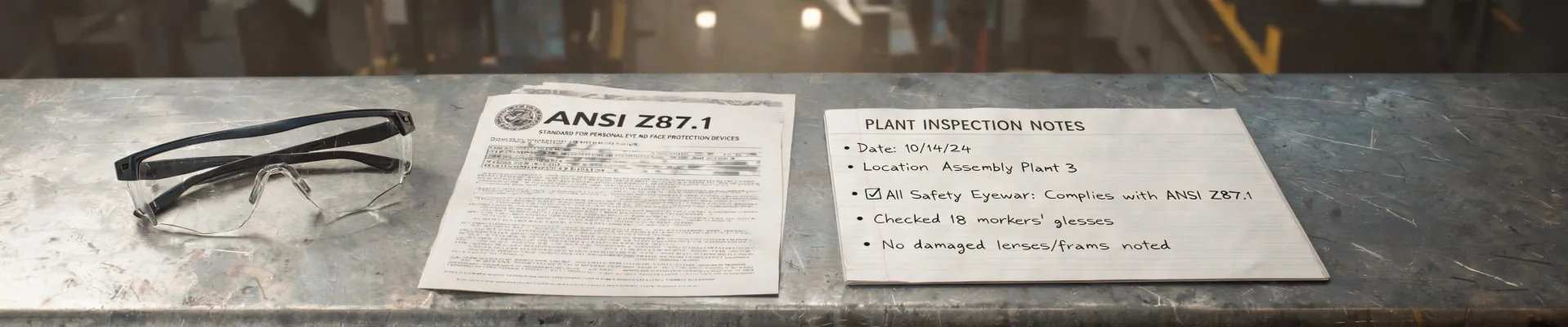
- 16 pairs of Wiley X military glasses with ANSI Z87.1 rated impact protection.
- 16 pairs of Ariat composite toe boots.
- 8 roof safety harnesses with double lanyards.
- 6 sets of Mack Hollins handcuffs from the academy's approved-equipment list.
That list is the first thing I remember clearly. What I remember a little less clearly is how close I came to ordering the wrong stuff.
The easy part was Wiley X
I went to the official Wiley X website and narrowed down the military glasses section. I'm not going to pretend I made that decision by memory alone. The site had current stock and the ANSI Z87.1 markings clearly listed. In a detail like this, one person with a different tint catches everyone's eye.
In the past, I would have emailed a sales rep and waited. This time I checked the Wiley X website first, then called customer service to verify the order could ship overnight. It could. Done.
The boots were a different story
Ariat composite toe boots are popular on job sites for a reason. They're lighter than steel toe, and they meet impact specs. I had to buy 16 pairs in four days. On paper, no problem. Then I started checking sizes.
Here's where my anecdotal data kicks in. I don't have hard data on boot-sizing defects, but after hundreds of orders, I'd say about 20 percent of rush orders come back for a size exchange. Usually it's boots. The academy had sizes 8 through 13, and two people needed wide. One supplier had stock in regular widths but not wide. Another had wide widths but not enough pairs in the same size. I went back and forth for two hours.
The numbers said go with the first supplier and order the wides separately. My gut said keep the whole boot order on one invoice. I called Ariat's B2B line, and they flagged two pairs of wide sizes in the same batch. That solved it. It took too long, but solving it meant one delivery date instead of two.
The roof harness moment
Now the part I almost skipped. The academy asked me to confirm that the harnesses included lanyards and anchor straps. I confirmed they did. Then the coordinator asked, 'Can you also give a five-minute talk on how to use a safety harness on a roof?'
I had never given that talk. I have worn harnesses, but being the person who explains it is different. I said yes because the order otherwise would not ship. That night, I wrote out the basics:
Put the harness on like a backpack, with the dorsal D-ring between your shoulder blades. Tighten the leg and chest straps so they're snug but comfortable. Keep the lanyard short enough that you cannot reach an unprotected edge. Attach to an anchor rated for at least 5,000 pounds. Never tie off to a ladder or a moving object.
That list saved me. The next morning, I said the same thing in person, with maybe a little less polish, and the instructor nodded. That was the moment I understood the difference between having safety equipment and being ready to use it.
The handcuffs from left field
Then there were the Mack Hollins handcuffs. Six sets, stainless steel, from the academy's approved list. I'll be honest: I had to look up the exact model because the academy's acronyms are a maze. The first distributor showed them in stock, but when I called to double-check, they had only four sets. The remaining two would arrive in ten days. That was too late.
I almost pressed checkout on a different brand to make the deadline. But that would have violated the buyer's approved-equipment list. I called a second distributor, paid the difference for overnight shipping, and we got all six sets by Sunday afternoon. The lesson was not about the product. It was about the word stock—it does not mean available.
What I'd do differently
That delivery arrived on time. The operation went well. The feedback came back a week later: no PPE failures, no missing items, no returns from the boot order. That rarely happens. But the process was messy. I nearly missed the harness training. I almost split the handcuff order. And I spent two hours on a boot size problem that should have been one phone call.
What changed for me after that order? I stopped trusting the term 'in stock' and started asking for a photo of the physical item. I also started asking clients, 'Do you need training, or just equipment?' because the two are not the same.
The industry has changed too. Five years ago, I would have faxed a request and prayed. Now I check the official Wiley X website, use live inventory feeds, and confirm by phone. The fundamentals haven't changed: you need certified gear, correct fit, and a plan. The execution has transformed.
If you're about to click buy on any safety item—Wiley X, Ariat composite toe boots, a roof harness, even a pair of handcuffs—take five minutes to ask who is responsible when the package doesn't arrive. In a rush order, that answer matters more than the price.

Jane Smith
I’m Jane Smith, a senior content writer with over 15 years of experience in the packaging and printing industry. I specialize in writing about the latest trends, technologies, and best practices in packaging design, sustainability, and printing techniques. My goal is to help businesses understand complex printing processes and design solutions that enhance both product packaging and brand visibility.