-
Are Wiley X Safety Glasses with a Prescription Worth the Cost?
-
What Makes Wiley X Saber Advanced Safety Glasses Different?
-
Safety Glasses or Goggles: Which One Belongs in Your Spec?
-
Are Wiley X Glasses Ballistic? What Does the Marking Actually Prove?
-
Should You Pair Carhartt Coveralls and Brunt Work Boots with Wiley X?
-
Can You Use Latex Gloves for Cooking?
-
What Should a PPE Purchase Spec Include Before You Compare Prices?
A few weeks ago, a facility manager asked me why he should pay more for Wiley X when a “certified” safety glass from a surplus catalog was a third of the price. I didn’t give him a brand pitch. I asked to see his hazard assessment and his last eye-injury report. That’s how I treat most PPE questions now.
I’m not going to hand you a “best safety glasses” ranking, because rankings ignore the work site. I’m a quality/compliance manager at a safety equipment distributor. I review 200+ line items a year before they go out, and I’ve rejected about 6% of first deliveries in 2024 because the spec on the box didn’t match the spec on the PO. This FAQ is built around the questions I actually get from plant managers and safety coordinators.
Are Wiley X Safety Glasses with a Prescription Worth the Cost?
When I first started in PPE procurement, I assumed prescription safety eyewear was just a way for the optical vendor to add margin. The lesson hit when I compared two sets side by side: same frame model, same lens tint, one with a flimsy insert and one with a properly fitted RX carrier. The cheap setup fogged, shifted, and ended up in a drawer. The properly fitted one stayed on a face.
If you type “Wiley X safety glasses prescription” into a search, you’ll see two paths for most models: direct Rx lenses in a Wiley X frame, or an RX insert carried inside a ballistic frame (often called an RX carrier). Neither is the cheap route, but the total cost of ownership changes when you include fit and compliance. A worker who can’t see clearly with his safety glasses will stop wearing them—that’s a bigger cost than any frame. I now calculate TCO before comparing any vendor quotes.
What Makes Wiley X Saber Advanced Safety Glasses Different?
The Saber Advanced is basically a wrap-style tactical frame with a removable RX insert. It’s one of the Wiley X models I see specified for law enforcement and range work because it meets the military ballistic-impact requirement—MIL-PRF-31013—and carries the ANSI/ISEA Z87.1 high-impact classification. You’ll also see a “+” marking on the lens or frame, which is the part that matters.
People assume “military grade” means unbreakable. It doesn’t. It means the product passed a defined test at a defined threat level. If a vendor can’t show you a model-specific ballistic test report, you’re buying a claim, not a spec. The Saber Advanced is not a replacement for a welding helmet or a respirator hood, but for patrol and site inspection roles that need wraparound coverage and an optical correction option, it checks the right boxes.
Safety Glasses or Goggles: Which One Belongs in Your Spec?
This is the question that reveals whether you’re buying PPE by brand or by hazard. Safety glasses with side shields are for impact. Goggles are for splash, dust, and chemical mist because they form a seal against the face. OSHA’s PPE standard (29 CFR 1910.133) says eye protection must be selected based on the hazard assessment—not based on whichever frame looks best in a catalog photo.
If your hazard assessment says “chemical splash,” a Wiley X Saber Advanced—or any other pair of glasses—is not the final answer. Use goggles where the hazard requires a seal. The most expensive wrong product is still wrong. If your crew does both grinding and chemical handling, you may need both types in the PPE matrix.
Are Wiley X Glasses Ballistic? What Does the Marking Actually Prove?
I’ll be blunt: ballistic-rated is not bulletproof. A ballistic-rated lens is tested against a high-velocity fragment, typically under a military spec like MIL-PRF-31013. That’s a meaningful standard, but it doesn’t mean the lens can stop every round.
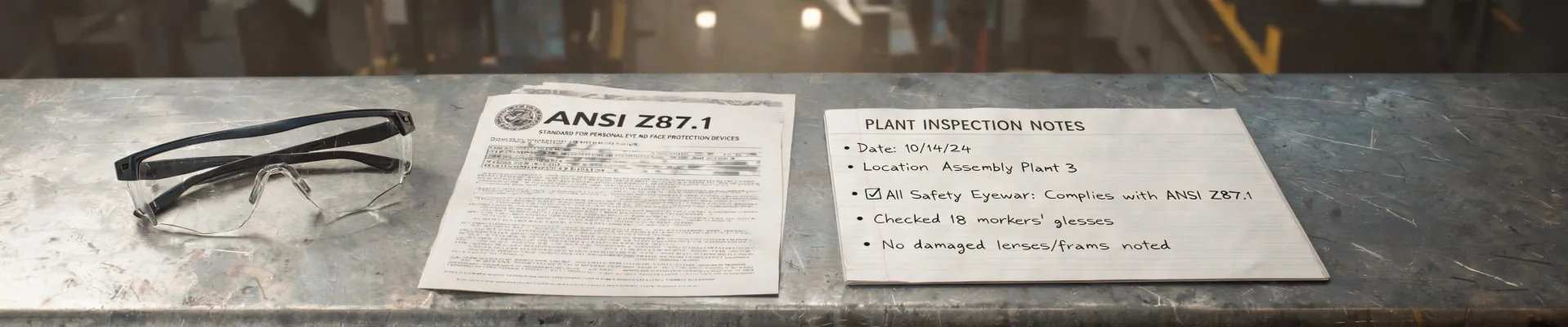
When I review an order, I look for two things: the high-impact “+” mark and a ballistic test report. If the label says only “Z87,” it passed basic impact—not the same as high impact. From the outside, all “tactical” glasses look tough. The reality is in the fine print. Words like “tactical style” or “military look” mean nothing for impact protection.
Rule I use: if it doesn’t say “Z87+” and the seller can’t provide the test report, don’t put it in a high-impact PPE spec.
Should You Pair Carhartt Coveralls and Brunt Work Boots with Wiley X?
If you’re outfitting a crew, eye protection is one line on a much longer list. I’ve seen purchase orders with excellent eyewear and then nothing for the rest of the body except “whatever the warehouse had.” That’s a total-cost failure. TCO includes training workers on when to wear what, replacing lost items, and paying for corrective actions after an audit.
Carhartt coveralls can be the right call, but “coveralls” is a category, not a performance rating. If someone lists “carhart coveralls” on a PO, stop and ask what hazard they’re for. Cold work? Cotton duck may be fine. Arc flash? You need an arc rating or HRC/CAT category. Welding? You need FR fabric. The same logic applies to Brunt work boots: honestly, they have solid entry-price options with safety toes, but the purchase spec should require ASTM F2413-18 marks on the tag. A boot without the ASTM tag is not a safety shoe, regardless of the logo.
Can You Use Latex Gloves for Cooking?
Short answer: yes, but I wouldn’t make latex the default. The food-safety rule that matters is no bare-hand contact with ready-to-eat food. Many U.S. health departments follow the FDA Food Code, which focuses on preventing contamination rather than banning latex outright. Latex is allowed in some jurisdictions, but latex allergy is a real issue in food service, and latex can break down in contact with certain oils and acidic foods.
If you’re buying gloves for a kitchen, look for food-grade nitrile or vinyl on the box and avoid grabbing the same black shop gloves the maintenance crew uses—those are often not food-contact certified. This sounds off-topic until you run a site with a machine shop and a cafeteria. I’ve had that exact conversation.
What Should a PPE Purchase Spec Include Before You Compare Prices?
Price matters, but only after the spec is fixed. My default checklist:
- Eye protection: ANSI/ISEA Z87.1 high-impact (“Z87+”); ballistic test report if the risk assessment justifies it.
- Footwear: ASTM F2413-18 impact/compression rating if toes are exposed to impact.
- Coveralls: FR or arc rating if heat/electrical hazards exist; otherwise, the right fabric weight for the environment.
- Food-contact gloves: food-grade nitrile or vinyl, not general-purpose shop gloves.
When I first started, I compared unit prices. Now I compare cost per worker per year. A $15 pair that gets replaced monthly isn’t cheaper than a $75 pair that survives a year. If you ask me, that’s the whole job: assess the hazard, write the spec, verify the label, then compare the TCO.

Jane Smith
I’m Jane Smith, a senior content writer with over 15 years of experience in the packaging and printing industry. I specialize in writing about the latest trends, technologies, and best practices in packaging design, sustainability, and printing techniques. My goal is to help businesses understand complex printing processes and design solutions that enhance both product packaging and brand visibility.