In my role coordinating PPE orders for a regional safety distributor, I've handled roughly 200 rush requests in eight years. The most common one isn't what you'd expect. It's a contractor calling on a Tuesday afternoon with a safety audit Friday morning and needing 40 pairs of something rated for impact. In March 2024, a client called at 3:45 PM with exactly that problem. Normal turnaround for prescription safety glasses is seven to ten days. We got it done because we had the inventory and the cert sheets. But the larger point is that choosing the right piece of PPE is a triage decision. This article sets two common choices side by side—safety glasses and face shields—and then covers the two items that people often don't think about until they're already on a roof or standing in a parking lot with a broken boot.
I'm not going to tell you a face shield is always better than glasses. That kind of blanket statement gets people into trouble when they skip eye protection because they wear a shield. Instead, compare them on the three dimensions that actually change a purchase: hazard coverage, all-day practicality, and long-term cost.
Safety Glasses vs Face Shields: The Three Dimensions That Matter
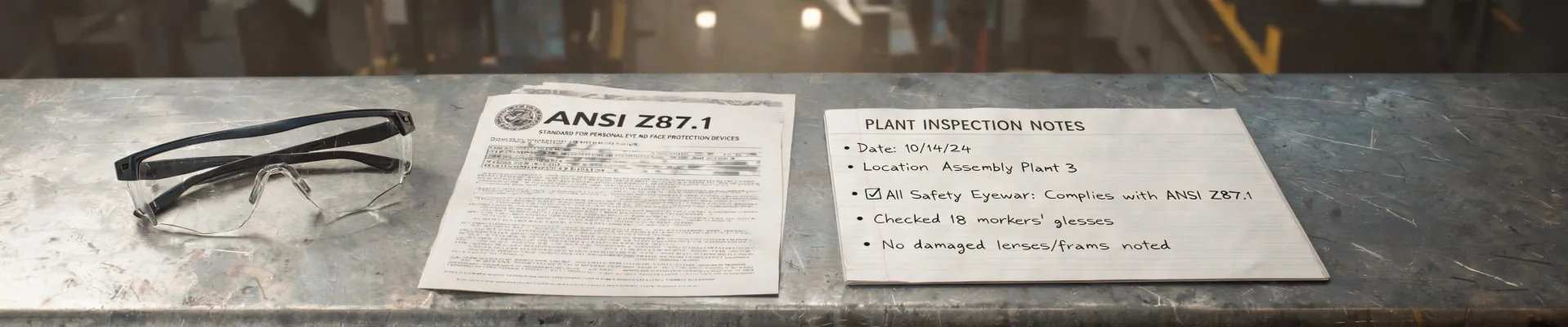
Hazard coverage. Safety glasses are built to protect the eye area from impact. The baseline in the US is ANSI/ISEA Z87.1-2020. A pair like the Wiley X Ovation safety glasses carries high-impact ratings when the lens and frame meet that standard. But glasses leave the rest of your face open. A face shield like the Uvex Bionic face shield covers the whole face, which matters for chemical splashes, chipping, grinding, and hot liquid. That doesn't make shields superior. It makes them a different layer of defense for a different risk profile.
All-day practicality. I can wear a pair of Wiley X Ovation safety glasses for a full shift and forget they're on. The frame is light, and the optical quality is solid, especially if you're comparing it to the cheap wraparounds that scratch after four days. Face shields are heavier and fog up, though newer models like the Uvex Bionic have better airflow. To be fair, if you're doing rough construction or grinding, the extra weight is a fair trade for a face covered against sparks. But if you're doing finish work, a shield can be a pain. That's not a flaw. It's a fit issue.
Cost and logistics. Rated eyewear is a no-brainer for every crew. The Wiley X Ovation safety glasses sit above the throwaway price range, but they last and can accept prescription inserts, which makes them a good investment for people who wear corrective lenses. Face shields have a higher entry cost plus replacement visor cost. Again, not a reason to skip. It's a reason to buy based on risk. The Wiley X website is actually useful here because it lists the ANSI rating for each model, so you can check spec before you order instead of trusting a vague product title.
Beyond Eye and Face: Steel Toe Boots and Roof Harnesses
The first thing people often type into Google before a morning shift is 'steel toe shoes near me.' I understand why. When your boot finally gives up, you don't have time for a week-long order. But the search results near you don't know your job site. A store nearby might have a boot that looks safety-rated, but the label is what matters. For construction-related work, look for ASTM F2413-18 impact and compression ratings. That's the baseline. My experience with this is based on PPE orders for construction, oil and gas, and light industrial crews. If you're doing logging, electrical work, or heavy welding, your boot requirements are stricter than mine. The rule stays the same: buy the rating, not the store. Proximity is a convenience, not a safety spec.
The other big one is fall protection. Lots of people search 'how to use safety harness on roof' after they're already looking at an anchor point question. That's backwards. In the US, OSHA 29 CFR 1910.140 defines general requirements for personal fall protection systems, but it won't teach you how to set up your particular roof. A harness is one part of a system. You also need an anchorage, a connector, and enough fall clearance. If your anchor is below your D-ring or your lanyard is too short, the harness isn't a solution. It's just a piece of equipment. I learned this the hard way on a purchasing mistake: we specified a 'full-body harness' and the supplier sent the harness body without the lanyard. The lanyard was a separate item. That's a communications failure that could have left a crew member fifty feet up with nothing to tie off to. I'm not a fall protection engineer, so I don't hand out roof-specific diagrams. Get a competent person to plan the anchor points and train your crew on where to connect. That's not an extra cost. It's the real cost.
So Which Should You Choose?
Bottom line: don't ask whether glasses are better than shields. Ask what's coming at you. If your biggest risk is dust, wind, a stray nail, or line-of-sight debris, a pair of Wiley X Ovation safety glasses is a solid daily driver. If you're working with chemicals, chipping concrete, or grinding overhead, use a face shield like the Uvex Bionic face shield on top of your glasses, or at least a shield that covers the full face. If a boot fails, don't just search 'steel toe shoes near me' and take the closest option. Check the ASTM label first. And if you're about to climb onto a roof, stop reading generic advice and get someone who can show you exactly where to anchor the harness. The right piece of PPE depends on the moment. That's okay. It means buying for the actual hazard, not for the glovebox.

Jane Smith
I’m Jane Smith, a senior content writer with over 15 years of experience in the packaging and printing industry. I specialize in writing about the latest trends, technologies, and best practices in packaging design, sustainability, and printing techniques. My goal is to help businesses understand complex printing processes and design solutions that enhance both product packaging and brand visibility.