If you've ever had to choose PPE for a crew with a deadline, you know the question. Wiley-X tactical goggles or Wiley X safety prescription glasses? I've been on both sides of that decision — first as the person who ignored the safety lead's advice, later as the one signing rush orders for a twenty-person team. Here's how I compare them when every hour counts.
This isn't a 'one is always better' argument. It's about the hazard, the user, and the lens. I use four comparisons: impact protection, prescription compatibility, comfort under other gear, and total cost.
Impact Protection: Goggles Win, but Not for the Reason You Think
Let's start with the reason most people pick tactical goggles: impact protection.
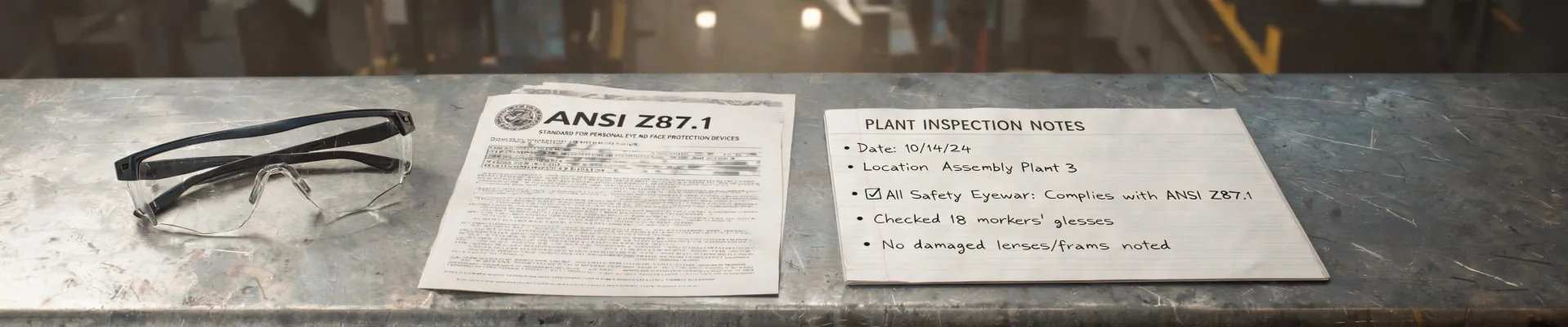
Wiley X tactical goggles are built with a sealed frame, a strap, and lens material that meets ANSI Z87.1. Many of their frames also carry military impact ratings. That matters when you're grinding, cutting, or working with tensioned wire. A loose piece of metal doesn't always come from where you're looking — it can come from the side, and glasses leave that area exposed.
I only believed in full-seal goggles after ignoring that advice once. In 2022, a cable snapped on a fence stretcher job and a wire fragment clipped the side of an operator's face. His glasses stayed on, but the open gap was enough to make me change the rule. From then on, anything involving tensioned wire gets goggles. Not because glasses are bad, but because goggles are better at what 'impact' actually means.
Bottom line: If you're dealing with flying particles or sharp debris, goggles win. If the job is mostly indoors and low-debris, glasses can be enough. But don't rely on a wraparound lens to cover a side hit.
Prescription Compatibility: Where the Decision Gets Personal
Now the part that catches a lot of teams off guard.
Wiley X safety prescription glasses are exactly what they sound like: your corrective prescription built into a safety frame. For anyone who needs correction all day, they're usually the easier choice. No insert to line up, no extra surface to clean, no fogging between the insert and the outer lens.
Goggles with prescription inserts work, and many Wiley X goggles are RX-ready. But here's something vendors won't tell you: the ballistic rating tells you how hard a lens can take a hit, not how comfortable it is to wear for eight hours. A goggle with an insert has two layers of optics, which adds weight and can reduce peripheral clarity. It's fine for short tactical tasks, but it's not the same as a true prescription lens.
The counterintuitive part: a goggle you take off because it's fogged is less safe than a pair of safety glasses that stay on your face. So if your team won't wear goggles for their whole shift, prescription glasses may be the safer tactical choice for them.
Bottom line: All-day prescription need? Go with Wiley X safety prescription glasses. Occasional use, high-risk tasks? A goggle with an RX insert is worth considering. Just don't assume inserts feel the same as a dedicated lens.
Comfort and Compatibility With the Rest of Your PPE
Comfort is not a soft factor. It's the difference between gear that stays on and gear that ends up in a locker.
Prescription safety glasses are lighter, breathe better, and fit under hard hats and ear protection more easily. They're my default for site walks, inspections, and anyone who goes between field and office. Tactical goggles, on the other hand, stay put when you're crawling, climbing, or looking up. They also seal out dust and wind better if you're outside.
I shouldn't have to say this, but eye protection is one part of the ensemble. When I spec a response kit, I also look at hands. Black nitrile gloves are my default for general response because they handle oils and chemicals without getting sticky, and they don't leave fingerprints when you're handling sensitive gear. It sounds small, but in an emergency, the wrong glove and the wrong eye protection are equally annoying.
If you're doing field repairs in brush or high grass — say you're setting posts and using a fence stretcher — goggles keep dust and plant material out better than anything with an open gap. That alone has made goggles the standard for our outside crew.
Bottom line: Glasses for all-day comfort and interface with helmets. Goggles for stability in tight positions and sealing out the environment. No universal winner until you know the task.
Cost and Turnaround: The Part That Gets Ignored
Let's talk money, because that's where most decisions start falling apart.
As of early 2025, I've seen Wiley X tactical goggles priced under $100 for some models. Prescription safety glasses usually start around $150 and go up from there, depending on coating, tint, and your prescription. But that comparison isn't the whole picture. A goggle with an RX insert can end up costing more than a dedicated pair, because you're paying for two optic surfaces instead of one.
I had a client in October 2024 need a replacement pair of Wiley X safety prescription glasses in 48 hours for a site audit. Normal turnaround from a glasses vendor was 10 business days. We paid a $95 rush fee on top of the $238 base cost, and got it done. If we'd needed an impact-only goggle, it would have been an $85 purchase and no rush fee. But the client needed prescription vision, so that wasn't an option.
That experience changed our inventory policy. We now keep a set of no-prescription Wiley X goggles in each vehicle for visitors, and we order prescription safety glasses only after a confirmed assignment. It sounds obvious, but it took one $95 lesson to make us do it. Actually, one $95 rush fee plus the cost of the expedited part — about $140 total. Anyway.
Based on our internal data from 200+ rush orders, rush fees add 20-40% to the base cost of PPE. Most of those were avoidable.
Bottom line: If you need prescription and lead time is tight, buy ahead. If you just need eye protection for a one-off task, goggles are cheaper and faster. Don't run a rush order on a line item you could have stocked.
So Which Should You Choose?
Stop asking 'which is better' and start asking 'what's the task?'
- Choose Wiley X tactical goggles for high-impact work, dusty or windy sites, tensioned tools like a fence stretcher, or any role where eye protection has to stay sealed in place.
- Choose Wiley X safety prescription glasses for all-day wear, mixed indoor/outdoor work, and anyone who needs corrective vision without managing an insert.
- Stock both if your team does a mix of tasks. It's not about picking a winner; it's about having the right tool available before the emergency starts.
And while you're updating your readiness checklist, don't leave the rest of the kit for later. We had a near-miss in 2023 when a fire extinguisher couldn't be used because its inspection was overdue. That's when I learned to search 'where to get a fire extinguisher inspection near me' and confirm the certifier's credentials before scheduling. It's not glamorous, and honestly, it's easy to skip until it's too late — but it's the same mindset as choosing the right goggles: know what you have, know what's missing, and fix it before you need it.
I learned these models and pricing from our orders and site experience as of early 2025. Product lines change, and safety standards are updated, so verify current ANSI/CE ratings and availability before you buy.

Jane Smith
I’m Jane Smith, a senior content writer with over 15 years of experience in the packaging and printing industry. I specialize in writing about the latest trends, technologies, and best practices in packaging design, sustainability, and printing techniques. My goal is to help businesses understand complex printing processes and design solutions that enhance both product packaging and brand visibility.