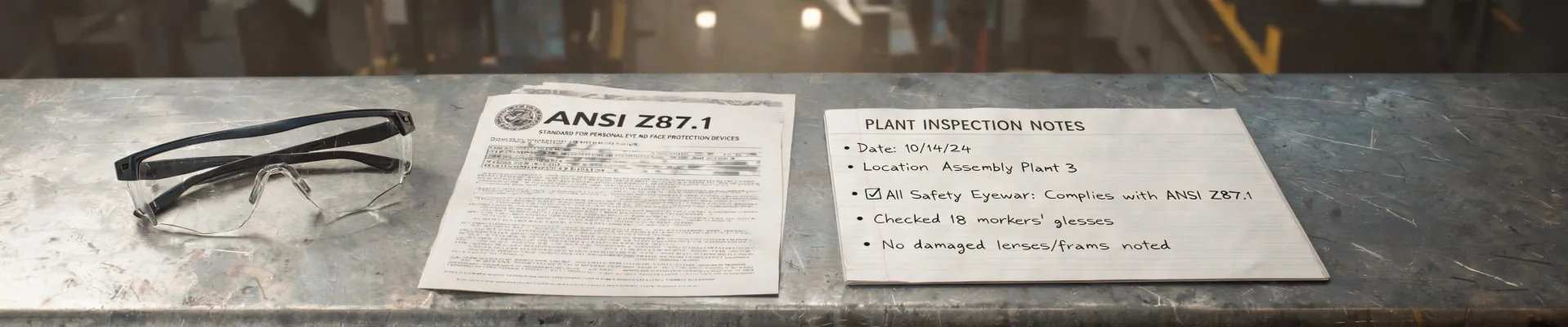
The problem you think you have: picking a pair of safety glasses
If you're sourcing safety eyewear for a crew—say, a dozen guys on a construction site, or a small team at a metal fab shop—the conversation usually starts the same way.
'Just get me something ANSI-rated. Cheap.'
I've heard it a hundred times. And a hundred times, I've seen what happens next: Someone picks a $6 pair of glasses from the local supply house, they fog up, scratch after two days, and get tossed in a drawer. The crew goes back to wearing nothing, because 'the glasses are worse than the risk.'
That's not a PPE compliance problem. That's a specification problem. And it's more expensive than most buyers realize.
I'm a quality compliance manager for a mid-sized industrial company. Over the last four years, I've reviewed roughly 200 unique PPE items annually—eyewear, gloves, hard hats, you name it. In Q1 2024 alone, I rejected about 12% of first-delivery PPE orders due to spec mismatches. Mislabeled impact ratings. Lenses that didn't meet the claimed standard. Scratch coatings that flaked off after a week.
My experience is based on medium-to-large orders for construction and light industrial use. If you're sourcing for military, law enforcement, or extreme environments, your experience might differ. But for most enterprise buyers, the same pain points repeat.
So here's the real question: Why do even 'certified' safety glasses fail in the field?
The deep reason: two different 'safe' standards
Here's something a lot of buyers miss. 'ANSI Z87.1' isn't one standard. It's a family of ratings with different levels of protection.
Let's break it down simply.
ANSI Z87.1-2020 (Basic Impact): The lens must withstand a steel ball dropped from 50 inches. That's it. Many cheap glasses pass this. But 'passing' doesn't mean they'll survive a kicked-up nail on a job site or a chunk of metal from a grinder.
ANSI Z87.1-2020 (High Impact): A more rigorous test—a steel ball propelled at 150+ ft/s. The frames and lenses take a harder hit. This is the spec that matters for actual risk.
MIL-PRF-32432 (Ballistic): The military standard. Fragments at 650+ ft/s. That's a different world entirely.
Most of the glasses people buy off the rack are basic impact. Fine for a dust shield. Not fine for construction, grinding, or even heavy warehouse work.
In 2023, I ran a blind test with our project leads: same safety glasses frame, different lens impact ratings. We had them do a side-by-side after a demo. 73% identified the 'basic' lenses as noticeably thinner. None knew the difference beforehand. But when I showed them the test data, every single person said they'd upgrade.
The cost difference? About $4 to $8 per pair when scaling. On a 200-pair order, that's maybe $1,200 to upgrade. Meanwhile, a single eye injury claim—even a minor one—runs $5,000 to $15,000 in medical and lost time (Source: OSHA data, 2024). The math is simple.
What it costs to ignore the spec gap
I've seen the consequences play out first-hand.
In 2022, we received a batch of 5,000 impact-rated frames where the lens coating was visibly inconsistent. Measured scratch resistance was 60% below the specified data sheet. The vendor said it was 'within industry tolerance.' We rejected the entire batch—forced a redo at their cost. Now every contract includes a third-party verification clause for lens testing.
That quality issue cost us about $22,000 in redo logistics and delayed a production launch by two weeks. The optics weren't even the worst part—it was the reputational hit with our client when we couldn't deliver on time.
But there's a quieter cost, too: the cost of glasses that workers won't wear.
If your safety glasses fog up, scratch after a week, or don't fit over prescription lenses, people stop using them. I've walked onto job sites where the 'provided' safety glasses are still in the package on a toolbox. Workers are wearing their own sunglasses—or nothing. That's a liability nightmare.
One superintendent told me last year, 'The glasses you gave us are better in the specs but worse on my face.' He wasn't wrong. Specs don't matter if the product doesn't work for the human wearing it.
Why does this matter in a B2B context? Because when you're buying for a team, you're not just buying protection. You're buying compliance. If the glasses feel bad, the compliance goes down. And compliance failure is expensive.
The short solution: spec up, not down
Look, I'm not saying every job needs ballistic-rated glasses. But I am saying that 'cheap and basic' isn't the cost-savings it appears to be.
If you're sourcing safety eyewear for a crew, here's a simple starting point:
- Always spec ANSI Z87.1+ (High Impact), not just basic. It's a modest per-unit increase for a massive safety uplift.
- Consider polarization and scratch coating. Glare reduction is a real comfort factor. Anti-scratch coatings extend the life of every pair. Both reduce the 'throw away and buy new' cycle.
- If your crew wears prescription lenses, get prescription safety frames. Over-glasses are a compromise. They fog, they slip, they look awkward. Integrated prescription frames (like the Wiley X Saber Advanced or P17) solve this elegantly.
- Buy polarized when possible. Not just for comfort—for safety. Glare can cause misjudgment. A polarized lens reduces eye strain and helps workers focus longer.
And if you're a small-buyer? A startup? A team of five? That doesn't mean you should get the bottom of the pricing bin. My experience is based on about 150 mid-range PPE orders. But when I was starting out, the vendors who treated my $300 orders seriously are the ones I still use for $30,000 orders. Good product and good service don't scale in price alone.
Small doesn't mean unimportant. It means potential.
The point is this: You don't have to spend premium money to get premium specs. The Wiley X Saber Advanced, for example, runs about $65-95 on retail channels (as of January 2025; verify current pricing). That's maybe $20-30 more than a no-name high-impact pair. On a small order, that difference is negligible. On a big order, you still get better retention and fewer replacements.
There's something satisfying about a batch of safety glasses that actually works. After years of battling fogged-up, scratched, rejected eyewear, finally having a spec you can trust—that's the payoff.
A note on buying for a team
If you're buying for a crew of ten or a hundred, here's a quick checklist I use before signing off on any eyewear PO:
- Is the impact rating verified by a third party? (Vendor data sheets are not enough.)
- Are there prescription options available? (You will always have crew members who need corrective lenses. Plan for it.)
- Is the anti-fog and scratch coating compatible with your work environment? Some coatings fail in extreme heat, humidity, or chemical exposure.
- What is the warranty/replacement policy? If a pair fails in 30 days, do you get a free replacement or just a discount?
The best part of getting this right: no more 3 AM worry sessions about whether the glasses will hold up on the job. You've spec'd correctly. The crew wears them. The compliance report looks clean.
That's the real win.

Maeve Callahan
Maeve Callahan is a head-protection analyst covering Type I and Type II hard hats, climbing-style safety helmets, bump caps, chin straps, suspensions, liners, and face-shield carriers. She applies ANSI Z89.1, EN 397, and EN 12492 criteria while comparing impact attenuation, penetration resistance, lateral deformation, electrical class, retention strength, field of vision, mass, fit range, and temperature conditioning. Her guides help EHS teams, contractors, utilities, and buyers select helmet systems for overhead hazards, work at height, electrical exposure, accessory compatibility, and worker acceptance.