I manage purchasing for a 60-person industrial services company. I don't write the safety manual, but I do order the PPE, and for the last four years the most dependable eye protection I've found is the Wiley X Ovation safety glasses. They are not the cheapest pair on the shelf, and they are not the right call for every job, but for general impact risk in construction, maintenance, and fabrication, the Ovation is the first thing I put on our inventory list.
If you landed on this page because you wanted the Wiley X official website, here's the shortcut: wileyx.com. People type it as wiley-x with a hyphen, but the official site is one word. I still check specs there before I issue a purchase order, because reseller listings can be outdated.
Why I trust the Ovation
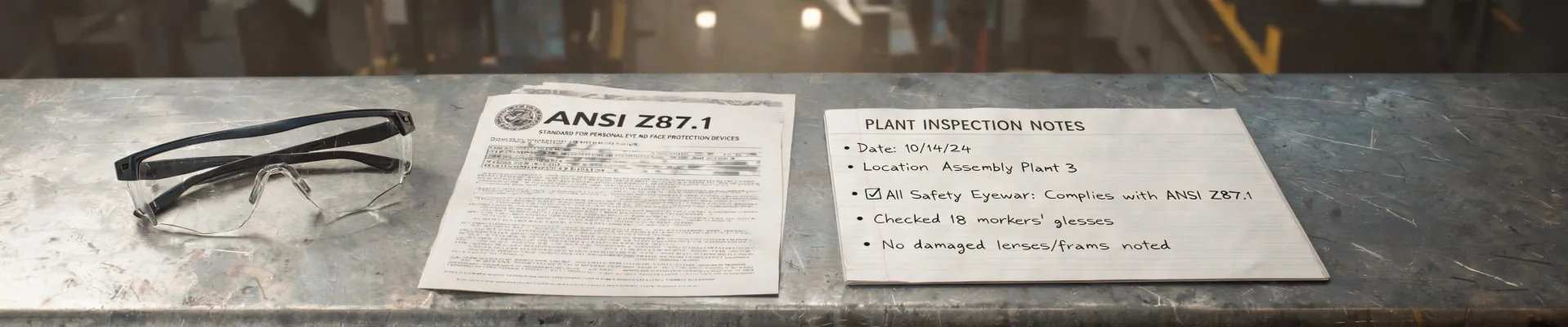
My trust is based on documentation, not marketing. Every pair I've received has the ANSI Z87.1 impact marking. According to ANSI (ansi.org), Z87.1 covers impact resistance and basic eye protection requirements for workplaces. For us that matters because our quality manager asks to see compliance paperwork during internal audits. The Wiley X official website lists which models meet which standards, and I've been able to verify each line before ordering.
I also like that the Ovation is a wrap-style frame. It is not a goggle. It fits close enough that dust and wind are less of a problem than with standard flat lenses, but it still gives peripheral vision. I've seen one size handle a range of employees from a small female technician to a large male site supervisor. Not everyone, but most. Put another way: I've issued maybe 90 pairs over the years, and the fit complaints have been rare enough that I can remember them by name.
The prescription and polarized options are useful too. A small group of our crew wears prescription safety glasses, and the ability to get Wiley X Ovation safety glasses with corrective lenses means we don't have to push them into weaker frames. Polarized lenses help outdoor workers around water and snow glare. If I remember correctly, the non-prescription version is affordable enough to stock in quantity.
I have mixed feelings about making any brand a default. On one hand, consistency helps with training and inventory. On the other, no brand should get a free pass just because it worked before. I re-evaluate every couple of years, and the Ovation keeps winning because crew feedback outweighs my habit.
The 2022 order that changed my process
I didn't always start with Wiley X. In 2022, with the budget squeezed, I ordered about 80 pairs of cheaper safety glasses from a new vendor. They were ANSI-rated on paper. What I didn't check was scratch resistance and frame durability. Within a month, the lenses looked like they'd been scrubbed with steel wool. Arms broke when workers stuffed them in pockets. We reordered 70 pairs of the next option up before the quarter ended.
Net result? The savings disappeared, and the stress was worse. I still kick myself for not testing a sample pair before buying in volume. If I'd spent $60 on 4 samples and field-tested them for a week, I would have caught the problem. Instead I spent about $1,100 more on replacements and expedited freight. Mental note: order samples before any bulk order. That was my penny-wise, pound-foolish lesson: the price per pair is almost never the real cost.
Where the Ovation is not the right answer
Here's the honest limitation. The Ovation is not a chemical splash goggle. If workers are mixing acids, handling caustic chemicals, or dealing with splash hazards, a sealed goggle is the safer choice. The Ovation also does not keep out fine dust as well as a foam-lined or indirect vent goggle. When we installed composite privacy fence panels around our storage yard last year, the saw cut created a fine fiberglass dust that got under any standard glasses. That job got goggles, not the Ovation.
And no piece of eyewear is indestructible. A ballistic-rated lens means it passed laboratory impact tests with high-speed projectiles under specified conditions. It does not mean 100% bulletproof in real-world situations, and I do not trust any brand that implies otherwise. Wiley X does not, as far as I've seen. If you need full face protection, you need a faceshield over the eye protection. The worst mistake is to pick a familiar model and skip the hazard analysis.
Loops earplugs, privacy fence panels, and Ariat boots: the rest of my purchase log
One side effect of managing purchases: my search history looks like a random generator. Last month alone I needed loops earplugs for the office, a quote for privacy fence panels, and a crew member asked me 'are ariat work boots good?' I don't have a strong opinion on any of those, because they are outside my responsibility. But I understand why they show up in the same search world.
Loops earplugs are comfortable and reusable, which is why people like them, but for high-noise industrial areas I select hearing protection by NRR rating, not brand. Privacy fence panels were a facility project, and they taught me that the dust they create is an eye hazard. As for Ariat work boots, I don't buy boots for our crew because fit is too personal to order in bulk. I won't tell you they're the best, because I haven't done the testing. That's the same standard I apply to safety glasses: match the product to the hazard, not to the name.
A practical note on ordering: I usually buy through our safety distributor, but I cross-check model numbers on the Wiley X official website. One time a reseller advertised an old Ovation variant as current. The spec sheet was still compliant, but it didn't match the samples we'd tested. Since then, I verify every SKU against the manufacturer page before paying.
When to look outside the Ovation
So, are the Wiley X Ovation safety glasses right for you? If you need general impact protection, all-day comfort, and a company that publishes clear compliance data, they're a strong default. If you're facing splash, fine dust, full-face hazards, or a budget so tight that you can't afford replacement lenses, look at a different category. As of January 2025, I've paid between $16 and $27 per pair depending on quantity and coating, but verify current pricing with your distributor.
My rule now is simple: start with the worst thing that can realistically hit a worker's eyes, then choose the product that stops it. For our mix of grinding, cutting, welding support, and outdoor work, that rule points to the Ovation about 80 percent of the time. The other 20 percent is goggles, faceshields, or a different hazard-specific design. That's not a brand problem. That's how PPE should work.

Maeve Callahan
Maeve Callahan is a head-protection analyst covering Type I and Type II hard hats, climbing-style safety helmets, bump caps, chin straps, suspensions, liners, and face-shield carriers. She applies ANSI Z89.1, EN 397, and EN 12492 criteria while comparing impact attenuation, penetration resistance, lateral deformation, electrical class, retention strength, field of vision, mass, fit range, and temperature conditioning. Her guides help EHS teams, contractors, utilities, and buyers select helmet systems for overhead hazards, work at height, electrical exposure, accessory compatibility, and worker acceptance.