-
The Question Every Procurement Manager Asks
-
Impact Protection: The Floor vs. The Real World
-
Lens Optics: The Fishbowl Effect
-
Wear Compliance: The Best Glasses Are the Ones That Stay On
-
Total Cost of Ownership: The Math That Surprises People
-
Who Should Buy What
- Two More PPE Questions Buyers Ask Me
-
For Procurement Teams: Use the Wiley X Login Portal
The Question Every Procurement Manager Asks
When I first started reviewing safety eyewear as the quality compliance manager at a PPE distributor in 2022, I carried a convenient assumption: if a pair of glasses was stamped ANSI Z87.1, it was good enough for any job site. A standard is a standard, right?
Three years and roughly 600 inspection reports later, I can tell you that's not the case. I review about 200 PPE orders a month before they go out to industrial, construction, and military clients. In 2024 alone, I rejected 30% of first deliveries from new suppliers because their certified products didn't hold up to our verification testing. And the question I hear most from procurement teams hasn't changed:
"Do we really need the Wiley X P17, or is a $15 pair of ANSI-certified glasses just as good?"
Fair question. Here's the comparison I run for every client who asks, across the four things that actually matter: impact protection, lens optics, wear compliance, and total cost of ownership.
Impact Protection: The Floor vs. The Real World
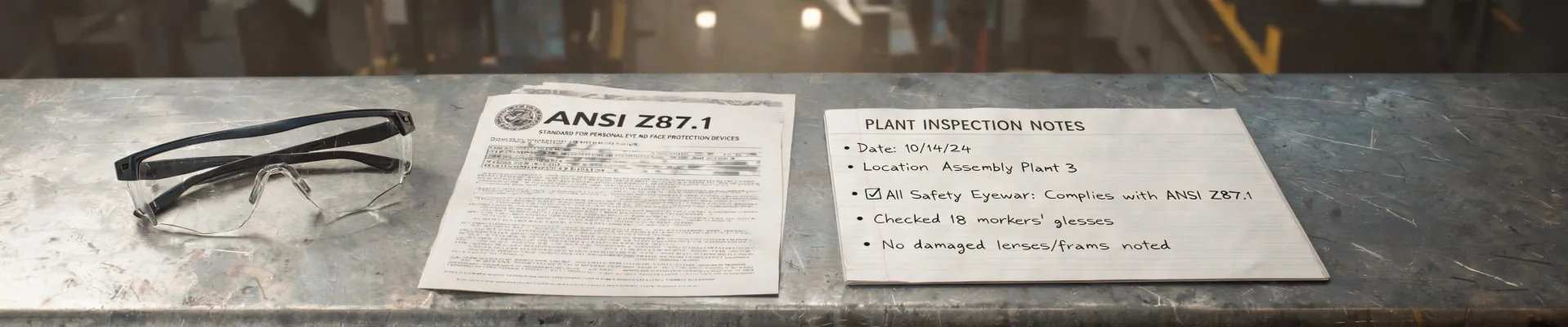
The U.S. baseline for safety eyewear is ANSI Z87.1-2020. The basic impact test drops a one-inch steel ball from fifty inches onto the lens. That's it. It's a minimum, not a promise.
The Wiley X P17 is tested to MIL-PRF-32432, the military standard for ballistic eyewear. The lens has to stop a .22 caliber projectile at speed. The P17 uses a 2.8mm polycarbonate lens with V73 coating, which is engineered to handle abuse—not just to pass a drop test.
Why does that difference matter on a normal construction site? Because grinding, chipping, cutting, and demolition create debris traveling far faster than a steel ball dropped from fifty inches. A lens built for the bare minimum can handle the test. A lens built for ballistic impact handles the real world.
Here's a story that stuck with me. In Q3 2024, we got a 5,000-unit order of ANSI-certified glasses from a new vendor. Paperwork perfect, price attractive, samples good. Then our QC team ran high-velocity impact tests on the production batch. 40% of the lenses cracked. The vendor said it was "within industry standard." We rejected the entire lot and made them redo it at their cost—$18,000 in rework, plus a three-week delay for our client.
We now run the same impact test on every new eyewear vendor. The P17 passed 20 out of 20 units in the last round (finally, a supplier that gets it). Of the six entry-level models we tested alongside it, three failed.
Lens Optics: The Fishbowl Effect
The second thing I check is what the world looks like through the lens. This is harder to quantify than impact strength, but just as real in daily use.
The P17 has a cylindrical lens design that wraps around your face. Standard glasses with flat lenses have a narrower field of view and, at the edges, you see a slight curvature—the classic "fishbowl effect." A straight line appears bent when you move your eyes to the side.
On a forklift or a boom lift, that peripheral distortion is more than an annoyance. It affects depth perception and blind spot awareness. For electricians, some lenses distort colors, which can be dangerous when you're reading wire insulation.
I ran a simple test with a whiteboard and a straight line. The P17 kept the line perfectly straight from edge to edge. Two of the four budget models I tested curved it visibly. Also worth noting: the P17 is available in polarized versions for outdoor work, and the V73 anti-scratch coating holds up far better than the coatings on most budget lenses. Scratches are the #1 reason workers throw away safety glasses, so that coating is not just a marketing gimmick.
Wear Compliance: The Best Glasses Are the Ones That Stay On
Here's an uncomfortable fact: during unannounced walkthroughs at client sites, I usually find only 40-50% of workers wearing their safety glasses at any given moment. Not because they don't care. Because the glasses are uncomfortable, fog up, slide off, or end up on a hard hat "just for a minute."
You remember the Tom Sawyer Island fence defacement story from 2024? Someone reached over the fence and carved their name into it. The fence was well-maintained and clearly intended to keep people out—but it was low enough to reach over, so someone did.
Barriers that create friction eventually get bypassed. Your eye protection is no different. If glasses annoy your crew, they'll find a way not to wear them. It's not spite; it's human nature.
I ran a comfort test with 12 workers on a powder coating line in late 2024. Six wore the P17 for a week; six wore standard safety glasses. Ten of the twelve said the P17 was "noticeably more comfortable" without knowing which pair cost more. During unannounced checks, four of the six standard-glasses users had their eyewear off (one on a hard hat, one in a pocket, one on a bench, one in a truck). In the P17 group, only one did.
Total Cost of Ownership: The Math That Surprises People
"But the P17 is $80 and the standard ones are $15!" Fair point. Let's actually do the math.
In my experience tracking PPE orders, entry-level $15 glasses on active job sites last about three to four months before the lenses get scratched or the frame loosens up. That's 3–4 replacements per year: $45–60 annually.
The P17 frame routinely lasts 2–3 years in the same conditions. Replacement lenses run about $20. So year one costs $80–100, and year two costs $20–40. By year two, the P17 is cheaper. And that's before you factor in compliance.
A single OSHA citation for missing eye protection runs $4,000 to $13,000 per violation (Source: OSHA penalty structure, fiscal year 2024). One citation covers the cost of outfitting a small crew. When I look at the clients who've had repeat eye safety violations, the ones who switched to higher-quality eyewear stopped getting cited. That's not a coincidence.
I spent two weeks going back and forth (frustrating doesn't cover it) on a 50,000-unit annual eyewear contract for a mining client. The cheaper option saved $2.50 per unit—$125,000 in paper savings. But those glasses had failed our impact tests, and I knew what a mining environment does to thin polycarbonate. I recommended the P17 for high-risk zones and entry-level for admin areas. The client agreed. They renewed twice.
When I look back at the procurement decisions I've advised on over the past few years, the lowest quote has ended up costing more in roughly 60% of cases. Not because the cheapest option is always bad, but because price tags don't include what happens when a $15 pair of glasses fails on a job site. Prices referenced here reflect list pricing as of January 2025; verify current rates with your supplier.
Who Should Buy What
I want to be clear: entry-level safety glasses have a place. In low-impact environments—packing stations, administrative areas, visitor walkthroughs—they're perfectly fine.
Choose the Wiley X P17 if:
- Your crew works with grinding, cutting, chipping, drilling, or demolition
- Workers operate forklifts or vehicles where peripheral vision is critical
- You've had compliance issues with workers not wearing eye protection
- Work is outdoors and glare is a factor (the polarized P17 is worth every extra dollar)
- You need prescription safety glasses—Wiley X offers RX carriers that fit the P17 frame
Entry-level glasses are fine when:
- Impact risk is low and tasks are short
- They're for visitors, office staff, or occasional use
- There's a separate eye protection plan for high-risk zones (including proper goggles where applicable)
Two More PPE Questions Buyers Ask Me
Before you go, two questions that come up in almost every procurement conversation I have:
Are black nitrile gloves food safe?
Yes, if they're certified. The FDA permits nitrile rubber for food contact under 21 CFR 177.2600, and black nitrile gloves can be compliant when the colorants are FDA-approved. But not all of them are. When procuring for a food facility, verify that the product documentation states "FDA compliant for food contact"—don't assume based on the color.
What about no-dig fences for site boundaries?
I've seen a spike in interest among construction clients about no-dig fence systems. They use ground screws instead of concrete foundations, so installation is faster and there's zero excavation-related hazard. For temporary site perimeter barriers, that's a legitimate advantage. Same TCO logic applies: factor in installation time, repositioning flexibility, and the hazards you're avoiding in the ground, not just the sticker price per linear foot.
For Procurement Teams: Use the Wiley X Login Portal
One practical tip for enterprise buyers: set up a Wiley X login at wileyx.com before you begin the RFQ process. The B2B portal gives you direct access to certificates of compliance, spec sheets, and bulk-order pricing in one place. It's saved our own purchasing team hours of quote chasing every quarter.

Maeve Callahan
Maeve Callahan is a head-protection analyst covering Type I and Type II hard hats, climbing-style safety helmets, bump caps, chin straps, suspensions, liners, and face-shield carriers. She applies ANSI Z89.1, EN 397, and EN 12492 criteria while comparing impact attenuation, penetration resistance, lateral deformation, electrical class, retention strength, field of vision, mass, fit range, and temperature conditioning. Her guides help EHS teams, contractors, utilities, and buyers select helmet systems for overhead hazards, work at height, electrical exposure, accessory compatibility, and worker acceptance.