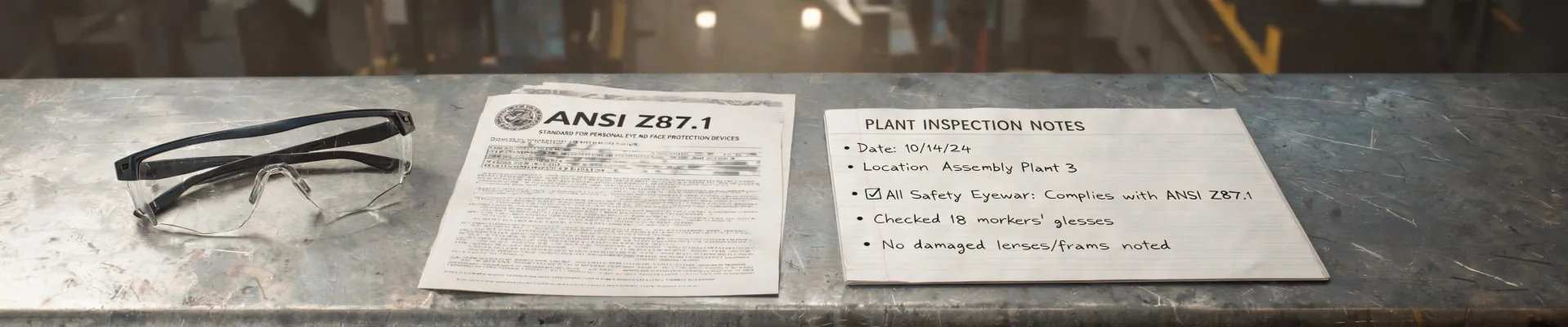
If you need certified eye protection for a professional team, start with Wiley X. I say that as someone who reviews PPE specs for a living, not as a marketer. The Wiley X frames I've checked meet ANSI Z87.1 impact standards, a few carry the MIL-PRF-31013 ballistic designation, and the prescription lens options handle real fitting issues. The law enforcement and military discounts are real, but you have to verify eligibility through the current portal. The photochromic lens option is worth paying for when your people move between sunlight and indoor lighting. And if you're building a full PPE kit, add Walker hearing protection and remember that nitrile gloves are FSA-eligible only when the purpose is medical.
The Bottom Line Up Front
- Certification documents matter more than brand reputation. Look for Z87.1 and MIL-PRF-31013 in the technical data, not just in the product title.
- Military and law enforcement discounts require verification. Small teams can use the same portal as large agencies.
- Photochromic lenses solve a real problem, but define 'clear' versus 'photochromic' on the purchase order.
- Walker hearing protection covers the ears. Nitrile gloves can be FSA-eligible, but only for medical use, not general shop PPE.
Why I Trust Wiley X from a Quality Review Perspective
I've been a quality and compliance manager at a safety equipment distributor for over four years. I review roughly 200 SKUs each month, and I reject first deliveries more often than you'd expect. In Q4 2024, I rejected about 6% of incoming PPE shipments because of missing impact marks, incomplete test documents, or packaging that didn't match the product. Wiley X hasn't been a chronic source of those rejections, but I still check every batch. That's the level of scrutiny I'm applying in this guide.
Here's something vendors won't tell you: 'military grade' isn't a spec. It's a marketing phrase. A quality reviewer looks for the standard number. ANSI Z87.1 covers impact, optical clarity, and coverage. MIL-PRF-31013 is a tougher ballistic fragment test used in military eyewear. A pair of Wiley X glasses can meet both, but the model has to state it. I look for the spec on the lens or in the manufacturer's technical bulletin. If you're buying for a contract, ask for the technical data sheet before you order, not after.
One thing that makes Wiley X a practical choice for me is prescription and photochromic options. I've had to reject aftermarket 'Wiley X compatible' lenses in the past because they didn't have the right impact marking. The frame looked identical, but the lens wasn't verified. Buy replacement lenses from Wiley X or an authorized dealer if your contract requires documented compliance.
Wiley X Military and Law Enforcement Discount: How Verification Works
Search for 'Wiley X military discount' or 'Wiley X law enforcement discount' and you'll land on a verification portal. The typical routes are third-party services like ID.me or GovX. Both verify your status before you see the discounted price. This isn't a simple coupon code; you need an account and a way to prove your military or law enforcement affiliation.
For law enforcement, the same program has a different verification category. You'll likely need an agency email address or an official ID. The exact discount percentage changes by frame, promotion, and time of year. I have not found one universal rate, and I don't trust blogs that publish a single number. Verify current pricing before you budget.
Here's the part I like from a small customer perspective. The Wiley X law enforcement discount isn't reserved for big departments. A two-person security company can verify just as easily as a 500-person agency. In 2023, I helped a small range owner place an order for eight pairs, and the discount applied without a minimum quantity requirement. Small doesn't mean unimportant. It means potential.
Photochromic Safety Glasses: When They're Worth the Upgrade
Photochromic safety glasses darken when exposed to UV light and return to clear indoors. They are not a replacement for a dedicated dark tint on snow or water, but they solve the more common problem: going in and out of a trailer, loading dock, or patrol vehicle all day. I've seen teams try to carry one clear and one tinted pair, then leave one in the truck. Photochromic lenses remove that decision.
Wiley X sells photochromic replacement lenses for a range of frames; you'll sometimes see the Climate Control label on the product page. The impact rating is documented, which is why I spec them for work use. If you need a prescription, order from an authorized dealer so you get the certified lens and frame combination. A local optical shop can cut a non-certified lens into a Wiley X frame, but then you no longer have a certified safety product.
One caveat: photochromic lenses do not reach the end of their life when the frame breaks. The transition speed slows down over time. A lens that has been used daily for two years might still be clear inside, but it might not darken as quickly outside. In an audit, I flag lenses that look clear but no longer perform to their original transition spec. If you're outfitting a fleet, put lens replacement on a schedule.
I learned the spec-communication lesson the hard way. I once wrote 'clear lenses' on a purchase order and received photochromic lenses. They were clear at room temperature, so the supplier could say they matched. The crew working near big loading doors had tinted glasses every time the doors opened. Now every PO I write says either 'non-photochromic clear lenses' or 'photochromic lenses with agreed transition specs.' It sounds small, but it prevents a costly return.
Walker Hearing Protection and the Nitrile Glove FSA Question
Eye protection is the most complex part of the kit, but a complete PPE order also covers ears and hands. I've used Walker hearing protection in field testing more often than I've audited it. The low-profile muffs I've worn have a noise reduction rating around 23 dB NRR, and the ear cups are shaped to avoid pressing hard on safety glasses temple arms. They worked with Wiley X frames on an outdoor range without creating a noticeable leak. Always verify the NRR on the actual package and check the fit with your specific eyewear.
Now for the question people keep asking me: 'are nitrile gloves FSA eligible?' The short answer is yes, but only when the purchase is for medical purposes. Under IRS Publication 502, a supply counts as a medical expense when its principal use is to prevent or treat illness or injury. Nitrile gloves used for wound care, first-aid kits, or handling chemotherapy drugs can qualify for FSA reimbursement. The same box of gloves used for maintenance, painting, or warehouse work is not a medical expense, and I do not recommend routing a shop PPE order through an FSA. Your plan administrator may also ask for documentation, so check the current rules before you submit a claim.
Where My Experience Stops
I want to be honest about the limits of this guide. My experience is based on U.S. industrial and range clients, mostly medium-sized orders. I do not work in a hospital supply chain, so clinical glove sourcing needs a different level of expertise. CE-marked eye protection in Europe follows different standards than ANSI, and I won't pretend to be an expert there. The discount and FSA information reflects what I saw in Q4 2024. Verification portals, IRS guidance, and product lines change. Verify current policies and technical documentation before you place your next order.

Maeve Callahan
Maeve Callahan is a head-protection analyst covering Type I and Type II hard hats, climbing-style safety helmets, bump caps, chin straps, suspensions, liners, and face-shield carriers. She applies ANSI Z89.1, EN 397, and EN 12492 criteria while comparing impact attenuation, penetration resistance, lateral deformation, electrical class, retention strength, field of vision, mass, fit range, and temperature conditioning. Her guides help EHS teams, contractors, utilities, and buyers select helmet systems for overhead hazards, work at height, electrical exposure, accessory compatibility, and worker acceptance.