It was 4:17 p.m. on a Tuesday in March 2024. Our operations manager walked into my office and said we had just won a one-week emergency contract at a county detention center. The crew needed to be on site Friday morning, which meant I had less than two days to get 40 people kitted out with the right PPE.
I've handled purchasing since 2020 for a 140-person industrial services company. Usually that means 60 to 80 orders a year, spread across about eight vendors. It's steady work, not always glamorous. But this was different. A county contract includes paperwork, safety certifications, and a long list of site-specific requirements. The last thing I wanted was to tell a project manager that the gear didn't show up because I tried to save $2 on a pair of safety glasses.
The specs everyone had an opinion about
The list started simple. Hard hats. Safety glasses. Work gloves. Then the facility requirements came through.
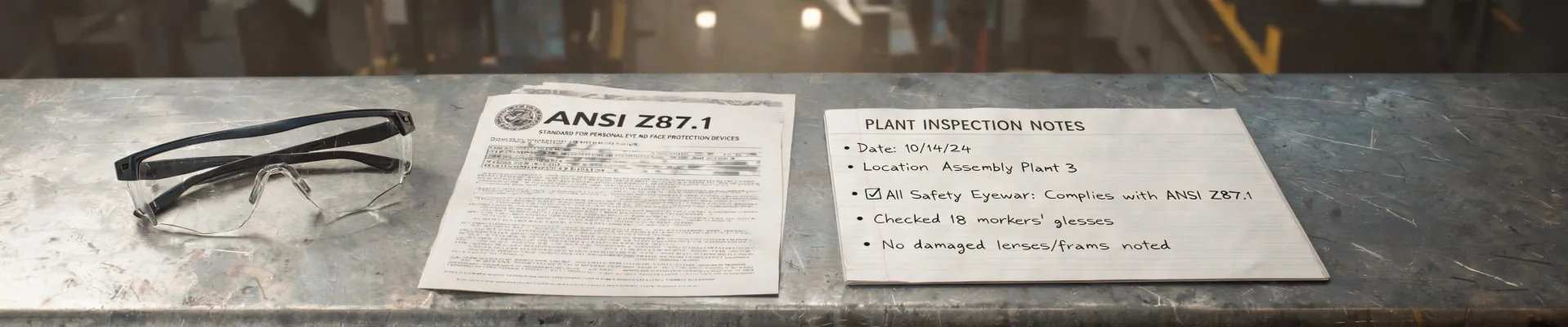
Every person needed impact-rated eye protection that met ANSI Z87.1. Site safety managers usually ask for the Z87 mark on the frame, and OSHA 29 CFR 1910.133 sets the expectation for appropriate eye protection. Some of the crew had their own, but a few showed up in sunglasses. That might work for a sunny day, but not when a safety manager wants to see a certification mark. So I started with Wiley X Brick safety glasses, a model I've used before for jobs that need solid coverage and a wraparound fit. They're not the most stylish thing in the cabinet, but they're dependable for this kind of work.
The harder part was eye protection for three team members who wear prescription glasses. They couldn't just wear goggles over their regular glasses, and they could not see clearly in basic non-prescription safety glasses. I needed prescription safety glasses Wiley X makes or a compatible pair with approved rx inserts.
At the same time, the detention center required Type II, Class E hard hats, not the basic bump caps we use for some light work. I specified Klein hard hats because I knew they carried the ANSI/ISEA Z89.1 rating and because our regular safety distributor had them in stock.
We also needed leather work gloves, of course. One field supervisor called and asked whether I knew how to soften leather gloves before the crew had to wear them for a full shift. New leather gloves can be stiff and uncomfortable, so I told him to work mink oil into them the night before, then wear them around the shop for an hour. That is not a procurement tip, but it saved us complaints the next morning.
Then came the wildcard. The security training coordinator wanted a simple handcuffs drawing for the use-of-force refresher packet. I am not an illustrator, so I found a public-domain training image and sent it over. I mention it because emergency orders never contain only the obvious items. There is always one request that makes you wonder how it ended up on your desk.
The moment I almost made a mistake
Our regular safety supplier had the Klein hard hats, the leather gloves, and the Wiley X Brick safety glasses in stock. If I ordered those by the end of the day, they would arrive Thursday. But when I asked about the three prescription pairs, the rep paused. Their lab could do Wiley X prescription safety glasses, but the lead time was seven to ten business days. I needed them in two.
I called a second supplier, one that focuses on tactical and safety eyewear. They said they could prepare the prescription pairs and ship them with a guaranteed Thursday-by-noon delivery. The catch was price: 38% more than the regular supplier's non-rush quote. They also wanted payment before processing the order.
My first reaction was to push back. Finance would question a purchase order that large. But I put the two options side by side on a whiteboard. On one side, $412 and an estimated delivery of probably Thursday, maybe Friday. On the other, $748 and a guaranteed Thursday delivery. Then I wrote down what a missed date would cost. The first week of this contract was worth about $9,000. Losing it because we lacked three pairs of glasses would make the $336 difference look like pocket change.
When I compared those two numbers, I finally understood something I had been saying for years. An estimated delivery date is just a hope. A guaranteed delivery date is a commitment. The extra fee buys the commitment, not just faster shipping.
What happened next
I placed both orders. The regular supplier got the hard hats, gloves, basic Wiley X Brick safety glasses, and backup goggles. The tactical supplier got the three prescription pairs with rush processing.
Wednesday morning, the regular supplier confirmed the Klein hard hats had shipped and would arrive Thursday. Good. At 2:30 p.m., the tactical supplier sent a tracking number with a scheduled delivery of Thursday at 11:15 a.m. Great.
Then the plot twist. Wednesday at 4:50 p.m., the regular supplier's system changed the hard hat delivery to Friday. No explanation. I called, and the rep said, 'It looks like it missed the truck.' That made me glad the prescription glasses were not on that shipment. If I had bundled everything from the cheaper supplier, we would have had no eyewear, no hard hats, and a very unhappy safety officer.
The prescription glasses arrived Thursday at 10:40 a.m. I checked the rx pairs against the orders, placed them in labeled cases, and handed them to the field supervisor. The Klein hard hats showed up Friday at 9:15 a.m., about two hours before the crew needed them. Technically on time, but I spent Thursday night making contingency plans in case they were delayed again.
I say all this because I have made the opposite mistake too. In 2022, I chose a vendor that was $70 cheaper on a specialized component but could only offer a probable Tuesday delivery. It arrived Friday, and we burned about $1,200 in labor waiting for it. That lesson is why I now separate 'I think it will arrive' from 'I can rely on it arriving.'
The lesson I keep relearning
I'm not an optician, so I can't explain lens coatings or rx insert mechanics. What I can tell you from a purchasing standpoint is that when you have a deadline, you are not paying for speed. You are paying for someone to stand behind a date.
To be fair, not every order needs rush treatment. If I have a two-week lead time, I will shop by price like anyone else. But when a site is ready and a crew is standing by, I treat delivery certainty as part of the specification. The low price only matters if it shows up in time.
Looking back, I should have negotiated an emergency ordering agreement with a rush-capable supplier before March. I did not. Since then, I keep a short list of vendors who can turn around prescription safety glasses in 48 hours, and I update it once a quarter. It costs nothing to keep that list. It costs a lot to discover it is missing in an emergency.
If you manage purchases for a company, take this with a grain of salt. Find the rush-capable vendor now. Check their invoicing, ask about their actual delivery history, and verify what their guaranteed delivery means. Then, when a Tuesday afternoon emergency happens, and it will happen, you won't have to make the same frantic calls I did.

Jane Smith
I’m Jane Smith, a senior content writer with over 15 years of experience in the packaging and printing industry. I specialize in writing about the latest trends, technologies, and best practices in packaging design, sustainability, and printing techniques. My goal is to help businesses understand complex printing processes and design solutions that enhance both product packaging and brand visibility.