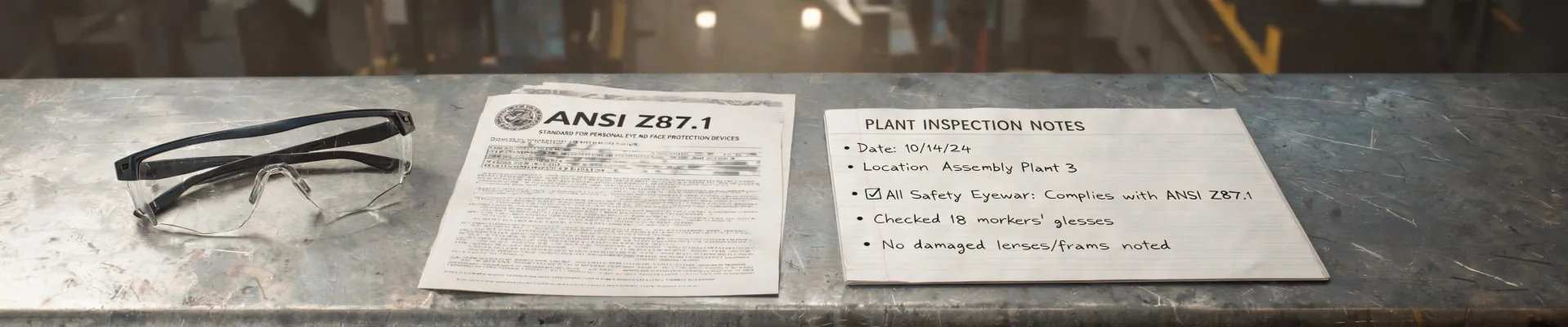
Let me start with what I used to believe: in an emergency, you grab whatever fits and move fast. Get the order out, worry about details later. Three years and about 150 rush orders later, I can tell you that's the most expensive mindset in this industry. Here's the thing: rushing with substandard gear isn't speed—it's a delayed problem wearing a deadline.
The Wake-Up Call: A $15,000 Project That Almost Flipped
For the past eight years, I've coordinated emergency logistics for industrial clients. When something goes wrong on a construction site or a security detail, my team is the one who gets the call. And if there's one thing I've learned, it's that rush orders are not an excuse to ignore standards. In March 2024, I got a call from a security firm. They had 48 hours to set up an upgraded safety perimeter for a high-profile site. The list: 30 pairs of Wiley X Kingpin safety glasses, 30 pairs of metatarsal boots—and if you're wondering what metatarsal boots are, they're reinforced safety shoes that shield the metatarsal bones from impact, critical on construction sites—plus one section of black aluminum fence to replace a damaged barrier. Oh, and for their on-site team, they needed handcuffs from a nearby source. It seemed impossible.
My first instinct? Call the local supply house, grab whatever safety glasses they had in stock, and hope for the best. But I'd been burned before. In 2023, we accepted a pallet of 'budget' eye protection for a client's warehouse team. Within two weeks, two pairs shattered on impact—nobody was injured (thankfully)—but the client ordered replacements and reissued a compliance warning. That $700 'savings' cost us over $4,000 and a dented reputation.
That experience is why, in March 2024, we didn't take the fast-and-dirty route. Instead, we sourced the actual Wiley X ballistic series—not just fashion eyewear with a logo, but lenses that meet ANSI Z87.1 impact standards. Under ANSI Z87.1, impact-rated lenses are tested with a 6.35 mm steel ball at high velocity; Wiley X ballistic models actually go further, meeting the military's MIL-PRF-31013 specification. The order arrived with 20 hours to spare, and the client passed their security audit.
Three Lessons That Fixed My Approach
Lesson 1: Certified Gear Is Faster Than 'Fast' Gear
Here's a paradox: certified equipment often feels like the safe, bureaucratic choice, but it's actually the fastest. Why? Because it doesn't bounce backward. When you install a pair of Wiley X Kingpin safety glasses, you know that lens is ballistic-rated—not just scratch-resistant, but OSHA and ANSI compliant for impact. That means no second-guessing at the audit stage, no rejected inventory, no rework.
What I mean is, if we'd ordered generic wraparounds for that security crew, and the site inspector flagged them, we'd have missed the deadline by two days. Instead, we spent an extra $18 per unit (maybe $19—I'd have to check the invoice) and gained a 100% pass rate on the first try.
Lesson 2: Facilities and PPE Are One System
A lot of buyers separate 'personal protective equipment' from 'infrastructure.' That's a mistake. On a rush project, a missing fence is just as dangerous as missing goggles. The black aluminum fence we installed wasn't just for looks. Aluminum won't rust, the black powder coating holds up in sun and rain, and it went in fast because we ordered the right height and gating system on the first call—no field adjustments.
We'd once ordered a cheaper steel panel for another job and spent four hours cutting and painting because it arrived slightly warped. Time is not neutral on a deadline. It's a currency.
Lesson 3: 'Near Me' Is Part of a Good Emergency Plan
Now, the handcuffs. I know this section sounds out of place for a safety blog, but stay with me. When that security firm asked for 'handcuffs near me,' they didn't want a master class in law enforcement supplies. They needed a local source that could deliver within a few hours, because their team was mobile and couldn't wait for standard shipping.
It took three phone calls to find a uniform shop with six pairs in stock. That's not a reason to panic-buy from random vendors—it's a reminder that your emergency supply chain should include local backup options. Same logic applies to your safety glasses and boots. If your regular supplier is 1,000 miles away, have a verified local vendor on speed dial.
We've also started using a digital pre-check system for every rush order. Instead of manually verifying each item's compliance, our team has built a spreadsheet and later a simple CRM that tracks certification numbers, reorder warnings, and local backup contacts. It doesn't replace experience, but it removes the most common bottlenecks. That's what efficiency means to me—not cutting corners, but cutting delay.
You Might Be Thinking, 'You're Just Pushing an Expensive Brand.'
I understand that reaction. I used to think brand names were margin fluff too. But my evolution is not about logos; it's about verification. Wiley X made my list because they publish their test data and back it with layers of certifications—military specs, ANSI Z87.1, and coatings that resist fogging and scratching. I've seen their manufacturing quality under stress, and more importantly, I've seen their distribution hold up when I needed 30 pairs in 48 hours.
Could another brand meet those standards? Probably. But on a deadline, I don't want 'probably'—I want traceable proof and a partner who answers the phone.
The Bottom Line: Define Efficiency as 'Speed with Standards'
If you think I'm saying 'always buy the premium option', you're missing the point. I'm saying your delivery process should never lower the safety bar to satisfy a ticking clock. The fastest route to completion is one that anticipates failures, checks compliance before purchase, and keeps local backups. That's not wasteful caution—it's efficiency engineering.
So next time someone tells you they need a rush order of safety gear, don't ask what's cheapest. Ask what's the fastest route to fully compliant. In my world, those are the same question.

Jane Smith
I’m Jane Smith, a senior content writer with over 15 years of experience in the packaging and printing industry. I specialize in writing about the latest trends, technologies, and best practices in packaging design, sustainability, and printing techniques. My goal is to help businesses understand complex printing processes and design solutions that enhance both product packaging and brand visibility.