I've been handling PPE orders for seven years. In that time, I've personally made and documented eleven significant buying mistakes, totaling roughly $26,000 in wasted budget. Eleven. If you're counting. I keep a list so our team doesn't have to repeat them.
My worst mistake wasn't buying cheap equipment. It was assuming the word "safety" meant the same thing on every product page. It doesn't. And I found out the hard way.
The surface problem: "It says safety, so it's safe"
When I first started ordering, I treated safety glasses as one generic category. If the frame looked tough and the description said "impact resistant," I bought it. That thinking led me to a $3,800 order of 86 pairs of eye wear that were closer to tinted sunglasses than protective gear.
The vendor listed "military style" and "impact resistant" in the title. The lens had no Z87+ marking. The frame didn't either. I didn't know to look. I approved the order, put it on the shelf, and only realized the problem when a technician pointed it out during a hazard review. 86 pairs. $3,800. Straight to the training bin.
The same thing happens with Amazon safety shoes. A listing says "safety shoe," and people assume it's OSHA-compliant. But OSHA's protective footwear standard (29 CFR 1910.136) requires compliance with ASTM F2413-18. If that marking isn't on the boot or in the product documentation, the word "safety" is just a descriptor. Not a standard.
And it shows up in even more confusing places. I can't tell you how often I've answered the question "what is a tactical vest?" from someone who assumes the word "tactical" means "bulletproof." It doesn't. A tactical vest is a platform for carrying gear or armor plates. The vest by itself may not stop anything. The label explains the intended use. The rating proves the performance. That's the same distinction people miss with eye protection.
The deeper problem: two different jobs, two different standards
Here's the part I wish someone had explained to me earlier. "Safety glasses" and "ballistic goggles" are not two price points for the same product. They're designed for different threats.
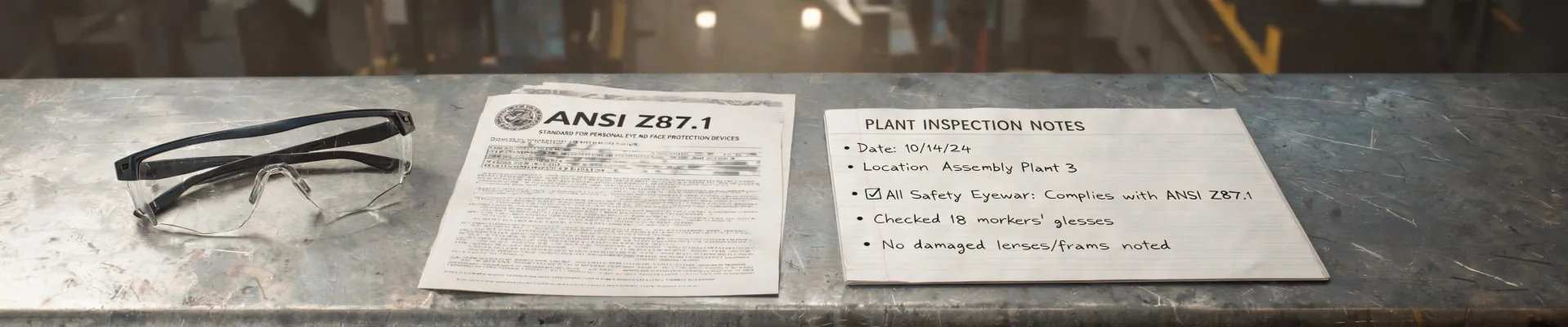
ANSI Z87.1 is the baseline in North America. According to ANSI/ISEA Z87.1-2020, basic impact-rated lenses must survive a drop-ball test at a specified velocity. High-impact lenses have to meet a more severe test, and those lenses are marked Z87+ on the lens itself. If you see just "Z87," it passed the basic test. If you see "Z87+", it passed the high-impact test. That plus sign matters more than most people realize.
Then there's ballistic eye wear. Wiley X ballistic goggles, for example, are tested against fragment impact at higher velocities than the ANSI high-impact test. Many also meet military specifications like MIL-PRF-31013. That's a different level of margin.
For someone working near a metal fence with a grinder, that difference can be the line between a lens that absorbs a hit and a lens that doesn't. The metal fence isn't the hazard. The tiny piece of rust or metal that comes off it at speed is.
The trigger: a cracked lens and a lucky day
In September 2022, I bought a mix of what I thought were high-impact glasses and goggles for a maintenance crew at a fabrication site. The order totaled $3,200. I checked the spec sheets. I checked the purchase order. I did not check the physical markings on a sample unit first.
On the third day, a grinder kicked a fragment off a steel fence rail. The technician wearing the basic glasses took the impact. The lens cracked. He was fine—but only because the piece hit thick plastic at a shallow angle. When I finally looked at the lens, it was marked Z87, not Z87+.
The vendor had written "high impact" in the product description. The lens had not met the high-impact test. We got lucky. The word that came out of the incident report was "near miss." It should have said "we missed the spec."
In hindsight, I should have asked for a sample and checked the marks before approving. But with a deadline and a maintenance director waiting, I made the call on incomplete information. That's on me.
After the third rejection in Q1 2024—not from the facility, but from our own internal review—I created the pre-check list our team still uses. That checklist has caught 47 potential errors in the past 18 months. The first item is always the same: verify the marking on the actual item, not the listing.
What I do now (and what I wish I'd done sooner)
The fix isn't to buy a premium brand blindly. It's to make the standard part of the decision, not an afterthought. Three questions:
- Is the marking on the lens? Not just in the product copy.
- Does the job require basic impact, high impact, or ballistic? If the task involves grinding, cutting, or any high-speed debris, Z87+ is the floor.
- Does the style fit the hazard? Glasses leave gaps. Goggles seal. For dust, splash, or overhead work, goggles are the safer call.
That's why I now recommend the Wiley X Axis safety glasses for general impact protection. They're ANSI Z87+ rated, lightweight, and available with prescription or tinted lens options. For higher-risk tasks, I recommend Wiley X ballistic goggles. They're tested against fragment threats that exceed the high-impact test, and the sealed frame adds coverage you can't get from a spectacle.
I still get asked about Amazon safety shoes. My answer hasn't changed: check for ASTM F2413-18 before you buy. If the listing doesn't tell you, that's an answer in itself.
And when someone asks me, "what is a tactical vest?" I give them a short answer: a tactical vest is a load-bearing platform. Armor inserts are what stop bullets. Know the difference before you spend money.
I'd rather spend ten minutes explaining this stuff than deal with the next mistake. An informed customer asks better questions and makes faster decisions. And the mark is the evidence.
Last thing: I do not claim to have perfect judgment now. I still buy things that don't fit or don't match. But I've stopped confusing labels with standards. That's the part that actually protects people.

Jane Smith
I’m Jane Smith, a senior content writer with over 15 years of experience in the packaging and printing industry. I specialize in writing about the latest trends, technologies, and best practices in packaging design, sustainability, and printing techniques. My goal is to help businesses understand complex printing processes and design solutions that enhance both product packaging and brand visibility.