-
1. Verify the product identity: Wiley X logo and paperwork
-
2. Match the impact rating to the actual hazard
-
3. Verify prescription and lens options
-
4. Gloves: know the difference between food-safe and industrial
-
5. Don't treat tactical boots as safety boots
-
6. Calculate total cost, not unit price
-
Common mistakes and final notes
Here's a line I've heard more times than I'd like: 'Just get the cheaper ones. They look the same.' That mindset is exactly why I have this job. I'm a quality and brand compliance manager at a safety equipment company. I review every incoming shipment before it reaches customers—roughly 150 line items a month, or rather 180 if you count accessory kits. In 2024, I rejected about 12% of first deliveries because specs didn't match what we ordered.
If you're a procurement lead, safety manager, or someone who approves PPE orders, this checklist is for you. It's based on what I actually open boxes and check, not what the marketing sheet says. There are six steps. Do them in order.
1. Verify the product identity: Wiley X logo and paperwork
The Wiley X logo is a useful first indicator, but it isn't the whole test. On genuine frames, the logo appears on the temple and sometimes as a lens etch. If the logo is missing, blurry, or looks like a sticker, treat it as a red flag. I've seen counterfeit frames sold under the 'Wiley X military' label, so don't rely on the logo alone.
Ask for the model number, UPC, supplier invoice, and product data sheet. If the seller can't produce them, that's a rejection reason for me. Traceability matters more when something fails later.
2. Match the impact rating to the actual hazard
For U.S. workplaces, OSHA 29 CFR 1910.133 (osha.gov) requires eye and face protection when workers are exposed to hazards like flying objects, chemical splashes, or harmful light. The first question isn't 'do we need eye protection?' It's 'what level of impact does this hazard demand?'
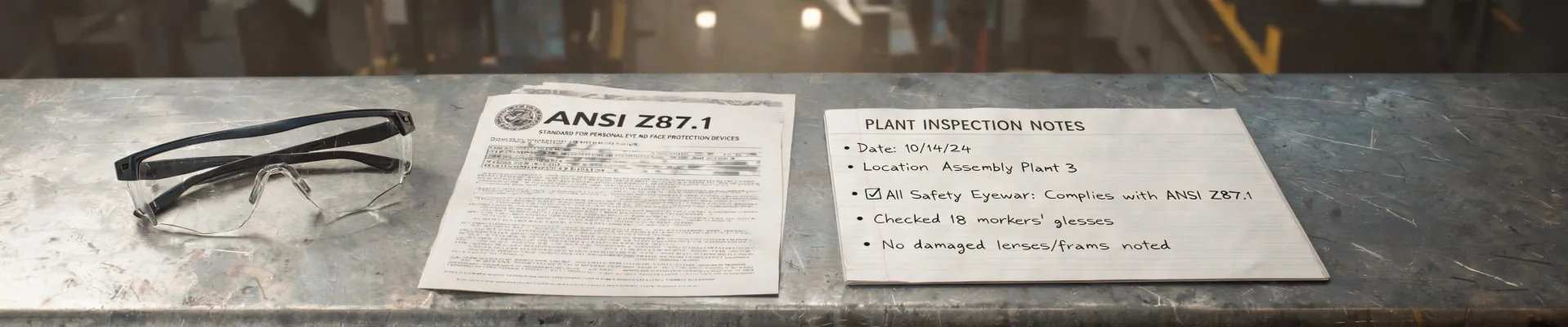
ANSI Z87.1 is the baseline for most industrial eye protection. It tests basic impact, but not every Z87.1-rated product is suitable for high-velocity threats. For work near electric fence lines, battery installs, or grinding operations, I'd want a goggle or eyewear that also meets high-impact requirements. The Wiley X military line is often specified for defense and law enforcement because it meets or exceeds MIL-PRF-31013, but each model is different. Check the specific model's certification, not the category name.
I once approved a batch of 'safety glasses' that looked right, but the ANSI marking was on the temple only. The lens had no impact rating. The numbers said go with the cheaper option. My gut said check the marking. Turns out the lenses were not impact-rated.
3. Verify prescription and lens options
If you're ordering prescription safety glasses, the frame is only half the calculation. The finished lens must meet the same standard as the frame. Ask for the lab certificate showing ANSI Z87.1 compliance for the finished prescription, not just a copy of the frame certificate. This is a step people skip, and it causes returned orders.
Check the tint, too. Polarized lenses are great for outdoor glare, but they are not an impact upgrade. A polarized lens still needs the same impact rating as a clear one. If someone requests 'polarized' just for style, that's a specification issue, not a safety upgrade.
4. Gloves: know the difference between food-safe and industrial
A question that comes up a lot: can nitrile gloves be used for food? Yes, but only if the glove is specifically manufactured for food contact. Food-safe nitrile gloves are usually marked 'FDA compliant for food contact' under 21 CFR 177.2600. Industrial nitrile gloves may contain processing agents that are not intended for food use.
I'm not a food safety specialist, so I can't speak to every FDA interpretation. What I can tell you from a PPE procurement perspective is to check the package and the product data sheet. If the documentation doesn't say food-safe, don't assume it is.
5. Don't treat tactical boots as safety boots
Footwear is easy to overlook. If your spec calls for Merrell tactical boots, remember that 'tactical' is not the same as 'safety toe.' I've inspected boots that looked tough but had no protective toe cap and no puncture-resistant plate. If the job site requires ASTM F2413 protective footwear, verify that exact rating on the label or in the manufacturer's documentation.
This worked for us, but we're a mid-size distributor with predictable orders. If you're a solo contractor ordering for one job, the calculus might be different. The point is to read the spec, not the name on the boot.
6. Calculate total cost, not unit price
By the time you reach this step, the products should pass your spec check. Now look at the real cost. Unit price is only one line. Add freight, lead time, order errors, returns, and the cost of a field failure. A low-cost pair of glasses with no traceability can become the expensive option if it fails an audit or causes a stop-work event. A higher-priced pair with full documentation might be the cheaper option in total.
I do not mean 'cheap is always bad.' I mean you can't compare quotes until you add the hidden costs. The quote that looks low on paper can turn out higher after shipping, replacement processing, and delay-related downtime.
Common mistakes and final notes
- Don't trust a logo alone. Counterfeiters know buyers look for it.
- Don't accept 'should be fine' as a spec. It should be written down.
- Check compatibility between goggles, hard hats, and ear protection. A good eye shield that doesn't fit the helmet is a safety gap.
- Keep storage and expiry in mind. Gloves and other rubber items degrade.
Regulatory information here is for general guidance only. Standards such as ANSI Z87.1, MIL-PRF-31013, ASTM F2413, and FDA 21 CFR 177.2600 are referenced as of January 2025. Verify current requirements with the relevant official source before making a purchase decision.

Jane Smith
I’m Jane Smith, a senior content writer with over 15 years of experience in the packaging and printing industry. I specialize in writing about the latest trends, technologies, and best practices in packaging design, sustainability, and printing techniques. My goal is to help businesses understand complex printing processes and design solutions that enhance both product packaging and brand visibility.