-
What's the difference between Wiley X ballistic goggles and regular safety glasses?
-
Does ANSI Z87.1 certification really matter?
-
Is “ballistic” overkill for a normal construction crew?
-
Can I get Wiley X ballistic goggles with prescription lenses?
-
Polarized or non-polarized: which should I choose?
-
How do I verify Wiley X ANSI Z87.1 compliance on the goggles I receive?
-
Where's the best place to buy Wiley X ballistic goggles near me?
-
Are Wolverine work boots good? And what about boots and coveralls?
I'm a procurement coordinator for an industrial contractor. I've been handling PPE and safety equipment orders for eight years, and in that time I've made (and documented) 14 significant mistakes—totaling roughly $31,000 in wasted budget. Now I maintain my team's procurement checklist so we don't repeat them.
This FAQ covers the questions I hear most often about Wiley X ballistic goggles and ANSI Z87.1 compliance. If you're getting ready to place an order, these are the things I wish someone had made me check before my first big purchase.
- What's the difference between Wiley X ballistic goggles and regular safety glasses?
- Does ANSI Z87.1 certification really matter?
- Is “ballistic” overkill for a normal construction crew?
- Can I get Wiley X ballistic goggles with prescription lenses?
- Polarized or non-polarized: which is right?
- How do I verify Wiley X ANSI Z87.1 compliance?
- Where's the best place to buy Wiley X ballistic goggles near me?
- Are Wolverine work boots good? And what about boots and coveralls?
What's the difference between Wiley X ballistic goggles and regular safety glasses?
Regular safety glasses are tested to ANSI Z87.1—the standard for basic impact protection in industrial settings. Goggles add a sealed frame that keeps dust, splash, and debris from getting around the lens. Wiley X ballistic goggles are a step above: they're tested to military ballistic specs (MIL-PRF-32432) and appear on the U.S. military's APEL list. That's basically the difference between “a dropped tool shouldn't break the lens” and “high-velocity fragments shouldn't break the lens.” For most construction work, ANSI Z87.1 is the minimum you need. For tactical, law enforcement, or military roles, the ballistic rating is the reason you're paying more.
Does ANSI Z87.1 certification really matter?
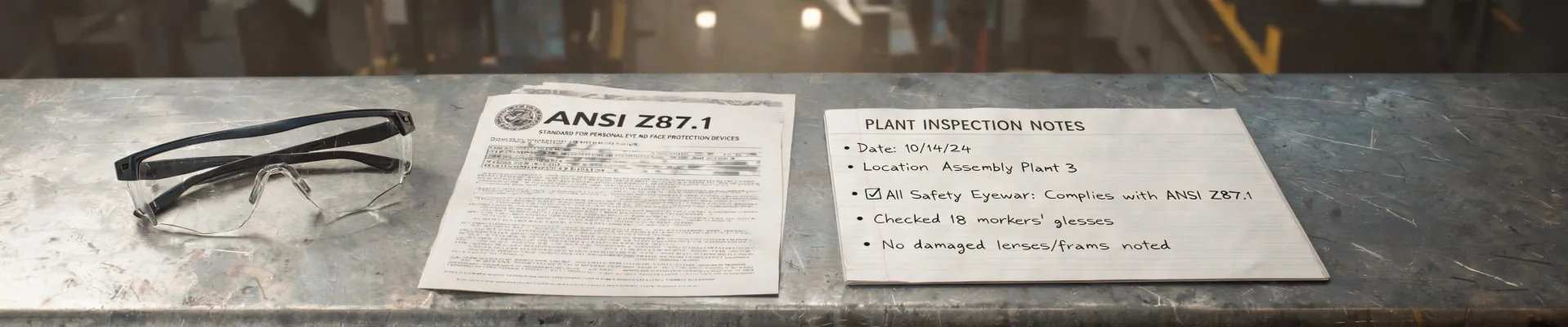
Yes. OSHA's eye and face protection standard (29 CFR 1910.133) requires employers to provide eye protection that complies with ANSI Z87.1. If an inspector sees a worker wearing glasses without the Z87 lens mark, that's a violation. But the bigger reason is the test itself—the mark means the lens survived an impact test, not just a marketing review. I once received a batch of “safety glasses” from a low-cost vendor with no Z87 marking on the lens at all. Caught it during receiving inspection. That $2,850 order went back, and the project slipped three days. Dodged a bigger problem, honestly. Bottom line: I check the marks on every single pair now. A missing Z87 stamp is a deal-breaker.
Is “ballistic” overkill for a normal construction crew?
“Ballistic” means the goggle has been tested against high-velocity projectiles, not just standard impact. Do you need that for everyday construction? Honestly, sometimes it's overkill. If your crew is doing light assembly, overhead work, or general maintenance, a standard ANSI Z87.1 goggle is likely enough. But if there's grinding, cutting, compressed air, or power tools throwing metal chips, I like the extra margin. My rule: run the hazard assessment first, then pick the right level of protection. Don't buy a military spec sheet when your actual risk is dust. And don't skip the ballistic rating on a cutting operation that genuinely needs it. This approach worked for our crews because we have a stable mix of indoor and outdoor work. If you're running a seasonal crew with constantly changing tasks, review your hazard assessment before every project, not once a year.
Can I get Wiley X ballistic goggles with prescription lenses?
Yes—and this is honestly one of the biggest reasons we standardized on Wiley X. They offer prescription-ready models (meaning the goggle shell accepts an RX insert), so crew members who wear corrective lenses are covered. But ask before you order. I learned that in April 2021: I ordered 60 pairs of Wiley X for a project, and 14 of the crew needed prescription inserts. I didn't know until after the goggles arrived. The result was $1,150 in after-market inserts and a two-week schedule headache. Now I count prescription users before I even request a quote. It takes one email—one short email—to the crew lead.
Polarized or non-polarized: which should I choose?
Polarized lenses cut glare from water, snow, wet pavement, and glass. They're a no-brainer for highway crews, utility workers, and outdoor trades. But there's a catch: polarized lenses can make LCD screens look dark or rainbow-like. If your team works with tablets, laptops, or electronic instruments, test one pair before you order fifty. My default is non-polarized for indoor shop work and polarized for outdoor crews. Supervisors who bounce between both get two pairs. It costs more upfront, but it's cheaper than a year of “I can't see the screen” complaints.
How do I verify Wiley X ANSI Z87.1 compliance on the goggles I receive?
Three checks, about 90 seconds per pair. First, look for the “Z87” or “Z87+” mark etched on the lens—that's the physical evidence of impact testing. Second, verify the model number on the frame matches the Wiley X product page on WileyX.com. Third, confirm the model is listed as ANSI Z87.1 compliant on the official product documentation (as of January 2025, the current Wiley X ballistic goggle lineup does list it). If any of those don't line up, reject the shipment. In September 2022, I skipped the second check on a marketplace order, and we ended up with eight counterfeit pairs. $680 gone, and zero protection provided. That was a red flag I should have caught in the photos.
Where's the best place to buy Wiley X ballistic goggles near me?
Use the dealer locator on Wiley X's website—that's the shortcut. It shows authorized dealers in your area. Local safety supply houses are good when you want to physically fit frames before buying in bulk. Military exchanges (the Army & Air Force Exchange and the Navy Exchange) also carry approved models, and I've seen guys in Navy coveralls grab them for deployment. Online, stick to authorized dealers—they usually have better stock of prescription variants. Online authorized dealers vary, too: some carry deep inventory, some ship faster, some specialize in prescription eyewear. Pick based on your timeline and your crew's needs. Unknown third-party marketplaces are how I ended up with fake lenses. Not worth the savings.
Are Wolverine work boots good? And what about boots and coveralls?
Honestly, I can't rate Wolverine work boots. Wiley X makes eye protection and tactical gloves, not boots—and I haven't field-tested Wolverine's lineup. Same goes for Brunt work boots—if you're asking where to find Brunt work boots near me, a local workwear shop is a better source than I am. People who wear boots all day can tell you more than a guy who buys eye protection for a living. Navy coveralls fall into that same category—they're a specialized clothing item with their own spec, and a military supply specialist would be the person to ask. But here's what I do know: when you're ordering eye protection alongside the rest of your PPE, give it the same scrutiny. Check the Z87 mark, verify the model, and buy from a source that can prove it's real. That's my lane, though. Our situation is a fixed industrial crew with fairly predictable PPE needs. If you're managing a large military or tactical team, the buying process might be different—and I'd defer to people who live in that world.

Maeve Callahan
Maeve Callahan is a head-protection analyst covering Type I and Type II hard hats, climbing-style safety helmets, bump caps, chin straps, suspensions, liners, and face-shield carriers. She applies ANSI Z89.1, EN 397, and EN 12492 criteria while comparing impact attenuation, penetration resistance, lateral deformation, electrical class, retention strength, field of vision, mass, fit range, and temperature conditioning. Her guides help EHS teams, contractors, utilities, and buyers select helmet systems for overhead hazards, work at height, electrical exposure, accessory compatibility, and worker acceptance.