I coordinate safety equipment and material orders for a supply company that works with construction crews, including a lot of fence installation contractors. Over the past six years, I've processed more than two hundred rush orders—and I've seen what actually goes wrong when a project is up against a locked-in start date. It took me a few years and a lot of late-night calls to understand that the people who panic-order aren't careless. They're just accountable for things that are only partially in their control. This checklist is what I walk through with a client when the clock is short and the site still isn't ready.
When This Checklist Applies
Use this when you're prepping for a fence installation, a landscaping job, or any outdoor project where the schedule is fixed but the gear isn't. The point is to get you from "we're missing things" to "we're ready" without losing a day. It's not a comprehensive safety training manual—it's the short list of what deserves your attention first. I've broken it into four steps, and they're in the order I'd handle them if I were in your shoes.
Step 1: Get Eye Protection That's Actually Rated
Fence work creates a lot of airborne debris. Cutting posts, driving staples, clearing brush—your eyes are at constant risk. I tell every client to start here because if someone takes a serious eye injury, the job stops completely. That's a much bigger problem than a slightly longer to-do list.
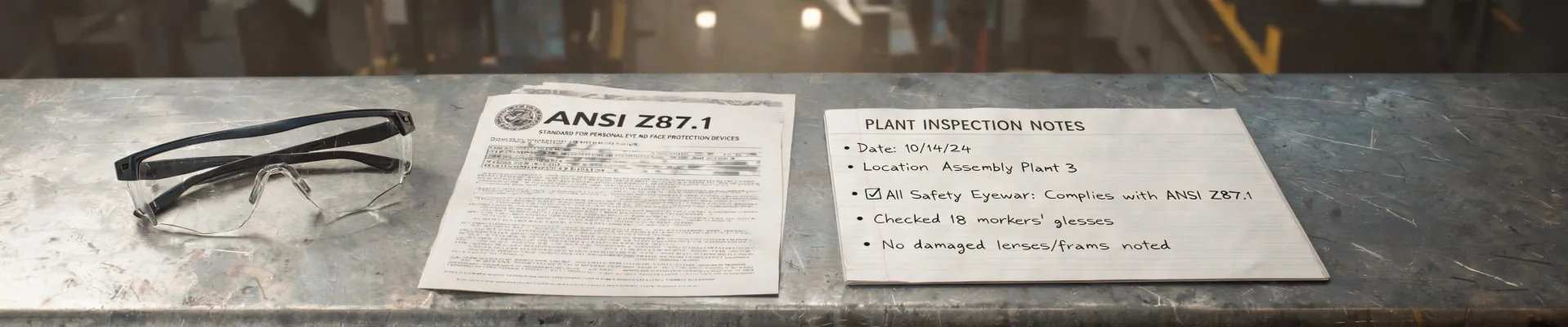
Wiley X safety goggles are a strong pick for this kind of work. They seal around the eye and they're certified to ANSI Z87.1, the impact standard that matters in the U.S. When the crew is working in changing light—morning sun, shaded tree lines, late-afternoon glare—Wiley X clear safety glasses are the most versatile option. Clear lenses don't force anyone to switch pairs halfway through the day. I keep saying "clear" for a reason: tinted lenses look great, but they're wrong for low-light conditions and they can actually be a liability on a shaded site. Clear is the safe default.
One thing I always check with clients: not every pair of "safety-style" glasses on the market is actually impact-rated. The frame or lens should carry the Z87 mark. If a product doesn't show the rating, treat it as a style product until proven otherwise. That's why I steer people toward the Wiley X lineup—the rating is clearly stated on the product listing, and that saves a round of phone calls when you're already out of time.
If you're equipping a crew, get a mix of goggles and clear safety glasses. Goggles for anyone doing overhead work or handling fast-moving debris; glasses for the general crew. It's a small difference, but it's one of those details that shows up on day two, when the job is already underway.
Step 2: Decide on Gloves Before You Hit the Site
Here's a question I get weekly: are nitrile and latex gloves the same? No, they're not.
Nitrile is a synthetic rubber compound. Latex comes from natural rubber latex. Nitrile gloves hold up better against oil, fuel, and punctures; latex is more flexible and gives a closer fit, especially when hands are wet. For handling treated lumber and wire, nitrile-coated work gloves are my default suggestion. The palm coating gives you grip, and the nitrile resists the moisture from wet ground. Latex does have its place—it's useful for tasks where dexterity matters and the environment stays dry—but because latex allergies are common, I always tell contractors to stock nitrile as the baseline.
It's not the answer to every situation, though. If your crew is doing finish work that requires a lot of feel—splicing wire, assembling hardware, handling small parts—a standard nitrile exam glove is often better than a thick work glove. Put another way: the glove has to match the task, not just the project. In my experience, the contractors who keep two types in the truck—nitrile-coated work gloves for the heavy work and nitrile exam gloves for the detail work—are the ones who don't call me for a second rescue order.
To be fair, I get why people grab whatever gloves are at the register. Budgets are real, and it's easy to push gloves to the bottom of the list. But after watching crews burn half a day with inadequate hand protection, the extra minute of thought is worth it. The money you spend on "about right" gloves isn't the problem; the lost time is.
Step 3: Lock Down the Fence Order and the Installation Timeline
This is the project itself. For property-line work, split rail fence is a common choice. It's a classic look, the sections are pre-cut, and it doesn't block the view the way a privacy fence does. That speed is an advantage when the schedule is tight. Cedar is the usual option, though composite is available too—it costs more up front, but it lasts longer and doesn't need staining. The material choice affects the timeline, because composite sections aren't always stocked locally.
When you search "fence installation near me," you're not just looking for a product—you're looking for a crew or a supplier with local logistics. And this is where the split rail fence decision connects to the real world: long rails and posts are heavy and awkward to ship. Freight is slow. A local supplier can often deliver in a day or two, which is exactly what you need when the start date isn't moving. I've seen fence orders get held up in regional distribution centers for a week, not because anything was wrong, just because the shipping lanes don't make it a priority.
What to confirm before you commit to a delivery date:
- Whether the rail sections are pre-cut to standard lengths or need on-site cutting
- How many posts and rail brackets come per section and whether they match your soil type
- Whether the crew's scope includes removal of an existing fence or simply setting a new one
- When exactly the material will arrive—ask for a window with a date, not "sometime early in the week"
Step 4: Verify What Was Promised
Time is the whole game. I tell clients: when someone gives you a delivery window, ask them to guarantee it. Ask for the ship date. Ask for the carrier's pickup time. Ask what happens if it's late. I've paid for rush freight more times than I can count and never regretted it.
In March 2024, a fence contractor called me at 3 p.m. His crew was set to install a split rail fence on a property that backed onto a country club. The base order—Wiley X clear safety glasses for the crew, nitrile work gloves, and split rail sections—was around $2,000. The rush shipping added $400. The job itself was worth $14,000, and the client's walkthrough was fixed on the calendar. He didn't hesitate. The delivery arrived two days later, and the project started on time.
The worst-case alternative was a postponed walkthrough, an unhappy property owner, and potentially a lost contract. That puts the $400 in perspective. The premium wasn't for speed alone—it was for certainty. I wish every contractor reasoned that way from the start, but I understand why they don't. Most people only think about rush fees in dollar terms, not in terms of what they're actually buying: the right to keep the project moving.
Common Mistakes That Cost You the Most
I've been doing this long enough to see the same pitfalls repeat. Here are the ones that hurt the most:
1. Assuming "safety glasses" means "certified safety glasses." If you can't find the ANSI Z87.1 marking, don't risk it. It's not worth finding out the hard way. That's exactly why I recommend a brand like Wiley X, where the rating is clear from the product listing and you don't have to dig through a PDF spec sheet.
2. Treating gloves as an afterthought. Nitrile and latex gloves are not interchangeable, and a crew that shows up with only one option is going to burn time swapping gear. Stock both, or at least make a deliberate call based on the task.
3. Underestimating fence material delivery delays. If a product isn't stocked locally, plan for an extra three to five days. In the fence world, the rail is the long pole. If you're not certain it's in stock, you're already behind.
4. Waiting until the day before to place the order. I get that emergencies happen. But the contractors who call me for the same rush order every month are the ones who eventually run out of luck. The habit is avoidable. If you know a project is coming, order the certified gear at the same time you book the equipment.
Final Thought
I won't tell you that a tight deadline is ideal—it isn't. But it's a realistic situation for a lot of contractors, and the fix isn't complicated. Start with certified eye protection, pick the right glove material for the task, confirm the split rail fence order with a local supplier who can actually deliver in your window, and verify every date before you hang up. The contractors I see succeed don't have a magic process. They just handle the essentials in order—and they don't let a $400 shipping charge put a $14,000 contract at risk.

Maeve Callahan
Maeve Callahan is a head-protection analyst covering Type I and Type II hard hats, climbing-style safety helmets, bump caps, chin straps, suspensions, liners, and face-shield carriers. She applies ANSI Z89.1, EN 397, and EN 12492 criteria while comparing impact attenuation, penetration resistance, lateral deformation, electrical class, retention strength, field of vision, mass, fit range, and temperature conditioning. Her guides help EHS teams, contractors, utilities, and buyers select helmet systems for overhead hazards, work at height, electrical exposure, accessory compatibility, and worker acceptance.