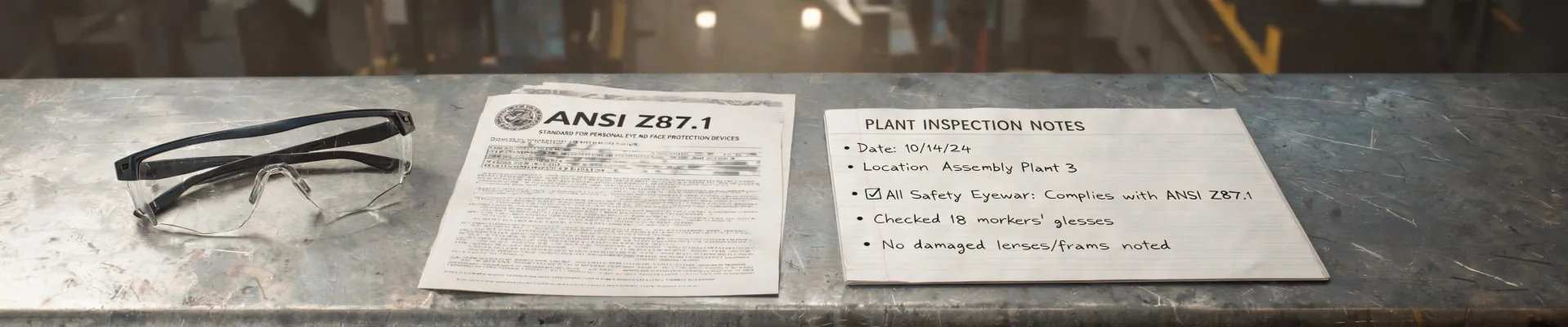
I'm the quality/compliance manager at a safety equipment company. I review every PPE order before it reaches customers—roughly 200 line items a year. I've rejected batches because of markings on labels instead of lenses, side shields that slid out within minutes, and one order where the frame left red marks on someone's temple after a short fitting session.
This checklist is for anyone buying safety glasses for a team: a plant, a crew, a police department, or a military unit. It's not a product review. It's the process I use when someone sends me a purchase request and asks, 'are these okay?'
Here are the steps, in order.
1. Define the hazard before you look at a pair
Most safety eyewear decisions start with a model number. I think that's backwards. The first question should be: what's hitting the eye?
- Impact from flying particles or debris?
- Liquid splash, welding sparks, or chemical mist?
- Dust in windy outdoor environments?
- Glare or UV exposure for outdoor crews?
If there is any chance something comes from the side, side protection matters. When I see the phrase 'safety glasses side shields,' I mentally translate it to 'side protection is part of the spec.' On many job sites, that's not optional.
2. Check the marking, not the marketing
Safety eyewear in the U.S. is usually measured against ANSI Z87.1—or rather, the current standard is ANSI/ISEA Z87.1-2020. The standard covers basic impact. The '+' after Z87 means the lens and frame meet higher impact requirements. If your team is around anything that can hit the eye, look for 'Z87+' on the lens or frame.
When I first started reviewing PPE, I assumed the marking on the box and the marking on the lens were equally reliable. They're not. A sticker can be printed for any product. A lens marking is molded or laser-etched into the actual component. That's the evidence. Simple.
If a supplier can't show you the marking on a physical sample, treat the spec claim as unverified.
For military and tactical buyers, the search is often 'Wiley X sunglasses military.' That will bring up several models. Some are ANSI-rated. Some are tested to MIL-PRF-31013, which is the military high-velocity impact spec. Some just have a tactical look. The model number and the data sheet tell you which is which.
3. Confirm the side shields stay in place
A side shield that falls off is worse than no side shield. It gives people a false sense of protection.
In March 2023, we received a batch of 200 pairs that looked correct in the packaging. The paperwork was right. The markings were right. But when one of our technicians bent down to pick up a carton, the left side shield popped out of the frame. We sent the entire lot back and added a physical 'bend and shake' test to our inspection process.
If you're comparing cheaper frames against Wiley X Axis safety glasses, pay close attention to the side shield attachment. Are they integrated? Are they removable? If removable, do they lock firmly? The axis model name doesn't matter as much as the side shield behavior on the actual unit.
To be fair, side shields are a common failure point across many brands. That's why I check them every time.
4. Match the lens to the environment
One lens doesn't work everywhere. For outdoor work, polarized lenses reduce glare and make contrast better. Clear lenses are usually the safest choice indoors, especially around vehicles and warning lights. Why does this matter? Because a lens that is right at noon can be dangerous at 4 p.m.
For prescription users, this gets more complicated. I'll be clear about my boundary: I'm not an optometrist. I can verify mechanical fit and markings, but the prescription itself needs a licensed professional. Prescription safety glasses are tested as a system—frame and lens together. A 'safety style' frame with a non-safety lens doesn't meet the spec.
If your team works in changing light, consider a photochromic lens. Or just issue two pairs. The cost of the second pair is usually less than the cost of a degraded vision incident.
5. Test fit before you buy in bulk
This is the step most people skip. It's also the step that saves the most money.
I once approved an order because the sample looked basically identical to the current model. It wasn't. The new frame put pressure on the temples, and we saw complaints on the first day. We had 50 pairs in the stockroom and a crew that didn't want to wear them. That's how you end up spending twice.
Now I order samples of each candidate model and hand the same pair to several people: someone who wears a hard hat, someone who wears respirators, someone with a narrow face, someone with a wider face. If a pair doesn't fit the person who will actually wear it, the spec doesn't matter.
The same applies when someone suggests 'let's just get Wiley X Axis safety glasses.' It's a strong model in many situations. But popularity isn't a fit test. Actually, no brand is a fit test.
6. Don't forget the two PPE items that usually slip
If you're doing a full PPE review, look beyond eyewear. Two items are frequently missed on purchase lists.
A CPR face shield
A CPR face shield is one of those items that sits in a first aid kit for years—until someone needs it. It's a compact barrier used during rescue breathing. It's not complicated. But if a kit doesn't include one, a responder may have to choose between giving rescue breaths without protection and doing nothing.
We found several 'complete' first aid kits in our facility that had bandages, gauze, and gloves but no CPR face shield. We changed the restocking requirement. If you audit kits, check for this.
Hearing protection, including the loop earplugs question
One question that comes up when people review PPE is: what are loop earplugs? The short answer: they're reusable earplugs designed for sleep, concerts, and focus. They're not a substitute for industrial hearing protection. For a worksite, you need earplugs with an NRR rating that matches your noise survey. Loop earplugs might be comfortable, but comfort doesn't equal compliance.
Why does this matter? Because the person buying safety glasses is often the same person buying all PPE. If 'earplugs' becomes a generic line item, the wrong product can seem acceptable.
Common mistakes I keep checking for
To be fair, most buyers aren't careless. They're juggling vendors, deadlines, and budgets. But these mistakes show up repeatedly in my reviews:
- Buying on brand name alone. A brand is a shortcut, not a specification.
- Ignoring replacement lenses. If you order frames but not lenses, you'll buy new frames when the first lens scratches.
- Skipping the physical marking check. Catalog photos can look more convincing than the product.
- Ordering one size. Face shapes vary. A team order often needs two or three sizes.
One more thing: don't trust 'compliant' without proof. A supplier should send you the spec sheet, the marking photos, and the test standard. If they hesitate, that tells you something.
That's the checklist. It's not exciting. It's a lot of checking and saying 'show me.' In my experience, that's exactly what keeps people safe.

Jane Smith
I’m Jane Smith, a senior content writer with over 15 years of experience in the packaging and printing industry. I specialize in writing about the latest trends, technologies, and best practices in packaging design, sustainability, and printing techniques. My goal is to help businesses understand complex printing processes and design solutions that enhance both product packaging and brand visibility.