Safety Glasses vs Goggles: There Isn't One Right Answer
Here's the thing about safety glasses vs goggles: there isn't a single winner. Search for a fence installation near me and you'll get a list of contractors who can put up a wood fence in a weekend. But here's a detail that rarely shows up in the bid: what eye protection is the crew actually wearing?
I've spent eight years on the PPE side of construction, and I've handled hundreds of rush orders for firms that realized the wrong gear was sitting in the truck. The question I hear most is safety glasses vs goggles — which is better? Actually, the right question is: what's going to hit your eye, and for how long can you wear protection without taking it off?
Neither category is universally better. Here's a decision tree you can use.
The Decision Tree: Three Questions First
Before comparing frames, answer these three:
- Is there high-speed impact risk — nail guns, grinders, chipping concrete?
- Does the worker need a prescription lens built into the protection?
- Will sweat, humidity, or dust make a sealed goggle fog up?
Your answers put you into one of four scenarios.
Scenario A: Wood Fence Installation and General Construction
For a standard wood fence installation, the main hazards are sawdust, wood chips, dirt, and nails. I normally recommend wraparound safety glasses with side shields rather than full-seal goggles. Wraparound glasses cover a lot of that debris, and crews are more likely to keep them on in hot weather.
Treated lumber and cedar dust also make you blink constantly. A good anti-fog lens is worth the extra few dollars. The common assumption is that goggles are always safer because they seal around the eyes. Early on, I made that exact mistake and sent a crew out with full-seal goggles on a humid fence job. They fogged, came off, and the crew spent the afternoon wiping lenses instead of setting posts. In practice, a fogged lens gets taken off. Then there's no protection at all.
If you're cutting overhead — say trimming fence rails or working under a deck — switch to goggles. That's the moment dust and chips fall straight into your eyes.
For most wood fence work, a good ANSI-rated pair of wraparound glasses is my first choice.
Scenario B: High-Impact Work and Ballistic Risk
Now, if your crew is running a grinder, a cutoff saw, or a nail gun all day, the hazard changes. It's not just dust anymore: it's fast-moving metal fragments or a nail bouncing sideways. This is where I stop talking about basic safety glasses and start talking about impact-rated and ballistic-rated protection.
Look for a frame and lens marked ANSI Z87+ or a military ballistic standard. The plus sign on ANSI Z87+ means the lens passed high-impact testing. It is not the same as a true ballistic rating, which tests against higher-velocity projectiles. For combined impact risk and prescription needs, a pair of Wiley X prescription ballistic glasses is often the right call because the lens is rated and the prescription is built in.
Don't skip the frame. A lens can pass a test, but if the frame allows the lens to pop out on impact, it doesn't matter. I'll be honest: ten years ago, I thought all safety glasses were basically the same. Then I saw what a cheap lens does on impact. The difference shows up before the part falls to the floor.
Scenario C: Prescription Wearers and Wiley X Prescription Ballistic Glasses
Prescription needs change the decision completely. If someone wears glasses all day, over-glasses goggles are the usual fallback. They work for a short task, but they're heavy, prone to fog, and slide around when the worker bends over to set a post.
Prescription inserts are another option. They fit inside a goggle and solve one problem, but they add another lens to keep clean and another surface to fog. For an all-day fence crew, I'd rather get dedicated prescription safety eyewear.
That's where a pair of Wiley X prescription ballistic glasses comes in. The prescription is built into an impact-rated lens, so there's no extra layer. And comfort matters too: adjustable nose bridges and temple grips keep the glasses stable when a worker is bending, reaching, or sighting down a post line. For a high-risk job, ask the supplier for a model with a military ballistic impact rating and confirm it on the package. Per FTC advertising guidance, claims like 'ballistic' need to be substantiated — a spec sheet is more useful than a sticker on the temple.
Scenario D: Humid, Dusty, or Fog-Prone Conditions
Then there's the scenario that causes the most aftermarket orders: fogging. A full-seal goggle in high humidity can become a greenhouse. I've watched a fence crew in South Carolina take their goggles off 15 minutes into the day. No one's gonna keep a fogged lens on their face when they're trying to line up nail spacing.
For that setting, pick wraparound safety glasses with an anti-fog lens. Some Wiley X frames can take a removable foam gasket, turning a pair of glasses into a hybrid when the dust picks up. That type of flexibility is more useful than a single-purpose goggle.
How To Tell Which Scenario You're In
Ask yourself one question: what's moving fastest near the worker's eyes? If it's wood chips from a chop saw on a wood fence build, wraparound Z87+ glasses are enough. If it's sparks or metal shards from a grinder, go ballistic-rated. If the crew wears glasses, get prescription ballistic glasses instead of layering temporary fixes.
When a buyer searches for a fence installation near me, they usually compare prices and scheduling. I'd add eye protection to that comparison. Here's the checklist I use before placing a large order:
- Will the lens stay in front of the eye during a hit?
- Can the worker see clearly through the lens for a full day?
- Is the ANSI or MIL marking printed on the product, not just on the outer packaging?
- If prescription is needed, is it built into the safety lens?
Standards, Rush Orders, and the 48-Hour Buffer
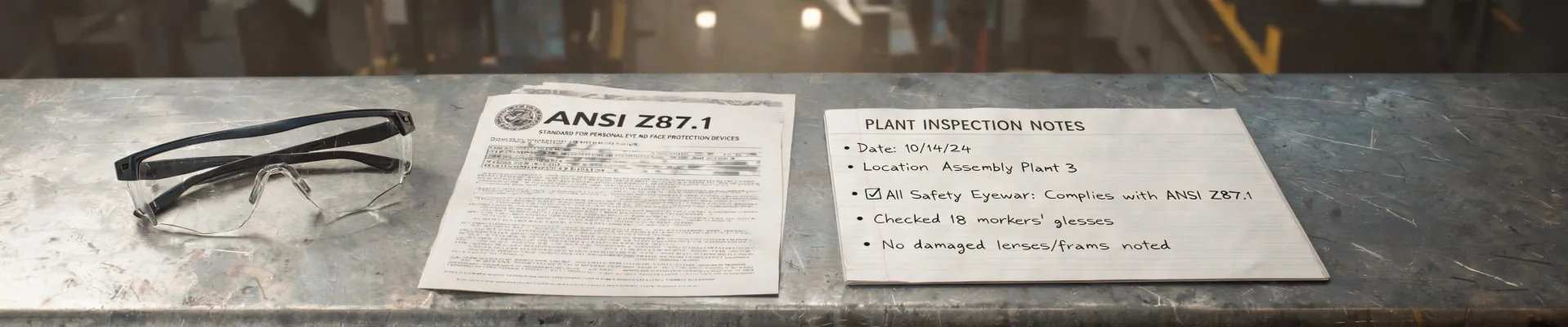
Let's talk standards because that's where procurement mistakes happen. OSHA 29 CFR 1910.133 requires employers to ensure appropriate eye protection for hazards like flying particles. For most construction work, that means ANSI Z87.1. The Z87+ high-impact marking is the minimum I want for anyone running a saw or using a nail gun.
The same logic applies to documentation. I ask for the cut sheet, not the brochure. If a model is ANSI-rated, the marking appears on the lens or frame. For ballistic models, the supplier should point to a test standard. That's how you avoid buying a box that looks serious and a lens that isn't.
Last-minute orders create the most mistakes. I've processed hundreds of rush orders, including 47 in one calendar quarter, and a surprising number were caused by assuming goggles and glasses were interchangeable. One client called me in March 2024, 36 hours before a fence project, because the crew had been sold over-glasses goggles that fogged in the first hour. We built a kit with a pair of Wiley X prescription ballistic glasses for the lead and a set of anti-fog wraparound frames for the rest, then delivered it overnight. The extra freight cost about $85. The crew's lost first day would have cost closer to $4,000. That's why our company policy now requires a 48-hour buffer before any jobsite starts.
Protection isn't just a compliance activity. It's part of the workflow. The right eyewear keeps a two-day wood fence job moving instead of stopping.
Bottom Line
So, safety glasses vs goggles? It's not a one-time choice. A wood fence crew needs different protection than a crew cutting concrete or a worker who wears prescription lenses. Start with comfortable wraparound safety glasses for general construction, upgrade to ballistic-rated when projectiles speed up, and choose prescription safety eyewear when needed.
And when you search for a fence installation near me, do the same thing I do with a rush order: check the task, check the hazard, and make sure the eye protection fits the day ahead.

Jane Smith
I’m Jane Smith, a senior content writer with over 15 years of experience in the packaging and printing industry. I specialize in writing about the latest trends, technologies, and best practices in packaging design, sustainability, and printing techniques. My goal is to help businesses understand complex printing processes and design solutions that enhance both product packaging and brand visibility.