-
There's no one-size-fits-all safety glasses solution
-
Scenario A: High impact risk and you need prescription lenses
-
Scenario B: Industrial work or a serious DIY project, like installing a fence
-
Scenario C: Low-risk environments and the wrong questions people ask
-
How to know which scenario you're in
-
The lesson I keep re-learning
I've been handling PPE orders for 8 years. I've personally made (and documented) six significant mistakes, totaling roughly $19,000 in wasted budget. The most expensive one? Ordering 60 pairs of safety glasses without checking whether the team actually needed prescription lenses. That was 2022. I still kick myself. That mistake broke down into $3,200 for the original order, $1,800 for the redo, and a two-week delay that hurt more than the money.
If you're searching for 'fence installation near me' or 'can I use latex gloves for cooking,' you might wonder why I'm talking about safety eyewear. Honestly? Because I've learned that people ask the wrong question when it comes to protection. They search for one exact phrase and miss the bigger safety issue. The same thing happens with safety glasses.
There's no one-size-fits-all safety glasses solution
No single pair works for every environment. It basically comes down to three things: physical impact risk, whether you need prescription lenses, and how many hours a day you'll actually wear them. Let me walk through the scenarios I've dealt with in procurement—and the mistakes I've made in each one.
Scenario A: High impact risk and you need prescription lenses
This is law enforcement, military, or high-risk industrial work. You don't just want eye protection; you want something that can take a hit and lenses that let you see clearly. If you wear corrective lenses, you have two paths: over-glasses or true rx safety glasses.
I've ordered both. If I had to do it again, I'd go straight to Wiley X rx safety glasses. Not because 'military grade' sounds cool, but because they meet ANSI Z87.1 and the military ballistic standard, and they're available with prescription lenses. The 'rx' part means the lens itself is ground to your prescription—not a plastic insert clipped behind the frame.
Here's what I didn't understand in 2017: a prescription insert inside a goggle isn't the same as a pair of rx safety glasses. The insert can fog up. The alignment can shift. I ordered inserts for a 40-person team, and within three months, half of them were back to wearing their old over-glasses. That order cost us around $3,200, and the redo cost another $1,800 plus a two-week delay. Lesson learned: if you need corrective lenses, spend the money on actual rx glasses.
Over-glasses seem like a money saver, and they are, at first. But they add a layer of distortion, they're heavier, and they don't seal as well against dust. For a team that wears safety glasses all day, the comfort difference is enough to make people skip protection entirely. In my experience, over-glasses work fine for occasional visitors, not for daily operators.
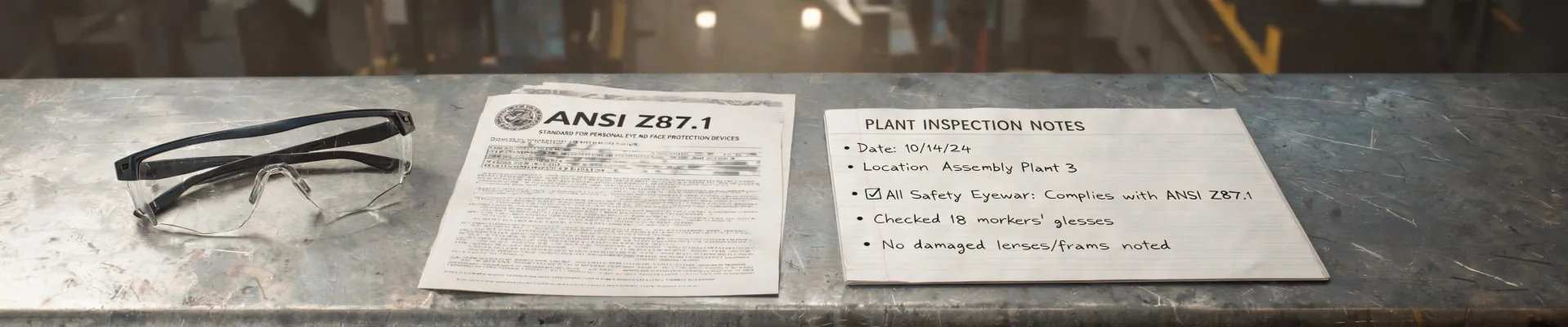
For reference, ANSI/ISEA Z87.1-2020 is the accepted U.S. standard for occupational eye and face protection. It includes basic impact and high-velocity impact tests. The military ballistic standard is stricter—it uses a more demanding projectile test. When a company says 'ballistic protection,' that's the spec they mean. That distinction matters if you're buying for a team that could face flying debris at high speed.
Scenario B: Industrial work or a serious DIY project, like installing a fence
If you're looking up 'fence installation near me,' you're probably planning a project that will involve flying wood chips, nails, or metal fragments. You need ANSI Z87.1 impact protection. You don't need ballistic military certification for a fence. Don't let a marketing department convince you otherwise.
The Wiley X Spectre gloss crystal safety glasses are a solid choice here. They're lightweight, the wraparound frame gives decent coverage, and the clear crystal frame looks neutral enough that people won't leave them in the truck. I started issuing these after a contractor complained that the old goggles fogged up and made him look like he was about to weld. That complaint changed our whole approach: comfortable glasses get worn; uncomfortable ones end up in a drawer.
This is also where I compared brands. 'Wiley X vs Bolle' came up a few times in my notes. I've worn and distributed Bolle safety glasses as well. They're a legitimate option. But when I compared the Wiley X Spectre against a similar Bolle model side by side, I finally understood why fit matters more than brand name. The Spectre's adjustable nosepiece sat better on our team's mixed facial profiles. Lens clarity was comparable, but the frame coverage handled dusty outdoor conditions a bit better. That said, I tested only a few samples, not a full lab comparison. If Bolle fits your face better, use Bolle. The point is to test on actual faces before ordering 100 units.
One more thing about fences: while you're protecting your eyes, don't forget your hands. That brings me to the next scenario.
Scenario C: Low-risk environments and the wrong questions people ask
This is where searches like 'can I use latex gloves for cooking' actually come from. There's a confusion between food-grade gloves and industrial protective gloves. Latex gloves can be used for cooking if they're food-grade and not powdered. But they won't protect your hands when you're installing a fence—a nail can go right through them. For that, you'd want a leather or cut-resistant work glove. The lesson: search the right question.
The same mistake happens with safety glasses. For genuinely low-risk environments, you don't need a premium brand. I'll be blunt. But if you're buying for a facility, the quality of your PPE is part of your company's image. I once walked through a construction site where the safety glasses were so scratched, visitors had to ask which direction the lenses faced. That's embarrassing. When your team is issued decent glasses that fit well, they wear them. That's not a luxury; it's a signal about your safety culture.
I don't have hard data on how many injuries were prevented by better compliance. What I can say anecdotally: comfortable glasses get worn 90 percent of the time. Uncomfortable ones get left on the truck.
How to know which scenario you're in
Before you buy anything, run through this checklist:
Is there any chance of high-velocity impact or fragments? If yes, choose ballistic-rated eyewear. If no, ANSI Z87.1 is sufficient.
Do you wear prescription glasses all day? If yes, invest in rx safety glasses, not inserts.
How long will you wear them each day? If more than four hours, weight and nose bridge design matter more than brand loyalty.
Are you buying for a team? Consider whether one frame fits all faces. The Wiley X Spectre has adjustable nose pieces; some other frames don't.
What's your actual budget? Spending more than $60 per pair for light-duty work is over-specifying. Spending under $15 might mean missing key features like anti-fog coatings.
The lesson I keep re-learning
I've wasted $19,000 on PPE mistakes. Most of that came from assuming a generic answer existed. There isn't one. Match the protection to the risk, the lens to your face, and the budget to the actual hazard. The right question isn't 'which safety glasses are the best brand?' It's 'which safety glasses will actually stay on your face when a piece of metal is flying at it?'
And if you arrived here from a search about fence installation or cooking gloves: please, just make sure whatever project you're doing, you're wearing the right kind of protection. The wrong gloves are bad. The wrong glasses are worse.

Jane Smith
I’m Jane Smith, a senior content writer with over 15 years of experience in the packaging and printing industry. I specialize in writing about the latest trends, technologies, and best practices in packaging design, sustainability, and printing techniques. My goal is to help businesses understand complex printing processes and design solutions that enhance both product packaging and brand visibility.