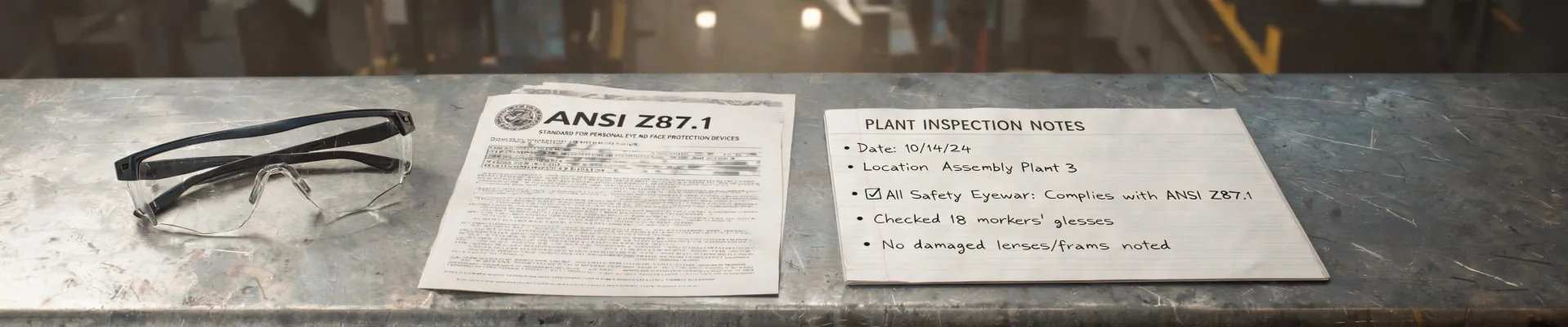
The $22,000 Lesson: When 'Approved' Safety Glasses Weren't Approved
In my Q1 2024 quality audit, I flagged a batch of 500 pairs of safety glasses. They had the right logo, the right packaging, and the right marketing copy. They didn't have the right impact rating for the job site. That oversight cost us a $22,000 redo and delayed a launch by three weeks.
I'm a quality and brand compliance manager. I review roughly 200 unique items annually before they reach customers. I've rejected about 12% of first deliveries in 2024 due to spec non-compliance. And I can tell you—most buyers are looking at the wrong things when they choose safety eyewear.
Look, I'm not saying budget options are always bad. I'm saying the procurement process is broken in ways that aren't obvious until you see the consequences firsthand.
The Surface Problem: Everyone Asks the Wrong Question
The question everyone asks is, "Are these glasses impact-resistant?" The better question is, "What standard are they tested to, and how was that testing done?"
The difference matters. Most buyers focus on a single phrase—"ANSI Z87.1 approved"—and assume that's the end of the story. They don't ask about the testing methodology. They don't verify if the lens thickness is consistent across the entire production run. They don't check if the frame will hold up under ballistic conditions versus a simple drop test.
And that's where the real costs start to stack up.
The Deeper Cause: Standards Overconfidence
Here's a misconception I run into constantly: "If it's ANSI-rated, it's good enough." Actually, ANSI Z87.1 is a baseline—not a guarantee. It specifies a minimum threshold for impact resistance. But there are multiple levels: basic impact, high impact, and ballistic.
The question no one asks is, "What's the difference between testing at 3 feet versus testing at 30 feet?"
A standard safety goggle might pass a drop ball test at ANSI minimum. A pair of Wiley X Saber Advanced ballistic glasses is designed for projectiles at velocities you wouldn't believe. Same ANSI standard, vastly different real-world capability. Most buyers see "Z87.1" and think they're equivalent. They're not. The causation runs the other way—the standard is a floor, not a ceiling.
The Cost of Getting It Wrong
I've seen this pattern play out more times than I'd like. A procurement team saves $6 per pair by going with a generic safety goggle over a ballistic-rated option. The unit cost difference seems justifiable on a spreadsheet. But that's not the only cost.
People think cheaper glasses are a better deal because they look similar. The reality is that the total cost includes:
- Field injuries that could have been prevented with higher-rated protection
- Increased replacement frequency due to lens scratches or frame fatigue
- Lost productivity when workers swap out uncomfortable or fog-prone models
- Regulatory or liability risks if an incident occurs with substandard gear
One of my peers in manufacturing shared a story: a crew on a fence installation job used standard work boots and no-name safety glasses. A stray wire snap sent a piece of debris into a worker's eye. The medical costs, lost time, and insurance premium increase totaled over $18,000. The original "savings" on PPE was maybe $50.
Penny wise, pound foolish? Absolutely. But it happens more often than people admit.
The assumption is that PPE is a commodity—you buy the cheapest that meets the label. The reality is that the label only tells part of the story. You're not just buying a pair of lenses; you're betting on the quality system behind them.
The Real Concern: Consistency at Scale
Here's what keeps me up at night as a quality manager: I can test one pair, see it pass, and not know if the next 499 will pass the same way.
When I specify requirements for a 50,000-unit annual order, I'm not testing a single sample. I'm evaluating the production process. Does the injection molding produce consistent frame thickness? Are the polarized lenses actually blocking glare at the advertised level? Is the anti-fog coating going to delaminate after three months in a humid warehouse?
I've rejected orders where the color deviation on a lens tint was Delta E of 2.7—above the standard of 2.0. The vendor claimed it was "within industry standard." We rejected the batch, and they redid it at their cost. Now every contract includes a color tolerance spec in writing.
That's the kind of thing that doesn't show up on a spec sheet. It shows up on a job site, when a worker can't see clearly because the tint is off and they're squinting into the sun. It shows up in a QC log, when 12% of first articles get flagged. It shows up in a liability audit, when someone asks, "What standard did you use?"
A Sustainable Approach to PPE Procurement
So where does this leave you? The same place it leaves me: trying to make decisions with incomplete information.
I can't promise you'll never run into quality issues. I can tell you that 5 minutes of upfront verification beats 5 days of corrective action. I've learned that the hard way, more than once.
Here's my standard checklist now:
- Ask for the specific test report. Not just the certification label. The actual test data for the specific product SKU.
- Verify the standard. Is it ANSI Z87.1 basic impact, high impact, or ballistic? The difference is critical.
- Check the consistency. Ask about QC sampling rates and rejection thresholds for the production line.
- Test for your environment. If you're in a dusty job site, polarized anti-fog lenses matter more than a high-fashion frame. If you're in a military depot, ballistic protection is non-negotiable.
And yes—sometimes the better option costs more up front. But the math changes when you factor in avoided rework, fewer replacements, and reduced risk.
If you're sourcing for a 50-person crew or a 5,000-person facility, the same principles apply. The goal isn't to buy the cheapest pair. The goal is to buy the right pair once, and not have to think about it again until the warranty expires.
I review about 200 unique items a year. I reject roughly 12% on first delivery. That's been consistent for four years. The numbers haven't changed because the pressure to take shortcuts hasn't changed. But the ones that pass? They don't come back.
That's the standard I aim for—no returns, no rework, no second-guessing. It's achievable, but it takes looking past the surface claims and asking the question everyone else skips: "What's the actual spec?"

Maeve Callahan
Maeve Callahan is a head-protection analyst covering Type I and Type II hard hats, climbing-style safety helmets, bump caps, chin straps, suspensions, liners, and face-shield carriers. She applies ANSI Z89.1, EN 397, and EN 12492 criteria while comparing impact attenuation, penetration resistance, lateral deformation, electrical class, retention strength, field of vision, mass, fit range, and temperature conditioning. Her guides help EHS teams, contractors, utilities, and buyers select helmet systems for overhead hazards, work at height, electrical exposure, accessory compatibility, and worker acceptance.