-
Who This Checklist Is For
-
Step 1: Understand the Hazard Classification (Not Just 'Safety Glasses')
-
Step 2: Determine If You Need Prescription or Polarized (and Why It Matters for Budget)
-
Step 3: Verify the Fit (The Forgotten Step)
-
Step 4: Check for Tactical or Military Requirements (This Is Not Standard PPE)
-
Step 5: Calculate Total Cost of Ownership (Not Just Unit Price)
-
Step 6: Source from Authorized Distributors (Avoid the 'Cheap' Surprise)
-
Step 7: Document Everything for Finance and Compliance
-
Common Mistakes (and What to Watch For)
-
Final Thought
Who This Checklist Is For
If you're the person in your company who gets told "we need safety glasses" and has to figure out which ones—without a background in PPE—this is for you. I manage purchasing for a 150-person industrial firm. I process about 70 orders a year across 8 different vendors. I'm not a safety engineer. I'm the person who has to make the budget work and keep everyone from operations to finance happy.
This checklist covers how to specify Wiley X products—specifically the Wiley X Fusion Safety Glasses and the Wiley X SG-1 Tactical Goggle. It's not a product review. It's a how-to guide for getting the order right the first time. Because I've learned (the expensive way) that a wrong spec costs more than just the return shipping.
Here are the 7 steps I now follow. Every. Single. Time.
Step 1: Understand the Hazard Classification (Not Just 'Safety Glasses')
This is the step most beginners skip. They search "safety glasses," find something that looks good, and order. If I remember correctly, that was my approach in 2021. Big mistake.
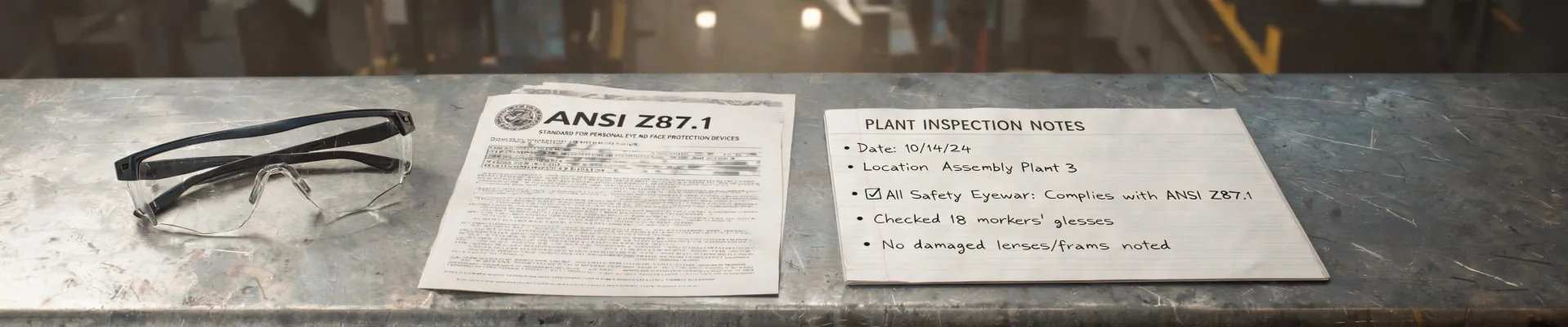
You need to know the specific hazard. Is it impact from debris? Splash from chemicals? UV exposure? Welding flash? The Wiley X SG-1 is a tactical goggle—it's rated for high-velocity impact (per ANSI Z87.1-2020). It's great for grinding, chipping, or any task where small particles fly at speed. But it's not vented. If you need splash protection, you'd want a different goggle (maybe with indirect venting).
Checkpoint before ordering: Get a written hazard assessment from your safety officer. Or, if you don't have one, ask your workers: "What's the worst thing that could hit your eye?" Their answer dictates the spec.
According to the American National Standards Institute (ANSI), the Z87.1 standard covers everything from basic impact to high-mass impact (Source: ANSI Z87.1-2020; verify current standard at ansi.org). Don't assume all 'safety glasses' are equal. They're not. Period.
Step 2: Determine If You Need Prescription or Polarized (and Why It Matters for Budget)
About 60% of our employees wear prescription glasses. They can't wear standard safety glasses over their regular ones—that's uncomfortable and unsafe. Wiley X offers prescription safety glasses in many of their frames, including the Fusion style. This is a huge advantage because it eliminates the need for over-glasses (which fog up constantly).
But here's the nuance: prescription lenses add cost. Frame pricing might be $60-120, but the prescription insert can double that (pricing as of January 2025; verify at wileyx.com). If you budget $100 per pair and the user needs RX, you'll be $100 short.
Polarized lenses are different. They reduce glare. Great for outdoor work, driving, or bright environments. But polarized safety glasses can make it hard to see LCD screens (like on some equipment). I learned this when our maintenance team couldn't read their diagnostic tablets.
Checkpoint: Survey your team. Ask: "Do you wear glasses? Do you work with digital screens?" This 5-minute survey will save you from ordering the wrong lens type.
Step 3: Verify the Fit (The Forgotten Step)
You can't return safety glasses after they've been issued—well, you can, but OSHA has rules about re-issuing used PPE. So fit matters from the start.
The Wiley X Fusion is a wraparound style with a rubberized temple tip. It fits most medium-to-large faces. The SG-1 is a goggle with an adjustable strap. It fits over most prescription frames (which is why it's popular in tactical and law enforcement).
But "most" is not "all." In 2023, I ordered 50 pairs of a certain model (not Wiley X). 15 were returned because they pinched. That's a $450 restocking fee plus 8 hours of admin time processing returns. (Note to self: order samples first.)
Action: Order 2-3 sample units in different sizes before committing to bulk. Have 3-4 employees with different face shapes try them for 15 minutes. Ask: "Does this hurt anywhere?" That's your test. Simple.
Step 4: Check for Tactical or Military Requirements (This Is Not Standard PPE)
If your team includes military personnel, law enforcement, or security contractors, the spec changes. The Wiley X SG-1 is a tactical goggle—it meets MIL-PRF-32432 (the U.S. military's ballistic standard). That's a higher impact level than ANSI Z87.1. It also has a removable foam insert for dust protection.
But here's the thing: if you order the SG-1 for general construction use, you're overspending. The SG-1 is $70-100. A standard Wiley X safety glass is $30-60. You're paying for ballistic protection you don't need.
Checkpoint: Ask your procurement contact: "Is this for general safety or for tactical use?" If the latter, verify the exact military standard required (not all 'tactical' glasses meet MIL-PRF-32432). Per the U.S. Department of Defense, this is the standard for ballistic eyewear (Source: MIL-PRF-32432; verify current version at assist.dla.mil).
Step 5: Calculate Total Cost of Ownership (Not Just Unit Price)
I used to buy the cheapest safety glasses I could find. $8 per pair. Great for the budget, right? No. Wrong. They scratched within a week. Workers threw them away and grabbed another pair. We went through 200 pairs in 6 months. That's $1,600, plus the environmental waste.
Wiley X lenses are scratch-resistant and treated with anti-fog coatings. A $40 pair might last 6-12 months. That's $40-80 per worker per year, versus $150-200 for the cheap stuff. Total cost of ownership (i.e., purchase price + replacement frequency + admin cost) favors the better product every time.
I did the math in Q1 2024. We switched to Wiley X for our grinding crew. Year one savings: about $600 on replacements alone. (Though I should note: we have a small crew—maybe 20 people. For a larger team, savings scale.)
Checkpoint: Calculate annual cost per worker, not unit cost. Assume 2-3 replacement cycles for economy glasses vs 1 for premium. That's your real number.
Step 6: Source from Authorized Distributors (Avoid the 'Cheap' Surprise)
This is the step that costs people money. You search online, find a Wiley X SG-1 for $50 (versus $80 retail). Seems like a deal. It's likely counterfeit, used, or a different model. Wiley X has a strict authorized dealer network. If it's not on their list, you're taking a risk.
What's the risk? A counterfeit lens might shatter on impact. That's not a budget problem—that's a safety and liability problem. In 2022, a company I know (not mine) bought 100 'Wiley X' goggles from an unauthorized seller. The lenses failed impact testing. They had to recall all units and issue real ones. Cost: $3,000 for the goggles plus 20 hours of admin time. (Surprise, surprise.)
Action: Check Wiley X's dealer locator (wileyx.com/dealers) before ordering. If the price is too good to be true, it probably is. Done.
Step 7: Document Everything for Finance and Compliance
As the admin buyer, you answer to operations and finance. If an auditor asks: "Why did you buy $3,000 worth of safety glasses?" you need a paper trail. I now keep a simple spreadsheet with:
- Hazard justification (per Step 1)
- Fit test results (per Step 3)
- Invoice from authorized dealer (per Step 6)
- ANSI certification number (on the frame)
This 10-minute step saved me when our VP asked about a $2,400 order. I could show him the hazard assessment and the fit test records. No questions asked.
Checkpoint: Before you click 'pay,' make sure you can answer: "Why this model?" and "Why this vendor?" If you can't, you're not done yet.
Common Mistakes (and What to Watch For)
1. Assuming 'Standard' Means the Same Everywhere
I once ordered 'standard safety glasses' from two vendors. They were different sizes, different lens curvatures, and had different anti-fog coatings. One batch fogged up immediately. I had to return 40 pairs. Cost: $120 in restocking fees. Now I check the product code, not the description.
2. Skipping the Fit Test for Tactical Goggles
The SG-1 is adjustable, but it's not one-size-fits-all. If the foam seal doesn't sit flush, you get dust infiltration. We had one user with a narrow face—the goggle leaked. We swapped it for a smaller model. Problem solved.
3. Forgetting the Warranty and Replacement Parts
Wiley X sells replacement lenses and foam kits for the SG-1. If you buy 50 goggles and 10 lenses scratch, you don't need 10 new goggles—you need 10 replacement lenses. This cuts replacement cost by 70%. I didn't know this for my first two years. Now I always check the spare parts page. (Mental note: order 20% extra lenses with every bulk goggle order.)
4. Not Verifying the 'Wood Fence' or 'Halo Dog Fence' Search Problem
I'm being serious—when I first searched for 'Wiley X safety glasses,' I got results for wood fences and dog fences. It's a search algorithm quirk. Don't trust the first 10 results to be relevant. Use specific model terms: "Wiley X Fusion," "Wiley X SG-1," or "Wiley X prescription safety glasses." Using exact keywords will get you to the right page much faster.
5. Ignoring the 'Are Loop Earplugs Worth It?' Question
This isn't about Loop earplugs. But the question matters: when a worker asks about hearing protection, they might see Loop earplugs advertised and wonder if those are a better option than standard earplugs. For industrial use, standard ANSI-rated plugs or muffs are required. Loop earplugs are consumer products, not PPE. If someone asks, direct them to your company's approved hearing protection list. Don't overthink this one.
Final Thought
Specifying safety eyewear isn't rocket science. But it's also not something you can rush. The 7 steps above cover hazard, fit, budget, and compliance. Follow them, and you'll avoid the $600 redo, the VP's awkward question, and—most importantly—the risk of someone getting hurt.
Prices as of January 2025; verify current rates at wileyx.com. Regulations per ANSI Z87.1-2020; verify current standard at ansi.org.

Maeve Callahan
Maeve Callahan is a head-protection analyst covering Type I and Type II hard hats, climbing-style safety helmets, bump caps, chin straps, suspensions, liners, and face-shield carriers. She applies ANSI Z89.1, EN 397, and EN 12492 criteria while comparing impact attenuation, penetration resistance, lateral deformation, electrical class, retention strength, field of vision, mass, fit range, and temperature conditioning. Her guides help EHS teams, contractors, utilities, and buyers select helmet systems for overhead hazards, work at height, electrical exposure, accessory compatibility, and worker acceptance.