The Call That Started It All
It was a Tuesday afternoon in March 2024 when my phone rang. On the line was a logistics coordinator for a regional military training exercise. They needed 200 pairs of ballistic safety glasses—specifically, Wiley X models—for a live-fire demonstration that was now scheduled three days earlier than planned. Normal turnaround for a custom order with prescription inserts? About two weeks. We had 36 hours.
This wasn't my first rodeo with a rush order, but it was definitely one of the tighter ones. In my role coordinating PPE for government and industrial clients over the past six years—handling something like 200+ emergency requests—I've learned that the difference between a successful delivery and a catastrophic miss often comes down to a handful of decisions made in the first hour.
The Temptation to Simplify
It's tempting to think choosing safety eyewear is as simple as picking a model and checking a box. The military-grade specs are clearly listed: ANSI Z87.1 for basic impact, MIL-PRF-32432 for ballistic fragmentation. But here's what that oversimplification ignores: the subtle differences in fit, lens curvature, and whether a prescription insert will actually seat properly for someone wearing a helmet and a radio headset. The 'just buy the right SKU' advice ignores the fact that a pair of glasses that's 5 millimeters off in bridge height can become a distraction—or worse, a safety hazard—during an 8-hour operation.
The Process Unfolds
First Steps: Triage and Specification
When I'm triaging a rush order, the first thing I do isn't look at inventory. It's ask three questions:
- What's the specific threat environment? (Ballistic? Chemical splash? Just impact?)
- What's the user profile? (Prescription needed? Polarized for glare reduction?)
- What's the absolute latest delivery time that's still useful?
For this order, the answers were straightforward: MIL-PRF-32432 ballistic protection, a mix of prescription and non-prescription users, and the glasses needed to be on-site by 0600 hours Thursday morning. The client originally asked for Wiley X Helix models—a solid choice with good fog resistance and a comfortable gasket—but we quickly realized the prescription volume might be a bottleneck.
Here's where things got interesting. The standard prescription insert for the Helix requires specific lab equipment that our usual vendor couldn't guarantee in 24 hours. I knew I should have escalated this earlier—maybe called a backup lab immediately—but we were all scrambling, and I thought, 'What are the odds the primary lab can't handle it?' Well, the odds caught up with me when they called at 4 PM saying they were backed up. That was the one time the 'it's basically the same as last time' thinking cost us. I had to find a second vendor, pay $400 extra in rush fees (on top of the $2,500 base cost for the glasses), and still got the delivery done at midnight instead of the planned afternoon.
The Middle Phase: Logistics and Risk
With the labs sorted, the next challenge was shipping. We needed six distinct SKUs—some with prescription inserts, some polarized, some with clear lenses for indoor use—all arriving together at a military base with strict security protocols. This is the part of the process where I've made every mistake possible. In my first year, I made the classic specification error: assumed that 'standard shipping' meant the same thing to every logistics partner. Cost me a $600 redo when a shipment arrived with a damaged case because the packaging wasn't rated for the route.
For this job, we went with next-day air from a carrier we have a contract with—which, honestly, felt excessive at $320 for a 10-pound box. But after 6 different rush-order failures with discount vendors over the years (including one where a shipment to a police department got lost for three days in a regional hub), we now only use carriers with real-time tracking and signature confirmation. It's a policy we implemented after losing a $12,000 contract in 2023 because we tried to save $200 on standard shipping instead of using a verified provider. The delay cost our client their certification deadline. That hurt.
The Turning Point: A Near Miss
The real crisis hit at 8 PM Tuesday night. The client called: one of their officers had an unusually strong prescription—something like a -8.5 diopter—and the standard insert couldn't accommodate it. The lab had already cut the lenses for the standard insert. We had two options: recut the lenses (another 12 hours and another $150 in fees) or swap the frame to a Wiley X model with a deeper prescription insert pocket, like the Valion or the Brick.
This was the moment that separated a good outcome from a disaster. I knew the Valion model had a slightly wider field of view and a deeper gasket, which would work for the prescription, but it would also delay everything by at least 8 hours because we needed a new frame from a different distribution center. I had to make a call: do I pay for the recut on the current frame and hope it works, or do I commit to the Valion swap and push everything back?
Based on our internal data from 200+ rush jobs, I know that trying to force a bad fit almost always ends poorly. We've had cases where glasses arrived, the user wore them for an hour, and had to take them off because the prescription alignment was off by a millimeter—which causes eye strain and headaches. So I made the call: swap to the Valion. Paid the extra rush shipping from a distributor in Texas, and scheduled a direct pick-up at the base to avoid carrier delays. Total extra cost: $220. But it saved the whole order.
The Result and the Lesson
The glasses arrived at 3 AM Thursday. The base security officer signed for them. The live-fire exercise went ahead without a hitch. The officer with the strong prescription later sent a note saying the Valion fit was 'the most comfortable I've ever worn under a helmet.'
So what did I learn from this? The biggest thing is that efficiency in procurement isn't just about speed—it's about having a system that anticipates the edge cases. In the rush to meet a deadline, it's easy to say 'this will work' and skip the verification step. But the automated process of maintaining a backup vendor list and pre-negotiated rush rates saved this order. We went from a normal 2-week turnaround to a 36-hour delivery because we had a protocol for triage, escalation, and risk management.
Switching to that structured approach cut our average emergency turnaround from 5 days to 2 days over the past year. And it reduced the 'surprise' failures—the ones where you realize at 10 PM that the insert doesn't fit—from about one in every five rush orders to about one in twenty. The process eliminated the data entry errors we used to have when people were typing orders manually while on the phone. Now, we use a digital intake form that prompts for all the critical specs: prescription power, lens type, frame preference, and delivery location. It's not perfect—sometimes the dropdown doesn't have the exact SKU—but it's way better than the whiteboard-and-scratch-paper system we had in 2020.
Three Things to Consider When Choosing Safety Eyewear for Your Team
If you're managing PPE procurement (especially for military, law enforcement, or industrial teams), here are the three questions I'd ask before any purchase:
- What's the worst-case scenario for fit? Most safety glasses are designed for average faces. But if your team includes people with strong prescriptions, wider or narrower head shapes, or those who need to wear glasses under helmets and headsets, don't assume a standard model works. Test it. Or get a vendor (like Wiley X, which offers multiple frame shapes and prescription depths) who specializes in accommodating those edge cases.
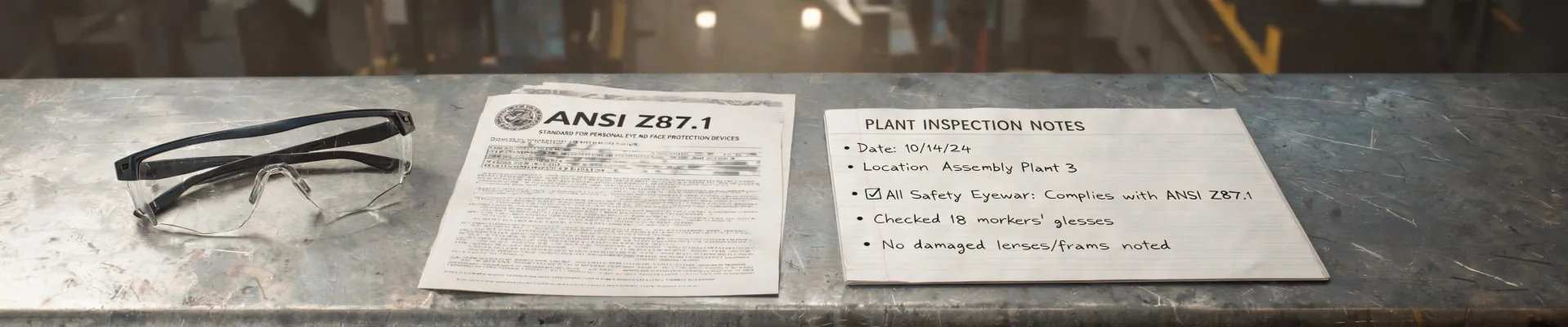
- How will you verify ANSI compliance? It's not enough that the box says 'ANSI Z87.1'. You need to know which specific tests the glasses passed (basic impact vs. high impact vs. ballistic). According to the American National Standards Institute (ANSI) guidelines, the marking 'Z87+' indicates high-impact compliance, while 'Z87-2' indicates prescription lenses with impact resistance. I've seen buyers assume a 'Z87' mark covers everything, only to realize later it doesn't cover the ballistic fragmentation they need. That's a $500 mistake.
- What's your backup plan for delivery? This sounds obvious, but I've been in meetings where the procurement team has no plan B for shipping. If your primary carrier fails—and it will at some point—do you have a second option that can deliver in 24 hours? Do you have a list of authorized distributors you can call directly? When we lost that $12,000 contract in 2023, it wasn't because the glasses were wrong; it was because we trusted a single logistics provider without a backup. Now, our standard operating procedure (I know, it's a boring term, but it's saved us a ton of headaches) includes a contingency shipping plan for every order over $1,000.
Final Thoughts
I'm not saying every order needs to be treated like an emergency. But the mindset of 'this will probably work' is a red flag in PPE procurement. The military and industrial clients I work with don't have room for 'probably.' They need glasses that fit, that meet a specific standard, and that arrive when promised. And honestly, that's what makes a vendor worth hiring: not just the price, but the process. The willingness to say, 'I know that model is popular, but for your prescription, this other model will actually be safer.' That's the difference between a supplier and a partner.
(And yes, we now have a policy: for any prescription safety eyewear order, we always ask for a digital scan or an up-to-date prescription from an optometrist. It takes 10 extra minutes, but it's saved us from at least four redo orders in the last year alone. Not bad for a lesson learned the hard way.)

Maeve Callahan
Maeve Callahan is a head-protection analyst covering Type I and Type II hard hats, climbing-style safety helmets, bump caps, chin straps, suspensions, liners, and face-shield carriers. She applies ANSI Z89.1, EN 397, and EN 12492 criteria while comparing impact attenuation, penetration resistance, lateral deformation, electrical class, retention strength, field of vision, mass, fit range, and temperature conditioning. Her guides help EHS teams, contractors, utilities, and buyers select helmet systems for overhead hazards, work at height, electrical exposure, accessory compatibility, and worker acceptance.