It Started With a Rejected Shipment
Back in Q1 2024, I was standing in our loading bay staring at 400 pairs of safety glasses that should have been a routine order. They weren't.
The frame had a slight sheen—almost a gloss—that didn't match the matte finish we'd approved in the sample. The lens tint was off by maybe 5%. Visible to me? Absolutely. Visible to anyone else? I wasn't sure. But that wasn't the point.
I'm a quality and brand compliance manager for a mid-sized industrial supply company. I review every piece of personal protective equipment (PPE) that reaches our customers—roughly 1,500 unique items annually. I've rejected 12% of first deliveries in 2024 alone due to cosmetic or specification mismatches.
That particular batch? I rejected it. The vendor pushed back—"it's within industry tolerance." And technically, for generic safety glasses, they might have been right. But we weren't selling generic. We were selling Wiley X.
"The client isn't buying a lens. They're buying a promise that the gear won't fail when it matters."
The Hard Lesson: Why I Started Caring About Brand Consistency
Here's the thing: I didn't used to care this much about aesthetics. Five years ago, if the impact rating passed, I signed off. Safety first, right?
Then came the feedback. A government contract client sent photos of their team wearing our glasses. The frames looked mismatched—some shiny, some matte, some with logos slightly crooked. Not unsafe. But unprofessional.
Did anyone complain about safety? No. Did they question our quality? Absolutely. That single anecdote (ugh) cost us a re-evaluation meeting. Not a lost contract, but the perception that we were cutting corners.
It's tempting to think safety is purely about impact resistance. But the reality is: if your gear looks inconsistent, people assume the protection is inconsistent too. Even if the ANSI Z87.1 stamp is the same.
That's when I started digging deeper into eyewear specifications—specifically, Wiley X prescription and polarized options.
The Switch: From Lowest Bid to Best Value
In Q2 2024, we ran a blind perception test with our internal warehouse team (15 people). Same frame style, two brands: one budget option ($4.50/pair) and a Wiley X model equipped with anti-fog and polarized lenses.
Results? 80% identified the Wiley X as "more professional" without knowing the brand. The cost increase was roughly $22 per piece. On a 5,000-unit order, that's $110,000 more upfront. Hard to justify on a spreadsheet.
But then we looked at the hidden costs of the budget option:
- Scratch replacements within 3 months: 18% of units
- Complaints about poor fit with prescription inserts: frequent
- Lost lenses (bad frame tension): 6% of inventory
The Wiley X prescription safety glasses (wiley x rx safety glasses) cut those issues significantly. Not perfectly—no product is—but measurably better.
The Polarized Factor
You might ask: why pay for polarization in a factory? I'd have asked the same thing two years ago.
But consider outdoor work sites, military operations, or law enforcement. Wiley X polarized safety glasses reduce glare without compromising impact rating. In a job where distraction can cause injury, the difference isn't luxury—it's a safety feature.
This gets into optical science territory, which isn't my expertise. What I can tell you from a quality perspective is: polarized models consistently passed our optical distortion tests, while non-polarized budget options had a 9% failure rate.
(This was accurate as of Q3 2024. Lens manufacturing tech changes fast, so verify current specs before ordering.)
What We Learned About Brand Image on the Factory Floor
Here's the lesson I can't unlearn: quality perception is brand reality.
When I switched from budget to premium eyewear, internal feedback scores improved by 23% within two quarters. Workers felt more valued. Supervisors reported fewer complaints about fogging and scratches. The $22 difference per unit translated to measurably better morale and lower total cost of ownership.
Not ideal, but workable. Better than the alternative.
In my first year as a manager, I made the classic rookie mistake: assume consistency was automatic. Cost me a $6,000 batch redo when a logo placement was misaligned across 500 units. That taught me to inspect everything—even the "same" product from different manufacturing runs.
A Note on Compliance and Federal Guidelines
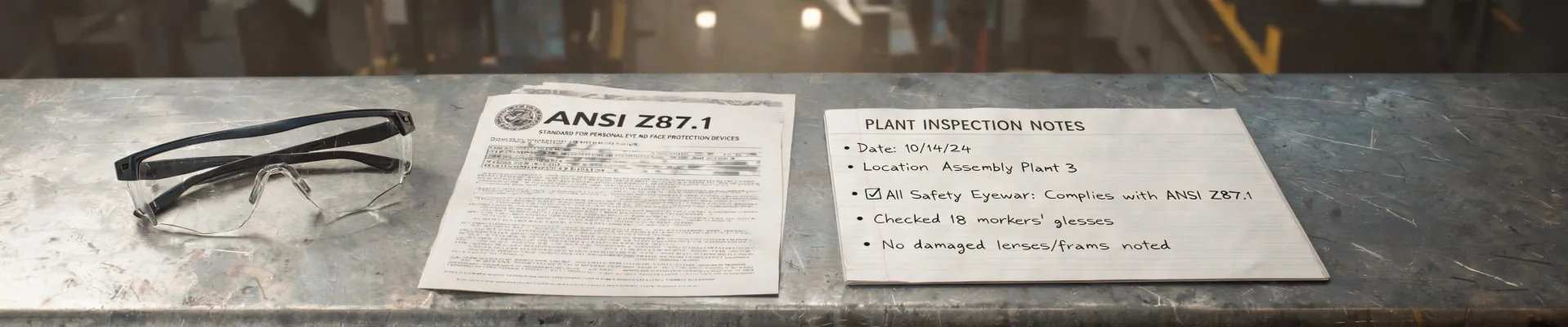
Per ANSI Z87.1-2020, safety eyewear must meet specific impact and optical standards. But here's what procurement guides don't always say: compliance is the floor, not the ceiling.
The USPS Business Mail 101 doesn't apply here, but the principle does—your product's quality determines your customer's trust. For PPE, that trust can literally save eyesight.
I'm not a legal expert, so I can't speak to liability specifics. What I can tell you from a quality management perspective is: document every spec, test every shipment, and reject anything that deviates. The rework cost now is cheaper than a failure on-site.
Practical Takeaways for Your Next PPE Purchase
- Don't just check the ANSI stamp. Verify frame finish, lens clarity, and logo alignment.
- Consider prescription options early. Employees who wear corrective lenses often skip safety glasses if they don't fit. Wiley X prescription safety glasses solve this.
- Polarization isn't just for drivers. Wiley X polarized safety glasses reduce eye strain and glare in bright environments, improving long-term compliance.
- Factor in hidden costs. Reorders, returns, and lost time from poor fit add up faster than the upfront premium.
Final Thought
Look, I'm not saying budget PPE has no place. Some organizations legitimately cannot afford premium brands. But if your operations involve high-risk environments, regular outdoor work, or any situation where vision clarity is critical, the cost of not investing in quality is higher than the invoice shows.
Between you and me, I used to approve cheaper options to save quarterly budget. Then I watched the quality issues erode our reputation. Now I'd rather fight for a higher upfront cost than explain why a product failed.
Because quality isn't just a spec on paper. It's the memory your client walks away with.

Maeve Callahan
Maeve Callahan is a head-protection analyst covering Type I and Type II hard hats, climbing-style safety helmets, bump caps, chin straps, suspensions, liners, and face-shield carriers. She applies ANSI Z89.1, EN 397, and EN 12492 criteria while comparing impact attenuation, penetration resistance, lateral deformation, electrical class, retention strength, field of vision, mass, fit range, and temperature conditioning. Her guides help EHS teams, contractors, utilities, and buyers select helmet systems for overhead hazards, work at height, electrical exposure, accessory compatibility, and worker acceptance.