-
Quick scenario map
- 1. Are Wiley X sunglasses safety rated? Yes, with the right marking
- 2. Fire extinguisher inspection tags: compliance is a process, not a sticker
- 3. Pool fence ideas: match the barrier to the risk
- 4. Who sells Brunt work boots near me? Probably no one, and that's okay
-
How to decide: the 10-minute TCO check
For the past six years, I've been the procurement manager at a 45-person industrial maintenance company. I manage about $180,000 a year in safety-adjacent spending, and I've documented every purchase order in a cost tracking spreadsheet. That's not a flex. It's just how I caught a $1,200 mistake in our old fire extinguisher tag system. The vendor charged us for 'expedited scheduling' because we waited until the last week of the year. That's the kind of hidden cost that never shows up in a unit price.
Here's the thing: there's no universal answer for what to buy. The right purchase depends on your situation. So in this article, I'm going to walk through four common searches—wiley x axis safety glasses, fire extinguisher inspection tags, pool fence ideas, and who sells brunt work boots near me—and explain how I'd approach each one if it were my budget. An informed customer asks better questions and makes faster decisions. I'd rather spend 10 minutes explaining the trade-offs now than deal with a mismatched order later.
Quick scenario map
- If you face impact hazards every day, read the Wiley X section.
- If you need to track extinguisher inspections, jump to the fire extinguisher tags section.
- If you're building a pool barrier, read the pool fence ideas section.
- If you need boots this week, go straight to the Brunt work boots section.
1. Are Wiley X sunglasses safety rated? Yes, with the right marking
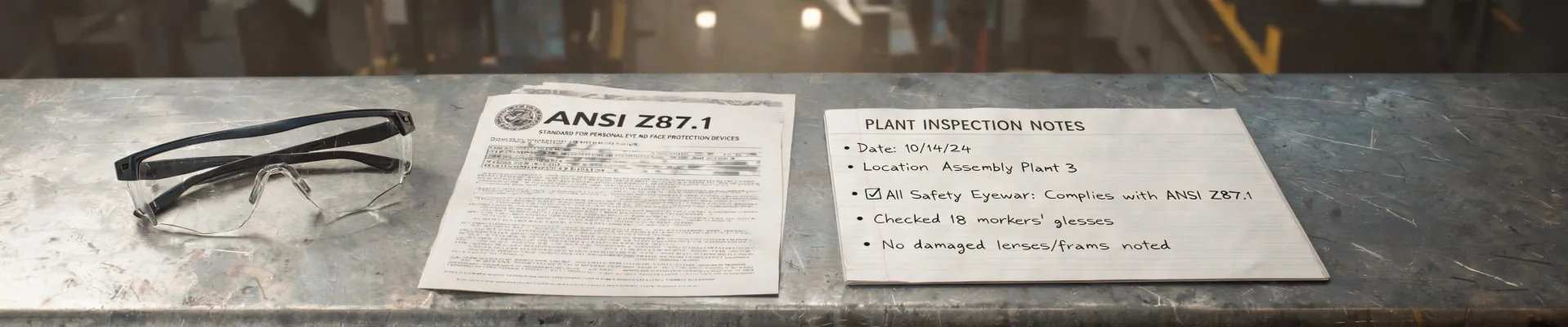
Let's answer the first question directly. Are Wiley X sunglasses safety rated? Yes, for most of the line, but only if the frame and lens carry the ANSI Z87.1 marking. The Wiley X Axis model is one I've ordered for our mechanics. It has a full-frame design and replaceable lenses. The 'safety rated' part is not vibes; it's a printed standard on the frame. Per FTC guidelines, a claim like 'safety rated' has to be substantiated. Wiley X does that with ANSI Z87.1 and, on certain ballistic models, MIL-PRF-31013.
I've typed Wiley-X into order forms more times than I can count, but the official brand is still Wiley X. If you search for wiley x axis safety glasses, you'll see about 30 different price points. Here's how I'd separate them.
Scenario A: daily impact hazard
Buy the Axis or a similar Wiley X model. The cost-per-wear math works out if you're wearing them daily. At $60 to $100 for a frame with replacement lenses, you're paying maybe $0.25 a workday over two years. That's less than the cost of a copayment for an eye injury. I don't have hard data on our injury claims because we've been lucky—no corneas scratched in my time here. But a single urgent care visit costs more than a drawer full of safety glasses.
Scenario B: prescription safety glasses
This is where Wiley X earns the price. Their prescription safety options are certified as a system, not just a lens with an Rx glued in. I've seen cheap 'safety glasses' from online stores that aren't actually ANSI marked once you put them under a lensometer. Check for the marking on both the frame and the lens. If a vendor can't show you the marking, treat the 'safety rated' label as marketing.
Scenario C: occasional use, no ballistic risk
Honestly, a $15 pair of ANSI-rated glasses is fine. Over-buying is waste. The Axis is a tough frame with replaceable lenses, but if you only need low-impact dust protection, buy the $15 pair and put the $70 difference toward other line items. My experience is based on maintenance crews, not weld shops or chemical labs. If you're in a higher-risk industry, step up to the ballistic rating.
Per FTC guidelines, 'safety rated' has to mean something verifiable. On Wiley X, the verification is printed on the frame: ANSI Z87.1, and on ballistic models, MIL-PRF-31013. No marking, no rating.
2. Fire extinguisher inspection tags: compliance is a process, not a sticker
Fire extinguisher inspection tags are one of those line items that look too cheap to worry about. A roll of tagstock costs a few dollars. The expensive part is missing an inspection date and having a fire marshal call it out during a busy week.
Here are the three scenarios I see.
Scenario A: small office, one or two extinguishers
A simple tag with the month and the initials of the person who did the visual check is probably enough. Keep a binder or a digital sheet too, because the tag is only as good as the record behind it. The monthly visual check doesn't need to be complicated. It does need to be dated.
Scenario B: multi-site company
This is where I've seen the hidden cost. You need tags that have room for annual maintenance, hydrostatic test dates, and the technician's certification number. The tag is not the product—the inspection service is. Get quotes from three vendors and compare the cost of the visit, not the tag. One time we went with a lower quote and the technician didn't leave a dated tag. The citation cost more than we saved.
Scenario C: leased property
Before you buy the tags, read the lease. The landlord might be legally responsible for extinguishers, but if they don't perform the inspection, you share the risk. In that case, purchase your own tags and do monthly visual checks while documenting everything. It's a small cost for a larger piece of mind.
OSHA's 29 CFR 1910.157 requires monthly visual inspections and annual maintenance for portable extinguishers. NFPA 10 gives the tag requirements. The tag is evidence, not bureaucracy.
3. Pool fence ideas: match the barrier to the risk
Pool fence ideas are everywhere online. Some are gorgeous. A few are even practical. When I helped install a perimeter fence around a pond on company property in 2023, I learned that the fence is only as good as the gate hardware and the gap underneath.
The U.S. Consumer Product Safety Commission recommends a pool fence at least 4 feet high, with gates that self-close and self-latch. That's the baseline. Now for the scenarios.
Scenario A: small children at home
Safety is the only priority. A mesh pool fence, the kind you unhook when you're using the pool, is not the prettiest, but it works. Look for one that meets the CPSC guidelines: at least 4 feet high, no climbable horizontal rails, and a gate latch your toddler can't reach.
Scenario B: HOA or backyard view matters
Ornamental iron or aluminum fencing looks better, but make the gate hardware the priority. A pretty fence with a cheap self-latching mechanism is a failure waiting to happen. I'd rather see a less beautiful fence that actually closes by itself than a showpiece with a gate that can be left open.
Scenario C: rental property and liability
If the pool is part of a rental property, a removable mesh fence is often the easiest install and doesn't require heavy construction. But check with your insurer first. Some policies require a permanent fence. We didn't expect that one, and it changed the budget.
Contrarian take: a decorative fence that's too short or has a window gap is worse than no fence at all. It gives you a false sense of security. The fence has to do the job when nobody is watching.
4. Who sells Brunt work boots near me? Probably no one, and that's okay
If your last search was who sells brunt work boots near me, this section is for you. Here's the honest answer: Brunt primarily sells direct-to-consumer at bruntworkwear.com. As of January 2025, a local dealer network isn't how they operate. I can't tell you about every regional shop, and I won't pretend to know your town. That's a sample limitation: I've only used Brunt's online ordering. If you need to try boots on, use their free returns as a safety net.
Scenario A: you need boots this week
Buy a cheap local pair for now and order Brunt for next week. The $50 stopgap is cheaper than a boot that hurts your feet for a month. In the long run, a $150 boot that fits well costs less than a $100 boot that gets replaced in four months.
Scenario B: you're buying for a crew
This is where I get interested. A boot that costs $160 and lasts 8 to 10 months is a better TCO than a $90 boot that lasts 3 to 4 months. I don't have hard data on Brunt's lifespan, but our foreman has been wearing a pair for six months and the sole is still holding up. That's an anecdote, not a datasheet. If you want numbers, ask the vendor for warranty claim data. If they won't share, that tells you something.
Scenario C: you just need a boot, not a brand
Then don't spend too much time on 'near me.' Find a safety footwear distributor in your area, try on five pairs, and ignore the brand until you know the fit. Brunt isn't magic. It's a price-value play. The right boot is the one that works for your foot and your workday.
How to decide: the 10-minute TCO check
If you're still stuck, don't read another article. Get a piece of paper and write down the total cost of the wrong choice.
- For Wiley X: what happens if a worker gets an eye injury?
- For fire extinguisher tags: what happens if an inspector writes you up?
- For a pool fence: what happens if a child wanders over?
- For work boots: what happens if your feet hurt so much you can't work?
Once you put a number on the worst-case scenario, the 'expensive' option starts to look cheap. That's the system I use. It's not about buying premium for the sake of it. It's about knowing which line items deserve the budget and which ones are just sticker shock. I'd rather spend 10 minutes explaining your options now than deal with a mismatched purchase order later. That's the whole point of customer education.

Maeve Callahan
Maeve Callahan is a head-protection analyst covering Type I and Type II hard hats, climbing-style safety helmets, bump caps, chin straps, suspensions, liners, and face-shield carriers. She applies ANSI Z89.1, EN 397, and EN 12492 criteria while comparing impact attenuation, penetration resistance, lateral deformation, electrical class, retention strength, field of vision, mass, fit range, and temperature conditioning. Her guides help EHS teams, contractors, utilities, and buyers select helmet systems for overhead hazards, work at height, electrical exposure, accessory compatibility, and worker acceptance.