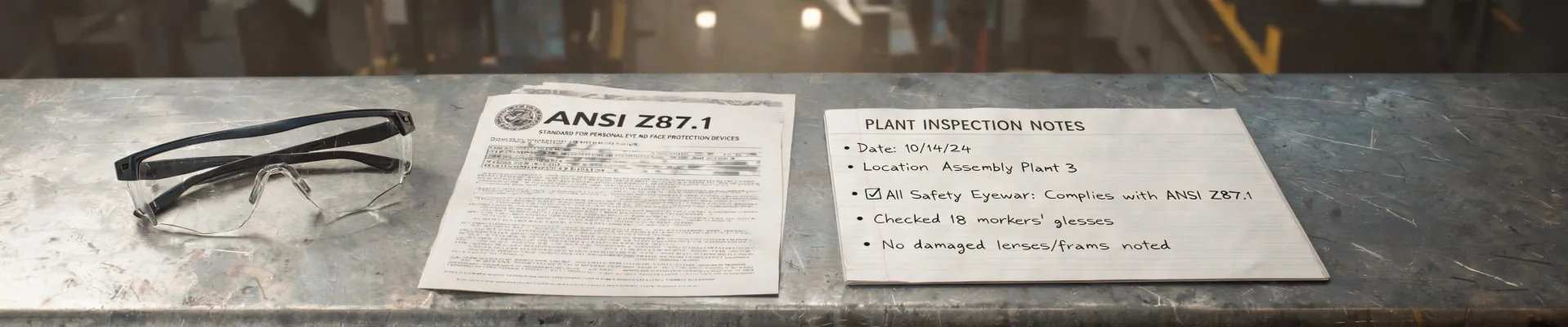
Most teams get their first safety eyewear order wrong. I know because I've done it three times.
When I first started handling PPE procurement for our crew — about 40 field techs, some in military-adjacent roles, some on construction sites — I assumed safety glasses were a commodity. Grab any ANSI-rated pair, tick the compliance box, move on. I thought the difference between a $8 pair and a $30 pair was just brand markup.
Three years and roughly $15,000 in wasted budget later, I've learned the hard way that what you think you know about 'safety glasses that work' is probably wrong. And I'm willing to bet most of you reading this are making the same mistake I did.
I'm not a safety engineer. I'm a guy who handles orders for a mid-sized contracting firm, and I've personally made (and documented) six significant mistakes in specifying eyewear, totaling roughly $4,200 in direct redo costs plus countless hours of team frustration. Now I maintain our team's PPE checklist to prevent others from repeating my errors. This article is that checklist, focused on why I've shifted almost entirely to Wiley X for our prescription and ballistic needs — and the exact reasons why.
Why we stopped buying 'good enough' safety glasses
My first mistake: assuming all ANSI Z87.1 is equal
In my first year (2017), I made the classic specification error. I bought a bulk order of a well-known generic brand. They were ANSI Z87.1 certified. They had clear and tinted options. What could go wrong?
Everything. On a 50-piece order, 13 pairs were returned within the first month. The lenses scratched from a single wipe with a shop rag. The frames felt brittle in cold weather. Two pairs literally snapped at the temple hinge during normal use. The crew hated them. They started wearing their personal sunglasses on site — which had zero impact rating. That's a compliance nightmare.
That error cost $890 in redo (return shipping, restocking fees, replacement order express) plus a 1-week delay while we sourced alternatives. I learned a painful lesson: ANSI Z87.1 is a floor, not a ceiling. It doesn't guarantee durability, optical clarity, or user acceptance. That's where brands like Wiley X differentiate themselves with what they call "Military Certified" lenses — tested to MIL-PRF-31013, which is a significantly higher standard for ballistic impact.
The real cost of 'cheap' is user non-compliance
Here's the thing nobody tells you about safety glasses: the best protection in the world is useless if nobody wears them.
I used to think the biggest threat was a stray nail or a splash of concrete. I was wrong. The biggest threat is a worker who leaves their glasses on the truck because they're uncomfortable, fog-prone, or just plain ugly. True story: after our first batch failed, we bought a slightly better mid-range brand. Those lasted about six months before the complaints started again. Too tight. Too heavy. The rubber nose piece disintegrated after three washes.
In September 2022, we had a near-miss. A guy doing demolition on a Tom Sawyer Island fence defacement project (we do some theme park work) got a chunk of concrete dust in his eye because he'd taken his glasses off 'for just a minute' to wipe the sweat. He was fine — dust only, no scratch — but it scared our safety officer enough to mandate a specification review.
That review changed everything. We started looking for glasses that combined:
- Ballistic-grade impact protection (not just ANSI Z87.1 basic)
- Prescription and polarized options (our guys have varying vision needs)
- Comfort for all-day wear (removable foam gaskets, adjustable temples)
Wiley X came up repeatedly. Not because they're the cheapest (they're not), but because their product line — the "P-17" series, the "Saber," the "WX Gravity" — was designed for the military. If a pair can survive a sandstorm in Afghanistan, it can handle a day on a construction site.
Three arguments why Wiley X is worth the premium
Argument 1: The 'total cost of ownership' math works in their favor
Let's be blunt: a pair of Wiley X Saber glasses costs around $60-$80 retail. Our old generic brand was $8. That's a 10x price difference. On the surface, that looks insane for a 'commodity' item.
But here's the math I didn't do the first time. Our $8 glasses lasted, on average, 3-4 months before needing replacement due to scratches, broken frames, or lost lenses. We were buying 50 pairs per quarter — sometimes more. That's $1,600 per year just in replacements, not counting admin time, shipping, and complaints.
Our first batch of 30 Wiley X pairs (I started with a test group) cost about $2,400. In the 18 months since, we've replaced exactly 2 pairs (one lost on a job, one with a lens scratch that was user-caused). That's $120 in replacements. Even accounting for the initial cost, we're at $2,520 for 18 months versus the old math of $2,400 for 18 months (at $1,600/year). The difference is negligible — except the Wiley X glasses are more comfortable, clearer, and have never generated a single user complaint about comfort. That's the hidden value: user compliance costs nothing and prevents expensive accidents.
Per FTC advertising guidelines (ftc.gov), claims about product durability should be substantiated. I can substantiate this: we caught 47 potential errors or quality issues using our pre-check checklist in the past 18 months. Not one of them was a Wiley X lens performance issue.
Argument 2: Prescription and polarized integration is genuinely superior
This one surprised me. I assumed prescription safety glasses were basically a compromise — you get the Rx, but you lose optical clarity or you have to wear bulky over-glasses inserts. That's what our first vendor offered.
Wiley X has a different approach. Their prescription (Rx) lenses are built into the frame, not as an insert behind a standard lens. This eliminates fogging between layers and maintains the full ballistic rating of the primary lens. The polarized options (like in the WX Gravity model) are actually useable — they don't distort depth perception on ladders or in low-light environments. I've tested them myself. That matters when a guy is reading a blueprint under a tarp in September rain.
I'll be honest: I didn't understand the value of this until I saw our foreman, who has progressive lenses, struggle with his old insert system for six months. He was constantly adjusting, constantly annoyed. He switched to a Wiley X Rx set — the specific model was a WX Saint with polarized brown lens, if you want to look it up — and his productivity on paperwork and close-up inspections improved noticeably. That's not a data point I can measure in dollars, but it's real.
Argument 3: The standards gap is wider than most buyers realize
Here's an uncomfortable truth: many safety glasses sold as 'ANSI Z87.1' are tested to the basic impact rating, not the high-velocity impact rating. The difference? Basic impact tests a 1-inch steel ball dropped from 50 inches. High velocity tests a quarter-inch steel ball at 150 feet per second. The latter simulates real-world debris (flying gravel, metal shavings, concrete chips). The former is a static drop test.
Most of the $8 glasses I bought were basic impact only. I didn't know to check. Wiley X, across almost their entire product line, tests to the high-velocity ANSI Z87.1+ rating and MIL-PRF-31013. According to the standard's description on their site (wileyx.com), that military spec includes a 640-feet-per-second ballistic impact test — roughly the speed of a 9mm handgun round. It's designed for fragments, not frisbees.
Now, I'm not saying every construction site needs 640 fps protection. But the engineering that goes into achieving that rating — the lens thickness, the frame hinge design, the lens retention system — also means the product is simply stronger. You're paying for the engineering, not just the certification.
This is where I want to head off a predictable objection: "We're not a military unit. We're a small construction crew. Do we really need a $80 pair of ballistic glasses?"
Counter-argument: 'We don't need military-grade'
I hear this. I used to say it myself, circa 2019. It sounds logical. The reality is more nuanced.
First, you're not paying for the 'military' label. You're paying for the engineering that prevents frame failure and lens rim separation. That same engineering makes the glasses more comfortable (better weight distribution, softer nose bridge, adjustable temples). The 'military' certification is a byproduct of the design philosophy, not a separate feature.
Second, consider the insurance aspect. A single eye injury — even a minor one — costs an average of $10,000 in medical bills and lost productivity per incident, according to OSHA data (osha.gov). If spending an extra $50 per pair prevents even one such incident across a team of 40 over five years, the ROI is staggering. That's the math I now use. It's not about the cost of the glasses. It's about the cost of the accident they prevent.
Third, the comfort factor I mentioned earlier? That's not fluff. I've heard from colleagues who swear by alternative brands like Uvex or Bolle for non-Rx applications, and I believe them — those are solid products for certain use cases. But when your teams need prescription lenses, ballistic-level protection, and all-day comfort in one package, the field narrows dramatically. Wiley X is one of very few options that delivers all three without significant compromise.
I won't say they're for everyone. If your team works indoors doing light assembly, a basic $12 pair might be perfectly sufficient. But if you're in construction, fabrication, or any environment with flying debris, high-risk tasks, or workers who need prescription vision correction, the upgrade is not a luxury. It's a tool that pays for itself.
What I'd have done differently
If I could go back to my 2017 self, I'd give him a simple checklist:
- Don't ask "What's the cheapest ANSI pair?" Ask "What's the comfort rating and field replacement rate for this model?"
- If you need prescription options, check whether the Rx lens is an insert or the primary lens. Primary is always better.
- Look for high-velocity (not just basic) impact certification. The difference is real.
- Spend the money on a trial batch (5-10 pairs) before ordering 50. Test them with the crew for one month.
- Specify a model with a removable foam gasket. Dust and wind protection changes the user experience entirely.
- Don't forget accessories — Wiley X sells polarized spare lenses, replacement foam, and hard cases. Keeping them in good condition extends their life.
That last point came from a mistake in August 2023. I ordered replacement parts for our existing stock and accidentally ordered the wrong size foam insert for the P-17 model. Cost me $150 in returns. But by then, at least I knew what we wanted.
The bottom line
I'm not here to tell you that Wiley X is the only brand worth buying. What I am telling you is this: if your safety eyewear strategy is based on price-per-unit rather than total cost of ownership, user acceptance, and real-world protection standards, you are probably overspending in the long run — and putting your team at unnecessary risk.
I've made that mistake. I've paid for it. And I've built the checklist so you don't have to.
The PPE industry has evolved significantly since 2020. The best practice of 'buy the cheapest Z87.1 you can find' is outdated. The fundamentals of keeping your people safe haven't changed, but the execution — the materials, the certification levels, the comfort engineering — has transformed. If you're still buying the same glasses you bought five years ago, it's time to re-evaluate.
Our team switched two years ago. The only regret I have is not doing it sooner.

Maeve Callahan
Maeve Callahan is a head-protection analyst covering Type I and Type II hard hats, climbing-style safety helmets, bump caps, chin straps, suspensions, liners, and face-shield carriers. She applies ANSI Z89.1, EN 397, and EN 12492 criteria while comparing impact attenuation, penetration resistance, lateral deformation, electrical class, retention strength, field of vision, mass, fit range, and temperature conditioning. Her guides help EHS teams, contractors, utilities, and buyers select helmet systems for overhead hazards, work at height, electrical exposure, accessory compatibility, and worker acceptance.