Why I Started Comparing Wiley X Safety Glasses and Hard Hats
It took me three years and about 200 PPE orders to realize that comparing apples to oranges can actually make sense—if you're comparing investment value. I'm a procurement manager for a 150-person construction company, and I've managed our safety equipment budget (about $48,000 annually) for six years. In Q2 2024, I sat down to compare two categories I'd always treated separately: premium safety glasses (specifically Wiley X) and standard hard hats.
Why? Because I kept seeing the same budget tension: "Do we spend extra on top-tier eye protection or stick with basic hard hats?" Most people thought the answer was obvious. I wasn't so sure. So I ran the numbers—looking at initial cost, total cost of ownership, emergency availability, and real-world performance. Here's what I found.
Dimension 1: Upfront Cost
Let's start with the obvious. A standard hard hat from a big-box supplier runs about $15–$25 each. A pair of Wiley X Fusion safety glasses? Around $60–$100 depending on lens options. On the surface, hard hats are clearly cheaper.
But here's the thing: that comparison is misleading if you stop there. I've learned the hard way that upfront cost is only the beginning. As of January 2025, I'm seeing bulk pricing for Wiley X bring that down to about $50 per pair for a 50-unit order (based on my latest quote from a distributor; verify current pricing). Meanwhile, hard hats in bulk might be $12 each. So per unit, Wiley X is about 4x more expensive. That's a big gap.
Dimension 2: Actual Cost Per Use (TCO)
This is where the real comparison lives. Over six years of tracking every PPE invoice, I noticed a pattern: hard hats have a shorter usable life in our environment. On a construction site, hard hats get dropped, scratched, and exposed to UV. We replace them about every 6–12 months. In contrast, a pair of Wiley X safety glasses—especially the ballistic-grade models—holds up much longer. I have guys who've been wearing the same pair for two years with only lens replacements.
Let's do the math. Over a 3-year period:
- Hard hats: 3 replacements × $12 = $36 per worker (plus labor for distributing and documenting)
- Wiley X glasses: 1 pair × $50 + maybe one replacement lens ($20) = $70 per worker
That's still a $34 difference, but it's much closer than the 4x gap in initial cost. And this doesn't include the hidden cost of compliance failures, which I'll get to.
Dimension 3: Emergency & Time Certainty
This is the dimension that surprised me most. When a hard hat breaks unexpectedly—say a crack develops mid-shift—your local hardware store probably has replacements. You can do "hard hat near me" search and get one in 20 minutes. That's cheap and fast. But when a pair of safety glasses gets lost or damaged, especially if they're prescription or polarized, replacing them on short notice can be a nightmare.
In August 2024, one of our team leaders lost his prescription Wiley X glasses on a Friday before a Monday deadline project. Standard overnight shipping would get him a new pair by Wednesday—missing two critical days. I called our Wiley X distributor and paid $35 extra for guaranteed next-day delivery. Total cost: $120 for the glasses + $35 rush = $155. But the alternative? Delaying a $14,000 job by two days because he couldn't work safely. That $35 rush fee was the cheapest insurance I've ever bought.
Time certainty has real value. When you're against a deadline, paying a premium for guaranteed delivery is rational—not wasteful. That "free" two-day shipping from a generic supplier doesn't help when you needed it yesterday.
Dimension 4: Protection & Compliance
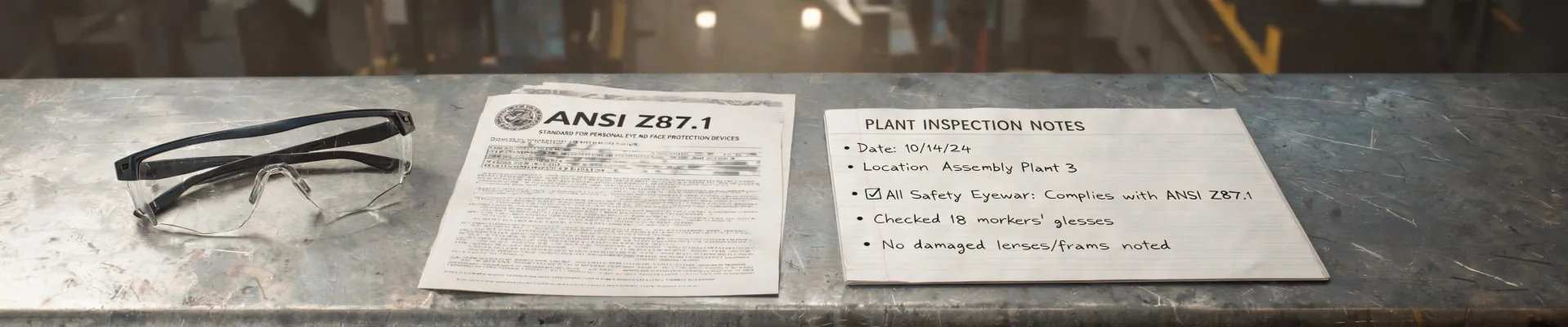
Hard hats protect against head impacts—they're required by OSHA for any overhead hazard. Safety glasses protect your eyes, which is equally critical. But here's the catch: not all hard hats are created equal, and neither are safety glasses. Wiley X glasses carry ANSI Z87.1 high-velocity impact rating and military ballistic ratings. Many cheap hard hats only meet the minimum ANSI Z89.1 standard. If a worker's hard hat fails an inspection, you might get a fine or a stop-work order. If a worker's glasses fail during an incident, the consequences are far worse.
From my cost perspective, compliance failure costs are massive. I've seen fines ranging from $1,000 to $10,000 for improper PPE on a single site. Spending an extra $30 per worker on Wiley X glasses that reduce the risk of injury and ensure compliance is a no-brainer when you factor in those potential losses.
So, Wiley X or Hard Hats?
This isn't an either/or question—your crew needs both. But if you're trying to decide where to allocate a tight budget, here's my rule of thumb:
- Invest in Wiley X safety glasses first when your team works in environments with flying debris, UV exposure, or when they need prescription/polarized options. The TCO is reasonable, and the protection is superior. Plus, the time certainty in emergency replacements can save you big.
- Don't skimp on hard hats either, but you can often buy them from local suppliers ("hard hat near me" searches work fine). The cost per year is low, and availability is high. But don't buy the absolute cheapest—get ones with proper ANSI Z89.1 rating and a 5-year lifespan.
If you're a fence company or a construction firm with a mobile workforce, I'd recommend keeping a small stock of Wiley X glasses in your truck or office. The $200 you spend upfront on a backup pair could save you from a $1,500 lost-time incident down the road.
Bottom line: compare total cost, not just sticker price. And when you're under the gun, the certainty of getting the right gear on time is worth paying for.

Maeve Callahan
Maeve Callahan is a head-protection analyst covering Type I and Type II hard hats, climbing-style safety helmets, bump caps, chin straps, suspensions, liners, and face-shield carriers. She applies ANSI Z89.1, EN 397, and EN 12492 criteria while comparing impact attenuation, penetration resistance, lateral deformation, electrical class, retention strength, field of vision, mass, fit range, and temperature conditioning. Her guides help EHS teams, contractors, utilities, and buyers select helmet systems for overhead hazards, work at height, electrical exposure, accessory compatibility, and worker acceptance.