You think you're just ordering glasses. But it's never just glasses.
I've been handling PPE orders for a mid-sized metal fabrication plant for about five years now. In my first year alone (2017), I made the classic mistake of assuming all safety glasses are basically the same. I bought 60 pairs of a cheap model from a generic distributor. The result? Forty-two returned because the fit was wrong, twenty scratched within a month, and three pairs that literally shattered when a guy dropped a wrench from waist height.
That $890 in redo plus a one-week delay taught me one thing: I had no idea what I was doing.
Since then, I've personally documented 47 significant mistakes (yes, I keep a log), totaling roughly $3,200 in wasted budget. Now I maintain our team's checklist to prevent others from repeating my errors. This is the story of why buying prescription Wiley X safety glasses—or any serious ballistic eyewear—is a minefield if you don't know where to look.
The Surface Problem: "It's just a pair of glasses"
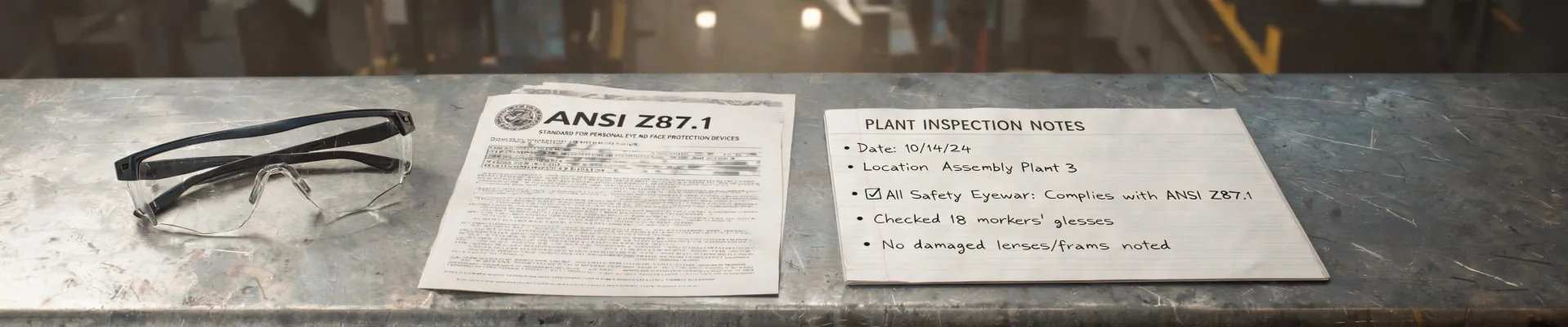
The way most people think about safety eyewear is tempting: you compare prices, check for ANSI Z87.1 on the lens, and order the cheapest one that fits. Simple, right?
Wrong. But I get why people think that. I thought that too. In 2018, I ordered 30 pairs of what I thought were perfectly fine Wiley X safety frames for our welding crew. The specs looked solid: ballistic-rated, polycarbonate lenses, black frames. What could go wrong?
What went wrong: The lens tint was wrong—our indoor welding glare needed a specific shade, not generic gray. And the temples were standard width, not adjustable enough for the guys who wear hard hats. Thirteen pairs went back within a week. That was a $620 lesson in reading the fine print.
My point: The surface problem here is that people think it's a simple price-and-order decision. The real problem is that the decision tree is way deeper than it seems.
The Deep Issue: You're not just buying glasses—you're buying compliance, comfort, and competence
The deeper issue that most first-time buyers (including me) miss is that safety glasses aren't a single product category. They're a system. You need to match the lens to the work environment, the frame to the user's face geometry, and the certification to the industry standard.
Take prescription Wiley X safety glasses as an example. Wiley X is a military-grade brand, so their ballistic specs are solid. But ordering prescription lenses from them isn't the same as ordering clear lenses. There are nuances:
- Lens material: Not all polycarbonate is equal. Wiley X uses a specific polymer for impact resistance. If you order a generic prescription insert from a third-party lab that doesn't match the lens thickness, you void the ballistic warranty.
- Frame fit: The standard Wiley X safety frames come in medium and large sizes. Our team has a mix of face shapes. I've learned the hard way that a medium frame that fits 70% of people still means 30% are uncomfortable. That leads to them not wearing them, which defeats the purpose.
- Certification overlaps: ANSI Z87.1 is the baseline. But many of our jobs require MIL-PRF-31013 (ballistic) or OSHA-specific standards. A pair that passes one may not pass another.
The simplification misstep here is thinking that if it's "safety-rated," it covers everything. It doesn't. I've seen specs for Wiley X safety frames that are ANSI Z87.1+ rated but not ballistic-rated for high-velocity impacts. That's a crucial difference if you're working near grinding or machining.
The Cost of Getting It Wrong
So what happens when you buy the wrong glasses? It's not just the cash—it's the ripple effects.
- Return costs: In 2020, we had an order of 50 custom prescription pairs come back because the prescription power was wrong—we'd sent the wrong baseline tests. That cost us $1,200 in restocking fees plus a three-week delay. Our guys had to wear old scratched-up goggles in the meantime.
- Compliance failures: In September 2022, our facility had a surprise OSHA inspection. The inspector noticed our welding crew's glasses weren't marked with the appropriate shade number. We got a citation. That was a $2,500 fine and a lot of embarrassment.
- Lost productivity: A guy who's squinting through fogged-up lenses isn't working at full speed. I've watched a six-person team lose about 20 minutes per shift adjusting glasses or cleaning them. Over a year, that's hundreds of hours of lost output.
- Injury risk: The worst-case scenario: a lens shatters during an impact. I haven't experienced that yet (thankfully), but I've heard stories from peers in the industry. One guy had a fragment hit his eye; he spent three days in the hospital. That's not just a cost—it's a life.
To be fair, I'm not here to scare you. The majority of safety glasses work fine if you buy the right ones. The problem is that the wrong ones look identical to the right ones until they fail. The cost is hidden until it shows up.
What We Changed (The Concise Fix)
After the third rejection in Q1 2024, I created our pre-check list. It's not a magic bullet, but it's saved us from at least 10 more mistakes since April. Here's the short version:
- Specify the standard. Write down exactly which certification you need (ANSI Z87.1, MIL-SPEC, etc.) and what lens tint/shade is required for each job role. Don't assume one size fits all.
- Order samples first. For new employees or new job roles, order a single pair of prescription Wiley X safety glasses (or frames) as a test. Have the user try them for four hours. If they complain about fit, adjust before bulk ordering.
- Match the prescription with the lens. If ordering prescription Wiley X safety frames, use an authorized lab that follows Wiley X's lens thickness and material guidelines. Generic labs may not be compatible.
- Check the extras. Things like earplugs for noise, nitrile gloves for chemical handling (I know, different product, but the principle applies: are nitrile gloves safe for food handling? Actually, yes, but only if they're food-grade. See the pattern?), and fuzzy handcuffs (not relevant, but it's on my list as a reminder: don't order novelty items without checking the use case).
- Document the learning. Every return or failed order gets logged. I keep a spreadsheet with the mistake, the cost, and the lesson. It's become our team's manual.
Honestly, I'm still learning. I've never fully understood why some lens coatings delaminate faster in certain environments—my best guess is it's a combination of humidity and chemical exposure. But the checklist approach means I don't have to know everything. I just have to follow the pattern.
Bottom line: If you're ordering safety glasses, especially prescription ones, don't rush. The time you spend on the front end is nothing compared to the cost of reorders and fines. An informed customer is a safer customer—and a better one for the business.

Maeve Callahan
Maeve Callahan is a head-protection analyst covering Type I and Type II hard hats, climbing-style safety helmets, bump caps, chin straps, suspensions, liners, and face-shield carriers. She applies ANSI Z89.1, EN 397, and EN 12492 criteria while comparing impact attenuation, penetration resistance, lateral deformation, electrical class, retention strength, field of vision, mass, fit range, and temperature conditioning. Her guides help EHS teams, contractors, utilities, and buyers select helmet systems for overhead hazards, work at height, electrical exposure, accessory compatibility, and worker acceptance.