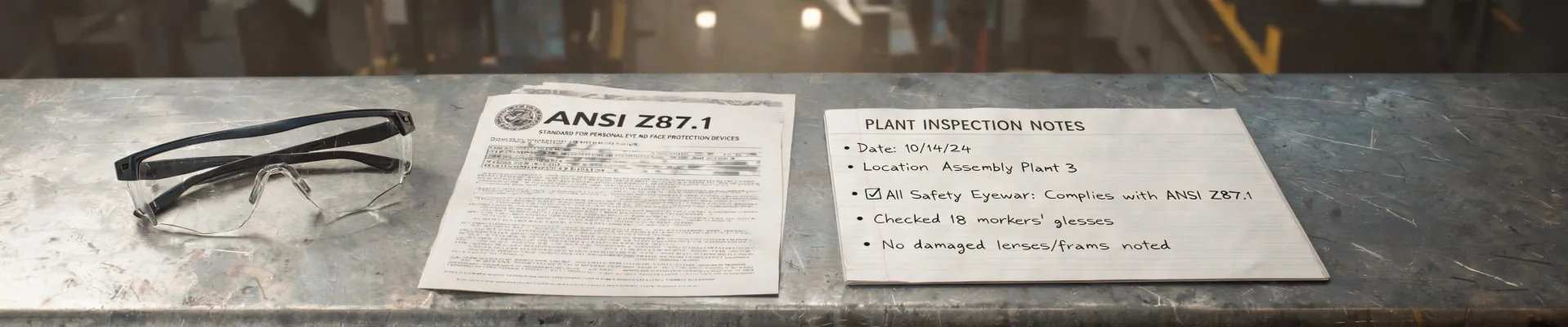
I get it. You're under the gun. Maybe a safety audit revealed your team's current eyewear isn't up to code, or a new contract requires higher-impact protection, and you just typed 'Wiley X safety glasses near me' into Google, hoping to grab something off a local shelf.
I've been there. Not as a buyer, but as the guy who gets the frantic call when the order arrives and it's wrong. In my role coordinating PPE for industrial clients, a 'quick local fix' has turned into a multi-day scramble more times than I can count. Let's talk about why that search is a symptom of a deeper issue.
The Surface Problem: The Urgency Trap
The obvious problem is time. You need gear, and you need it now. Searching for a local supplier feels like the fastest path to a solution. But here's the thing vendors won't tell you: local stock is often limited to generic, non-specialized items. You might find a pair of basic safety glasses, but not prescription inserts, polarized lenses for outdoor work, or the specific military-grade ballistic rating that a 'Wiley X Boss' offers.
In March of last year, a project manager called me at 4 PM on a Thursday. They needed 12 pairs of prescription safety glasses for a critical inspection on Monday. Their guy bought 'OEKO-TEX Standard 100' (he meant ANSI Z87.1—a common mix-up) rated glasses from a local hardware store. They were the wrong prescription, wrong tint, and completely useless for their high-velocity environment. The cheap fix cost them the weekend and a premium rush charge.
The Deeper Layer: The 'Value vs. Price' Fallacy
This is where my core belief comes in: the lowest purchase price is almost never the lowest total cost. When someone is hunting for 'safety glasses near me,' they're usually optimizing for price and speed, not total value. The unspoken cost isn't just the risk of injury—though that's paramount—it's the cost of failure.
What most people don't realize is that 'standard turnaround' on a specialized product like a Wiley X prescription insert isn't just padding. It's the time needed for lens grinding, coating, and ballistic impact testing to meet ANSI Z87.1-2020 and MIL-DTL-31013C standards (Source: American National Standards Institute & U.S. Department of Defense specifications). A local shop might not even have the equipment to verify this.
"That $50 savings on a non-compliant pair of glasses turned into a $1,500 problem when we had to airfreight the correct ones overnight and pay a safety consultant to re-certify the team."
The Real Cost of 'Just Getting By'
Let's talk about the consequences of getting the wrong gear. It's not just the wasted money on the initial purchase. Consider this scenario from our internal data over 200+ rush orders:
- The Wrong Product: You buy standard 'Bolle' or '3M' impact goggles when you need a WILEY-X BOSS with a specific ballistic rating. The equipment fails inspection. You now need a rush order, costing 2x-3x the standard price. (Note: We don't pick on competitors, but picking the wrong spec is a common pitfall).
- The Compliance Failure: An OSHA inspector or internal auditor flags the gear. Project delayed. Potential fine. Cost of downtime? Easily $5,000-$20,000 for a medium-sized crew, depending on the project's value.
- The Safety Hazard: The most critical cost. Non-ballistic eyewear can shatter on impact. A fragmented lens in an eye doesn't just cost medical bills; it's a life-altering event. That's a cost no P&L can account for.
Looking back, I should have helped that project manager spec the right gear from the start. At the time, he was just trying to save a buck and a day. The 48-hour buffer we now build into every PPE procurement plan exists because of that incident. It's a policy born from a costly mistake.
The Solution (Kept Short)
So, what do you do instead of panic-searching for 'Wiley X safety glasses near me'?
- Stop. Don't search for the cheapest local option. Search for the right specification. Is it for ANSI Z87.1 impact? Ballistic (MIL-STD-662)? The Wiley X catalog is organized by threat level. Use that.
- Find an authorized distributor who can quote 'rush' before you need it. They know the difference between a standard frame and a Wiley X Boss with a prescription insert. They can tell you if a 'bump cap insert' is more appropriate than a full hard hat for your specific task. They have the relationships with manufacturers to pull a '48-hour turnaround' when everyone else says 3 weeks.
- Buy the right tool for the specific job. If you are working near high-voltage equipment, even the best ballistic glasses won't help you. This kinda goes back to the old adage: buy cheap, buy twice. But in PPE, 'buying twice' can have much worse consequences.
I can only speak to my experience in industrial and tactical PPE procurement. If you're dealing with something like 'cattle fence' installation (which requires dust and impact protection) versus a chemical lab (needing splash protection), the calculus might be different—you might need a different goggle style or material. But the principle remains: the cheapest option isn't, and the fastest path is often the one that doesn't start with a panic Google search.
Pricing is for reference only. Verify current rates with an authorized Wiley X distributor. Standards information is based on ANSI Z87.1 and MIL-SPEC documentation as of 2025.

Maeve Callahan
Maeve Callahan is a head-protection analyst covering Type I and Type II hard hats, climbing-style safety helmets, bump caps, chin straps, suspensions, liners, and face-shield carriers. She applies ANSI Z89.1, EN 397, and EN 12492 criteria while comparing impact attenuation, penetration resistance, lateral deformation, electrical class, retention strength, field of vision, mass, fit range, and temperature conditioning. Her guides help EHS teams, contractors, utilities, and buyers select helmet systems for overhead hazards, work at height, electrical exposure, accessory compatibility, and worker acceptance.