A Friday afternoon order that cost me $2,400
I'm an office administrator for a mid-sized construction company—about 400 employees across three sites. I manage all our PPE ordering, roughly $120,000 annually across maybe a dozen vendors. When I took over purchasing in 2020, I thought I knew what I was doing. I was wrong.
One Friday, I found a great price on safety glasses from a new vendor—$1.80 per pair versus our usual $4.50. Ordered 1,000 pairs. They couldn't provide a proper invoice (handwritten receipt only). Finance rejected the expense report. I ate $2,400 out of the department budget. I still wince when I think about it. Now I verify invoicing capability before placing any order. But that's not the only thing I learned.
The real lesson? Buying safety glasses isn't as straightforward as it looks. You'd think it's just picking a pair with a Z87 stamp and moving on. But after five years of managing these relationships—processing 60-80 orders annually—I've learned there's a lot more to it.
The problem you think you have: finding cheap glasses that meet the standard
Most people start with the same question: "What's the cheapest pair that passes ANSI Z87.1?" That's what I asked. And it's understandable—when you're ordering for hundreds of workers, the price difference adds up fast.
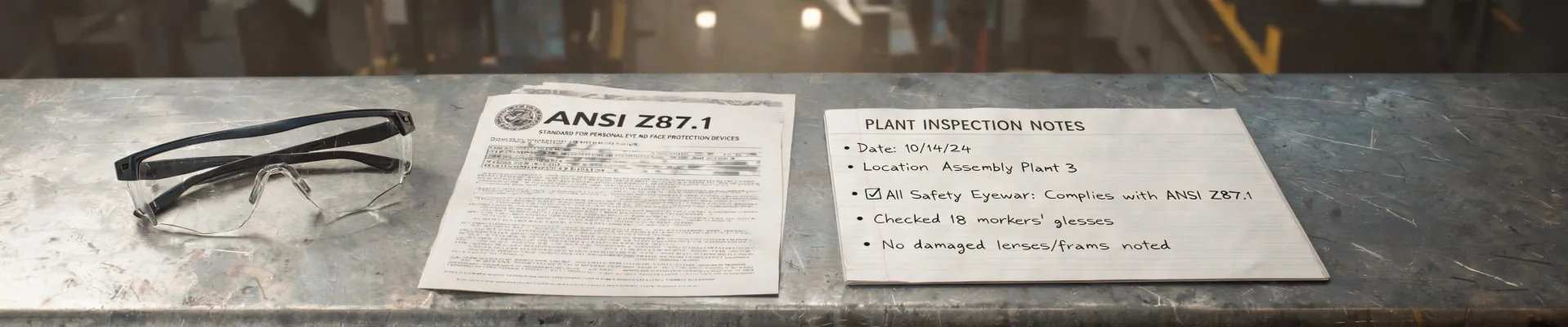
But here's what I didn't realize then: not all Z87.1 safety glasses perform the same. The standard has two levels: basic impact (Z87) and high impact (Z87+). The basic test drops a 1-inch steel ball from 50 inches. The high-impact test fires a quarter-pound projectile at 102 mph. Wiley X glasses typically meet both—they're certified for both Z87+ and ballistic impact standards (source: ANSI/ISEA Z87.1-2020).
That $1.80 pair? Basic impact only. Fine for light duty. Not fine for our guys working near heavy machinery.
The deeper problem: why cheap safety glasses cost more in the long run
This gets into compliance territory, which isn't my expertise. I'm not a safety officer—I'm a purchaser. But from a procurement perspective, here's what I learned.
Our company changed its PPE policy in 2022 after an OSHA inspection. We had to consolidate orders for 400 people across 3 locations. Using a single vendor for safety glasses cut our ordering time from about 6 hours monthly to 2 hours. But more importantly, it eliminated the problem of workers getting different brands and complaining about inconsistencies.
When you buy cheap glasses, you get:
- Workers who don't wear them because they're uncomfortable
- Lenses that scratch quickly (meaning more replacements)
- Frames that break under normal use
- No prescription options (forcing separate orders)
- Questionable supply chain verification
The total cost of ownership includes the base price, reorder frequency, admin time, and compliance risk. Cheap glasses often lose on all fronts except the upfront number.
The cost of getting it wrong
“In Q3 2024, I audited my PPE spend. The 'cheap' glasses vendor had cost us 30% more per year in replacements and admin time than the mid-range option. That reliable supplier I didn't want to use? Actually cheaper overall.” (Based on internal audit, Wiley X pricing estimated at $8-25 per pair for basic models as of Jan 2025; verify current rates.)
There's also the invisible cost: worker trust. When someone gets a pair of glasses that fog up, scratch, or don't fit under their hard hat, they stop wearing them. I've seen guys take off their safety glasses on the job site because they're uncomfortable. That's a safety violation waiting to happen.
What most people don't realize is that "military discount" isn't just marketing jargon. Wiley X is used by U.S. Special Forces, and meets MIL-PRF-32432 ballistic standards (source: USASOC, 2021 contract listings). A pair of glasses that passes military ballistic isn't the same as a pair that barely passes basic Z87. They're in different leagues.
Is your facility at that level? Probably not. But the point is: the engineering for high-impact safety is fundamentally different. You can't just slap a Z87 stamp on any plastic and call it done. The lens thickness, frame design, and material all matter. Wiley X uses 2.4mm polycarbonate lenses with T-Shell scratch-resistant coating. Cheaper models might use 1.5mm with no coating.
What actually works (and what I do now)
After years of trial and error—and more than a few painful budget conversations—here's my approach:
- Buy from established safety vendors. Wiley X, 3M, Uvex—they all have clear certification documentation and supply chain transparency.
- Check for ANSI Z87+ and ballistic ratings if your work involves impact hazards. Not all jobs need ballistic, but Z87+ is cheap insurance.
- Consider prescription and polarized options. Workers who wear prescription glasses often skip safety glasses because they're uncomfortable. Companies like Wiley X offer Rx inserts and full prescription safety glasses. We switched and compliance improved noticeably.
- Verify the 'military discount' claim if it matters to you. Many safety glasses brands offer them, but not all deliver the same ballistic protection. Check manufacturer documentation.
- Factor in total cost, not unit price. As of Q4 2024, Wiley X Trench Boss glasses run about $15-30 per pair depending on lens options (verify current pricing). A $2 pair that breaks in a month is actually more expensive over time. Source: multiple online retailer quotes, Jan 2025.
This isn't a sales pitch for any specific brand. I'm just sharing what works from a procurement standpoint. The cheapest option is rarely the most cost-effective. And when safety and compliance are on the line, the stakes are higher than a budget line item.
Final thought
If there's one takeaway from my years of ordering PPE, it's this: don't let the price sticker blind you to the real cost. The process of finding the right supplier—verifying certifications, checking supply chain, understanding total cost of ownership—is tedious. But it's cheaper than reordering 1,000 pairs of glasses that nobody wears. And it's definitely cheaper than the fines from a compliance failure.
Pricing as of Jan 2025; verify current rates with suppliers.
This article reflects general procurement experience and evaluation criteria used for PPE purchasing. Your specific needs, compliance requirements, and use cases may vary.

Maeve Callahan
Maeve Callahan is a head-protection analyst covering Type I and Type II hard hats, climbing-style safety helmets, bump caps, chin straps, suspensions, liners, and face-shield carriers. She applies ANSI Z89.1, EN 397, and EN 12492 criteria while comparing impact attenuation, penetration resistance, lateral deformation, electrical class, retention strength, field of vision, mass, fit range, and temperature conditioning. Her guides help EHS teams, contractors, utilities, and buyers select helmet systems for overhead hazards, work at height, electrical exposure, accessory compatibility, and worker acceptance.