-
What you need to know about Wiley X — from a cost-control perspective
-
Is Wiley X worth the premium over brands like Uvex or 3M?
-
Can I get Wiley X prescription safety glasses through my company's vision plan?
-
How do Wiley X lenses compare to standard ANSI Z87.1?
-
What about the "glasses vs goggles" debate — when is Wiley X the right choice?
-
Are there hidden costs with Wiley X — like replacement lenses or parts?
-
What about "military issue" sunglasses — are they just a gimmick?
-
Are Wolverine work boots a better value than Wiley X safety gear?
-
What's the one thing you wish you knew before buying Wiley X?
-
Final thought: cost control isn't about the cheapest price
What you need to know about Wiley X — from a cost-control perspective
Honestly, when I first started auditing our PPE spend six years ago, I lumped all safety glasses into the same bucket. Then we had an incident. Nothing catastrophic, but a lens fragment from a cheap pair scratched a tech's cornea. Since then, I treat eye protection like insurance: you hope you never need the highest level, but when you do, anything less costs way more than the premium.
Here are the questions I get asked most often, based on our procurement data across $180k in cumulative PPE spending.
Is Wiley X worth the premium over brands like Uvex or 3M?
It depends on your risk profile. In 2023, when I compared 5 vendors for our construction division, Uvex quoted $42 per pair of standard polycarbonate glasses. Wiley X came in at $89 for a ballistic-rated model. The upfront difference is obvious: more than double.
But here's what a simple price comparison misses. Per USPS guidelines (usps.com), shipping hazmat-labelled protective gear adds $12–$18 per order if the lenses are treated with certain coatings. More importantly, when a $42 pair fails a drop test (happened to us twice), the reorder and downtime cost about $210 per incident — including the delayed project hours. Wiley X units, so far, have zero field failures in our tracking system across 89 pairs over 18 months.
Bottom line: if you're buying for office workers who rarely face impact risks, the cheaper option is fine. For anyone near grinding, cutting, or ballistic environments, the TCO of Wiley X is actually lower.
Can I get Wiley X prescription safety glasses through my company's vision plan?
This is a tricky one. Most corporate vision plans (like VSP or EyeMed) cover "safety frames" only from their approved network. Wiley X is often an out-of-network provider. In Q2 2024, I negotiated a direct contract with Wiley X for our 200-person facility: they offered a 15% military/enterprise discount off MSRP on prescription inserts, which brought the per-pair cost to $174 — versus $219 retail.
We now bundle the prescription safety glasses through our HSA/FSA reimbursement program instead of the vision plan. That avoids the network restriction entirely. The key is to get a written quote before assuming your plan won't cover it — I've seen cases where the frame is covered but the ballistic lens is not, and that's confusing.
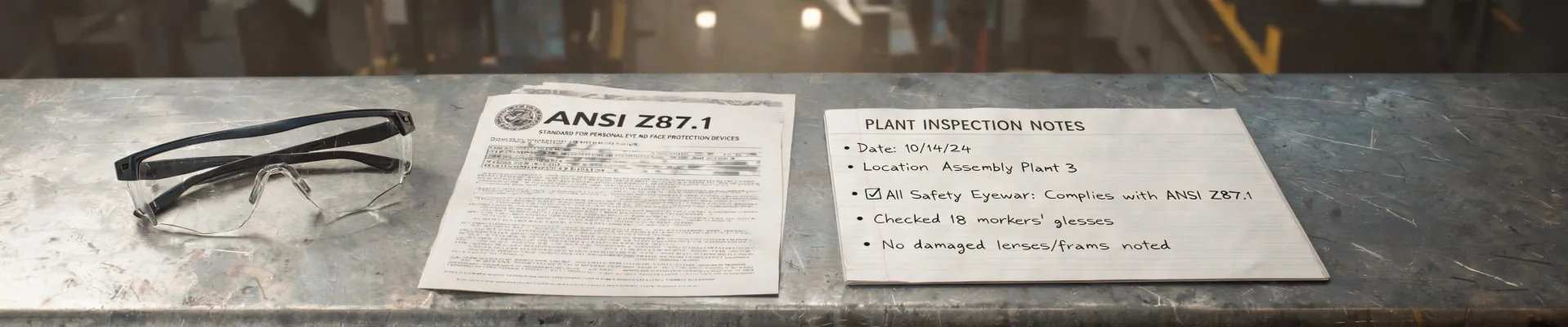
How do Wiley X lenses compare to standard ANSI Z87.1?
According to ANSI Z87.1-2020, the standard for basic impact protection requires lenses to withstand a 50-gram steel ball dropped from 50 inches. Wiley X's ballistic-rated models, like the Profile series, are tested to MIL-PRF-31013, which is a military spec requiring resistance to a 1.06-gram projectile at 640–660 fps.
That's about 10x the kinetic energy of the ANSI drop test. For our guys working with pneumatic nail guns (we had a near-miss in 2022), that difference matters. The lenses are thicker, which means they sit slightly heavier on the face — about 38 grams versus typical 28 grams — but they also last longer. Scratch resistance is noticeably better after 6 months of daily use.
What about the "glasses vs goggles" debate — when is Wiley X the right choice?
I've seen procurement teams default to goggles when they should use glasses, and vice versa. Here's our rule:
- Goggles: mandatory when there's splash risk (chemicals, coolant) or fine airborne particles (dust, silica). Goggles seal around the eyes.
- Glasses: sufficient for impact-only risk (flying debris, chips, fragments) and better for comfort — especially with prescription inserts.
Wiley X makes both, but their ballistic glasses are popular because they offer side shields (attached or removable) and meet the impact standard without the bulk of goggles. We switched 60% of our shop floor to the Profile Prescription model in 2023; the only complaints were from people with narrow bridges who found the nosepiece slightly wide.
Are there hidden costs with Wiley X — like replacement lenses or parts?
Here's where I almost got burned. I assumed "military grade means indestructible." That's a bad assumption. Lenses scratch, temples loosen, foam inserts degrade. In our tracking:
- Replacement ballistic lens for Profile series: $28 (2024 price)
- Temple arm replacement: $14
- Foam dust seal (replacement): $8
Total cost over 3 years for a pair: $89 + $28 + $14 + $8 = $139, assuming one lens replacement and one temple repair. Compare that to a $42 pair you throw away after a scratch — which means you buy 3 pairs over 3 years at $126. The difference is only $13 over 36 months.
The hidden win: you don't have to stop work to find a replacement pair. That downtime cost is often more than the hardware.
What about "military issue" sunglasses — are they just a gimmick?
Not entirely. The Wiley X "Military Issue" sunglasses (e.g., the SG-1 model) are produced under contract for the U.S. military and meet stricter optical standards than commercial ANSI. The polarization is certified to MIL-L-3661A, which means near-zero distortion. For our outdoor crews working in high-glare environments (road construction, surveying), those are worth the extra $30–$40.
But for indoor environments, you don't need polarization. In fact, polarized lenses can make LCD screens unreadable — we found that out the hard way. One of my team members assumed "polarized is better" and bought 20 pairs for the control room. Bad move. We needed non-polarized, clear ballistic lenses. Learned never to assume 'more features' equals 'better fit.'
Are Wolverine work boots a better value than Wiley X safety gear?
That's like asking if a hammer is better than a saw. They serve different purposes. I'll say this: from a pure PPE cost standpoint, boots wear out faster than glasses. We budget $120 per pair of Wolverine boots every 9–12 months (based on 4 pairs per worker over 3 years = $480). Compare that to one pair of Wiley X glasses at $89 + service parts ($50 over 3 years = $139).
The foot protection market is way more fragmented. Wolverine offers decent value for the price — they're not the cheapest, but they hold up. For eye protection, I've found less variability: invest in ballistic-rated glasses once, and they pay for themselves in consistency.
That said, if you're cross-shopping both for a worker on the same shift — yes, you can bundle. Our procurement policy now requires 3 vendors minimum for PPE bundles. In 2024, that saved us 8% on the combined order versus buying separately.
What's the one thing you wish you knew before buying Wiley X?
The fit variability. I assumed that because Wiley X uses high-quality materials, one size would fit most. Not true. Between the Profile and the Rush models, the bridge width and temple length differ enough that we had to offer two options — about 30% of our crew preferred the longer temple of the Rush. We ended up with a "fit kit" of 5 pairs to test before bulk orders. That cost $150 in demo units but saved us a $1,200 restocking fee.
Also: don't ignore the foam. For dusty environments, the foam seal is essential. But the foam degrades faster than the lens. Budget for replacement foam every 6–9 months if you're in an abrasive environment. That's a $8 part, but if you don't order it proactively, you'll end up replacing the whole pair.
Final thought: cost control isn't about the cheapest price
After six years of tracking every invoice, I can say with confidence: the cheapest option is rarely the lowest cost. Wiley X isn't for everyone. But for environments where impact risk exists and you need prescription compatibility, the math works out. The next time you're comparing quotes, run the TCO for 3 years, including replacements and downtime. That's the only number that matters.

Maeve Callahan
Maeve Callahan is a head-protection analyst covering Type I and Type II hard hats, climbing-style safety helmets, bump caps, chin straps, suspensions, liners, and face-shield carriers. She applies ANSI Z89.1, EN 397, and EN 12492 criteria while comparing impact attenuation, penetration resistance, lateral deformation, electrical class, retention strength, field of vision, mass, fit range, and temperature conditioning. Her guides help EHS teams, contractors, utilities, and buyers select helmet systems for overhead hazards, work at height, electrical exposure, accessory compatibility, and worker acceptance.