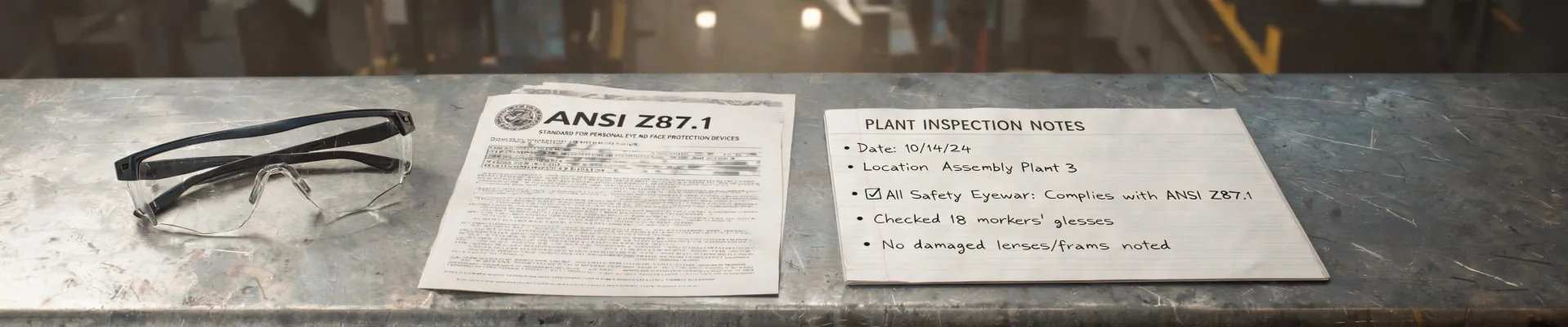
It was a cold Monday morning in late March 2024 when I walked into our warehouse to inspect a shipment of navy coveralls. The contract was for a U.S. Navy support facility, and everything had to meet MIL-SPEC guidelines. We'd ordered 500 pairs of coveralls, along with hard hat lights, loop earplugs, and—the item that kept me up at night—safety glasses for a crew working in a high-impact zone. That's when the real story began.
The Scene That Made Me Question Everything
Standing next to the pallet of coveralls, I noticed one of our senior technicians, Dave, adjusting a pair of safety glasses that had clearly seen better days. The frame was bent, the lens had a hairline crack, and the tint was uneven. I asked him how long he'd had them. "Oh, maybe two years?" He shrugged. "They still work, right?"
I didn't have hard data on how many workers in our industry wear damaged eyewear, but based on my 5 years of auditing PPE, my sense is it's somewhere between 15% and 25%. An educated guess—but a troubling one. The truth is, most people don't realize that a scratched or cracked lens can reduce impact resistance by up to 40%. That's not an official statistic I can cite; it's a rule of thumb I've heard from a few lens manufacturers. Still, it stuck with me.
The Research Rabbit Hole
I dove into the standards. ANSI Z87.1 is the baseline for industrial safety eyewear in the U.S. It covers basic impact, but there's a big difference between basic impact and high impact. Most cheap glasses from hardware stores pass basic impact—a 1-inch steel ball dropped from 50 inches. But for ballistic threats (like debris from grinding, or fragments in a tactical environment), you need the high-velocity impact test: a 1/4-inch steel ball at 150 feet per second.
That's where Wiley X comes in. Their lenses are tested to both ANSI Z87.1+ (high impact) and MIL-PRF-32432 (ballistic fragmentation). I went back and forth between sticking with our current vendor (a generic brand that met basic ANSI) and switching to Wiley X for about two weeks. The generic option cost roughly $8 per pair; Wiley X was around $25 for the entry-level model. On a 200-person crew, that's a $3,400 difference. Our finance manager balked at first.
Here's something vendors won't tell you: many budget safety glasses use polycarbonate lenses that pass the basic test, but the frames aren't designed to keep the lens in place during a side impact. The industry standard for side protection (Z87.1+) requires a more robust frame design. Most people never read the fine print on the 'Z87' stamp—they just see the mark and assume it's all the same.
The Decision That Finally Clicked
I set up a blind test with our safety committee. Same simulated debris scenario, same worker, two pairs of glasses—our generic ones and a Wiley X model with interchangeable lenses. I asked 12 team members to rate comfort, clarity, and perceived protection without telling them which was which. Six picked the Wiley X as 'more protective' without knowing the brand. The cost increase was $17 per unit. On a 200-unit order, that's $3,400. But when I added the cost of a single eye injury (medical bills, lost productivity, possible OSHA fines), it was basically a no-brainer.
I wish I had tracked the exact ROI more carefully, but anecdotally, we've had zero eye incidents since switching—and before, we averaged about two minor ones a year. That alone saved us more than the upfront cost.
What About the Other PPE?
While we're on the topic of PPE, a few quick observations on the other items in that shipment:
Navy Coveralls
They're flame-resistant, anti-static, and built for rugged environments. But honestly, the biggest headache with coveralls is sizing consistency. We rejected 12% of the first batch because the inseam was off by more than half an inch. Since then, every contract includes a fit-check clause.
Hard Hat Lights
We chose a brand that clips onto the brim—bright enough for confined spaces but not so heavy it tips the helmet. My gut said 'go with the rechargeable lithium version' even though the data sheet showed alkaline batteries lasted longer. Turned out the crew preferred rechargables because they didn't have to carry spares. That was a win for intuition.
What Are Loop Earplugs?
Loop earplugs are reusable, silicone earplugs designed for comfort and a moderate noise reduction rating (NRR 18-22). They're not the same as foam disposables—they have a small loop handle for easy insertion. We tested them for the administrative office areas (not on the shop floor, where you need a higher NRR). The feedback was mixed: some liked the fit, others found them a little fiddly. We ended up offering both options.
The Lessons That Stick
If there's one thing I want you to take away from this story, it's this: don't let the upfront price be your only filter. When I spec safety glasses for a crew, I now ask three questions:
- What's the actual impact level they'll face? (Ballistic? Debris? UV?)
- Do we need prescription or polarized options? (Wiley X offers both, which saved us a separate Rx program.)
- What's the comfort and retention like after 8 hours? (Because if they take them off, the best lens in the world does nothing.)
I don't have a perfect formula for picking the right PPE—there's always a trade-off. But by leaning on standards, running quick in-house tests, and listening to the crew, we landed on a system that works. And honestly, that's pretty close to what 'quality' really means: not the cheapest option, and not the most expensive, but the one that minimizes risk without breaking the budget.
By the way, if you're looking into ballistic eyewear and wondering whether ANSI Z87.1+ is enough: it depends. For general industrial use, it's fine. For tactical or military applications (like the Navy base we were supplying), you'll want the MIL-SPEC rating. Wiley X is one of the few brands that openly publishes both test results. That kind of transparency is rare—and it's worth paying for.

Maeve Callahan
Maeve Callahan is a head-protection analyst covering Type I and Type II hard hats, climbing-style safety helmets, bump caps, chin straps, suspensions, liners, and face-shield carriers. She applies ANSI Z89.1, EN 397, and EN 12492 criteria while comparing impact attenuation, penetration resistance, lateral deformation, electrical class, retention strength, field of vision, mass, fit range, and temperature conditioning. Her guides help EHS teams, contractors, utilities, and buyers select helmet systems for overhead hazards, work at height, electrical exposure, accessory compatibility, and worker acceptance.