I'm the office administrator for a 140-person industrial equipment company. I manage all the purchasing for PPE, shop supplies, and first-aid materials—roughly $90,000 a year across 9 vendors. I report to operations and finance, which means my job is to keep everyone safe and still be able to explain every line item.
After five years of doing this, I've landed on a position that surprises some people: the lowest quote is usually the most expensive option. I'm not talking about luxury upgrades. I'm talking about safety products that feel like they're going to fail when someone is actually relying on them.
The $2.10 Mistake
Back in 2022, I found a supplier selling safety glasses at $2.10 a pair. Our regular ones cost $7.60, so I ran the numbers: 250 pairs, a saving of $1,375. Sounded like a win. I placed the order.
The temple hinge broke on two pairs in the first week. One frame cracked in a way I hadn't seen before. A few workers stopped wearing them because they didn't feel secure, which is worse than any design flaw because now the equipment isn't protecting anyone. Then a metal chip got behind a lens. Nobody got hurt, but it took 45 minutes to write up the near-miss, check the eyewash station, and calm down the supervisor.
That's time I wasn't budgeting for. In the end, the $1,375 savings became a $2,900 problem when you count reorders, investigation time, and the 12 extra pairs I had to buy. That's when I started using a different formula.
Total cost = unit price + order processing cost + replacement rate + compliance time + failure cost. That formula changed everything.
What I'm Actually Buying Now
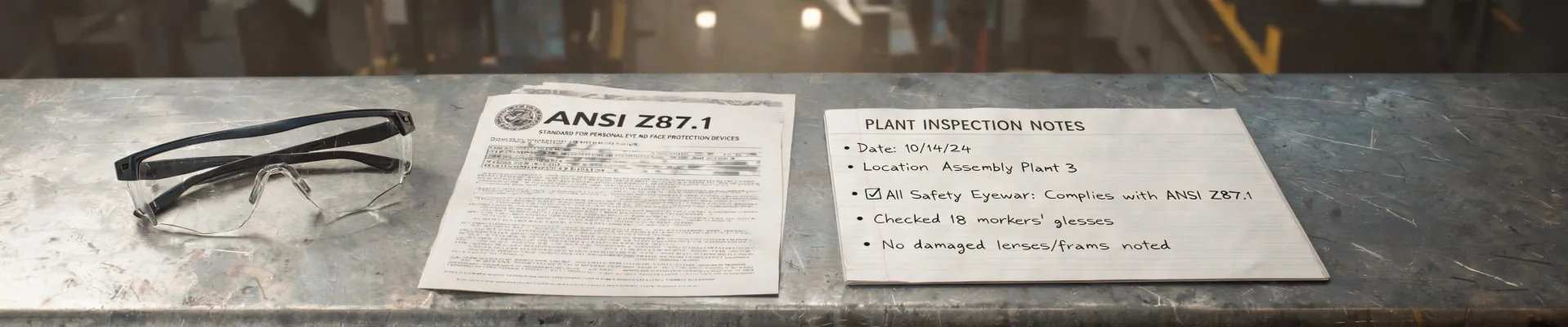
For high-risk and outdoor roles, I standardized on Wiley X. The Wiley X safety glasses with side shields are now my default for the machine shop. The side shields are part of the frame design, not a separate piece of plastic that falls off in the back seat of a truck. They carry an ANSI/ISEA Z87.1-2020 high-impact mark, which is the rating our safety team specifies. That matters because I don't want to be the person explaining why I bought something that didn't pass.
I've also added a receiving check: when a shipment arrives, I verify the lens markings before the boxes go into the supply closet. If the mark isn't there, it goes back. That one step has prevented more bad batches than any supplier promise I've heard.
For our survey crew and anyone who works outside for more than a couple of hours, I order Wiley X safety sunglasses with polarized lenses. The glare reduction isn't a luxury; it's what gets people to actually keep the glasses on. If a pair is uncomfortable, it doesn't matter what standard it meets, right?
Prescription lenses are another reason I stay with this brand. We have three machinists who need corrective vision. Trying to fit a prescription insert into a cheap pair of safety glasses was a nightmare. Now one vendor handles the whole thing, and the lenses arrive with the same impact rating. That saves me hours of headache, even if the line item is higher.
Leather gloves are another place where I used to bargain-hunt. The $11 split-leather gloves felt fine in the warehouse, but after a month of handling steel, the stitching would let go. A hand injury costs a lot more than the $6 I saved per pair. Now I buy leather gloves with reinforced palms and better stitching. They cost more, but they last three times longer, so the annual cost is almost the same.
Lightweight tactical boots are the newest addition to our purchasing list. I used to think 'tactical' was just a buzzword. Then I watched a warehouse lead's boot sole peel off while he was carrying a load. He didn't fall, but he could have. Lightweight tactical boots with oil-resistant soles and good ankle support cost more upfront. The alternative is a slip-and-fall report that costs way more than the boots.
I also keep a simple spreadsheet of item costs, replacement dates, and failure notes. It's not sophisticated, but it tells me which purchases are actually saving money. The items with the best unit price often cost the most over time.
The Case for Cheap (Sometimes)
I'm not saying every PPE purchase needs to be premium. For one-off visitor glasses, I still buy basic wraparounds. If we're doing a short task with minimal exposure, cheap can be rational. But that's a conscious decision, not a default. I ask: what happens if this fails?
What About 'Are Latex Gloves Food Safe?'
One question that comes up more than you'd expect: are latex gloves food safe? Our building has a cafeteria and first-aid rooms, so I buy gloves for both. The answer is not just 'yes.' It depends on the glove.
Some latex gloves are manufactured for medical or industrial use, not food contact. If a box says 'industrial use only' or doesn't have a food-service label, I won't put it in the kitchen. Under FDA food-contact rules, gloves used in food service need to be suitable for that use. I learned this after a health inspector asked to see the box for a pair of gloves sitting next to a prep station. No citation, but it changed how I order. For us that means buying gloves explicitly labeled for food service and keeping the boxes in the kitchen area so the health inspector can see what we're using.
(Also worth saying: a lot of facilities in our area are moving to nitrile for food prep because some people have latex allergies. That's a separate conversation, but it's part of why I don't just buy 'latex' without asking first.)
Is This Overpaying for a Name?
Some buyers argue that a cheaper pair of safety glasses passes the same ANSI test, so why pay more? I get it. I used to think that. But a lab test doesn't tell you whether the temple hinge will survive being thrown into a toolbox. It doesn't tell you whether someone will actually wear the glasses, or decide they'd rather squint than deal with lens distortion.
Also, the brand isn't the thing I'm paying for. I'm paying for a vendor who will still be there in nine months, who can provide traceability when an inspector asks, and who doesn't make me chase receipts. In 2023, a new vendor cost us $2,400 in rejected expenses because they couldn't issue a proper invoice. The product was cheap. The administrative cost wasn't.
Another hidden cost is time. Every time a worker comes back with a broken pair of gloves, it's a trip to the supply closet, a note, and a reorder. Multiply that by 140 people and it becomes a real job. I'd rather spend the extra two minutes up front researching a product than two hours a month tracking down failures.
My Bottom Line
I can only speak to our situation: 140 employees, two facilities, predictable ordering patterns. If you're a seasonal business with demand spikes, the calculus might be different. But the principle—pay for the performance you need, not just the lowest number—should still hold.
If you're building a procurement policy for safety gear, start with this: identify the items where failure means an injury. For those, lower unit price is a trap. For everything else, feel free to chase a deal.
My policy now is simple: value over price. I look at the total cost over a year, not the invoice on the first of the month. That's why I buy Wiley X safety glasses with side shields for the shop, Wiley X safety sunglasses for the outdoor crew, better leather gloves for the warehouse, lightweight tactical boots for the people on their feet all day, and food-safe latex gloves for the cafeteria.
It's not the flashiest procurement strategy, but it's one I can defend to finance (finally).

Maeve Callahan
Maeve Callahan is a head-protection analyst covering Type I and Type II hard hats, climbing-style safety helmets, bump caps, chin straps, suspensions, liners, and face-shield carriers. She applies ANSI Z89.1, EN 397, and EN 12492 criteria while comparing impact attenuation, penetration resistance, lateral deformation, electrical class, retention strength, field of vision, mass, fit range, and temperature conditioning. Her guides help EHS teams, contractors, utilities, and buyers select helmet systems for overhead hazards, work at height, electrical exposure, accessory compatibility, and worker acceptance.