-
1. Why do Wiley X safety glasses cost more than basic safety glasses?
-
2. Are Wiley X photochromic safety glasses worth it?
-
3. Can I order Wiley X Profile prescription safety glasses for employees?
-
4. What is the difference between ANSI Z87.1 and Z87+?
-
5. Are nitrile gloves food safe?
-
6. Are Carhartt coveralls worth the cost?
-
7. Why do cedar fence pickets belong in a PPE FAQ?
I'm the office administrator for a 43-person site services and light construction company. I manage all PPE and safety supply ordering—roughly $35,000 annually across 8 vendors—and I report to both operations and finance. My purchase orders include Wiley X safety glasses, Carhartt coveralls, nitrile gloves, and even cedar fence pickets. This FAQ is what I'd tell another buyer who wants to avoid my mistakes.
1. Why do Wiley X safety glasses cost more than basic safety glasses?
When I took over purchasing in 2021, I ordered the cheapest ANSI-rated glasses I could find. They scratched, fogged, and mostly ended up in the truck. After the crew supervisor complained twice, I piloted Wiley X for one crew of eight.
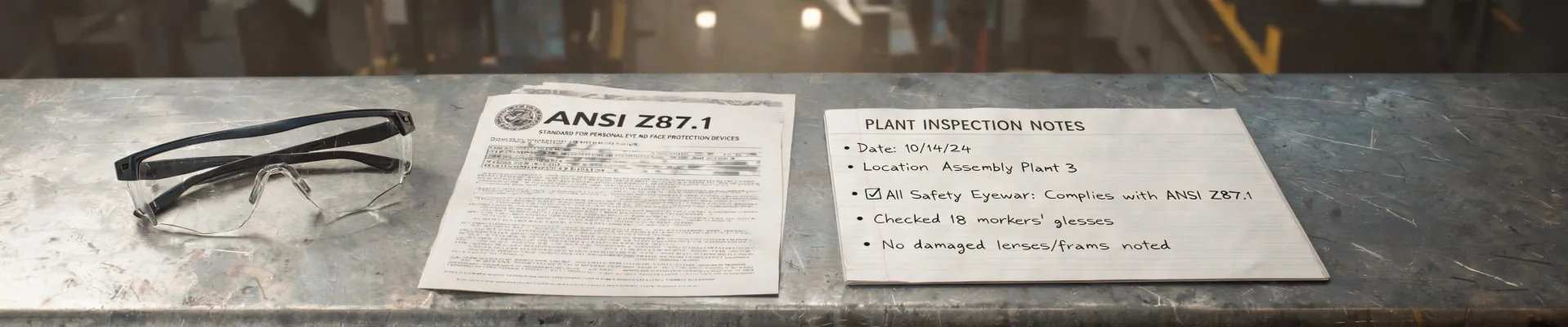
The lenses on the models we ordered are ANSI Z87.1 rated, and the frames carry the Z87+ high-impact mark. The frames have held up better than the cheap ones that snapped in the first month. I'm not a safety engineer, so I can't speak to every ballistic test report. What I can tell you from a procurement perspective: if a safety glass sits in a drawer because it's uncomfortable or fogs up, the cheap price doesn't matter. Many Wiley X models land around $15 to $35 per pair (based on quotes we got in 2024; verify current pricing). The cost per use can be better than replacing $4 glasses every other week.
Also, if you're buying for a military or law enforcement unit, ask about Wiley X's military discount before you issue a PO. And if a listing says “military-grade” without naming a standard, ask for the documentation. Per FTC guidance (ftc.gov), product claims have to be substantiated.
2. Are Wiley X photochromic safety glasses worth it?
I went back and forth between clear lenses and Wiley X photochromic safety glasses for two weeks. Clear plus separate tinted lenses was cheaper on paper. The problem: nobody actually switched. The photochromic pair darkens outside and fades back inside, so it solves the real-world issue of workers carrying two pairs.
I ordered one trial pair before buying the full set, and that trial taught me an important limit: photochromic lenses rely on UV, and most windshields block UV. If your crew spends all day driving, they may not darken enough. I'm not an optical scientist, but that's what the optician told me when the driving crew said their glasses weren't dark enough. For mixed indoor/outdoor work, though, the photochromic option is the one our crews actually keep wearing.
3. Can I order Wiley X Profile prescription safety glasses for employees?
Yes. Wiley X Profile prescription safety glasses are available through authorized Wiley X optical providers. That last part matters. In 2023, I ordered through a reseller who didn't verify the prescription, and the glasses came back with the wrong axis. The employee couldn't wear them. Looking back, I should have checked the prescription date and used an authorized channel from the start.
I'm not an optician, so I can't tell you which lens material is right for every person. What I can tell you from a purchasing side: put “ANSI Z87.1” on the PO line, and make sure the employee has a current prescription before ordering. A prescription insert is not automatically impact-rated just because the frame comes from a safety brand.
4. What is the difference between ANSI Z87.1 and Z87+?
Z87.1 is the baseline U.S. standard for eye and face protection. Z87+ means the product passed high-impact testing. The plus sign should be marked on the lens or frame. I almost placed a big order without checking that mark once. A safety supervisor caught it before I hit submit.
This gets into safety engineering territory, which isn't my expertise. From a buyer's perspective: if you need impact protection, specify Z87+ on the purchase order, not just “safety glasses.” And if a manufacturer can't produce a test report, treat that as a warning sign. Five minutes of checking beats a five-week correction cycle after a failed audit.
5. Are nitrile gloves food safe?
Not automatically. Nitrile gloves can be food safe, but only when the product is labeled for food contact. I keep two SKUs: one for the maintenance crew, one for the break room and food handling. If a box doesn't say “food safe” or “FDA-compliant for food contact,” I don't buy it for food use.
I'm not a lawyer or a food safety specialist, so I'm not going to quote regulations beyond what's printed on the package. The practical lesson is simpler than it sounds: “nitrile” is a material, not a food-safety claim. Check the box. Ask for the technical data sheet. Then order the right gloves the first time.
6. Are Carhartt coveralls worth the cost?
For our mechanics, yes. I went back and forth between Carhartt coveralls and a cheaper brand for two weeks. On paper, the cheaper brand saved about $20 per pair. In practice, the cheap pair needed stitching repair after three months. The Carhartt coveralls lasted through a full season. So I ordered a mix and let the crew decide what worked for their job.
Carhartt coveralls aren't always the answer. If you need flame-resistant clothing, the brand name matters less than the actual FR rating, and I'd ask for the label. But for cold-weather outdoor work, the Carhartt ones got worn instead of left in the truck, and that's the real outcome I care about.
People do type “carhart coveralls” into search a lot, by the way. Same thing, just missing a t.
7. Why do cedar fence pickets belong in a PPE FAQ?
They don't. That's kind of the point. Last fall, our maintenance supervisor ordered 40 cedar fence pickets and charged them to the safety supplies budget. The pickets were used to build a temporary visual barrier around a work area, which was fine. But the invoice line said “cedar fence pickets” under a PPE account, and finance flagged the whole order.
The most frustrating part was that the actual work was safe. The recordkeeping was the problem. If I had set up a separate line item for materials, the reclassification would have taken five minutes instead of five days.
Now I separate every purchase order by commodity: PPE, workwear, tools, materials, and supplies. It's not glamorous, but it makes audits easier. And it's the same principle I apply to safety glasses: verifying something on the front end is almost always cheaper than fixing it later.

Maeve Callahan
Maeve Callahan is a head-protection analyst covering Type I and Type II hard hats, climbing-style safety helmets, bump caps, chin straps, suspensions, liners, and face-shield carriers. She applies ANSI Z89.1, EN 397, and EN 12492 criteria while comparing impact attenuation, penetration resistance, lateral deformation, electrical class, retention strength, field of vision, mass, fit range, and temperature conditioning. Her guides help EHS teams, contractors, utilities, and buyers select helmet systems for overhead hazards, work at height, electrical exposure, accessory compatibility, and worker acceptance.